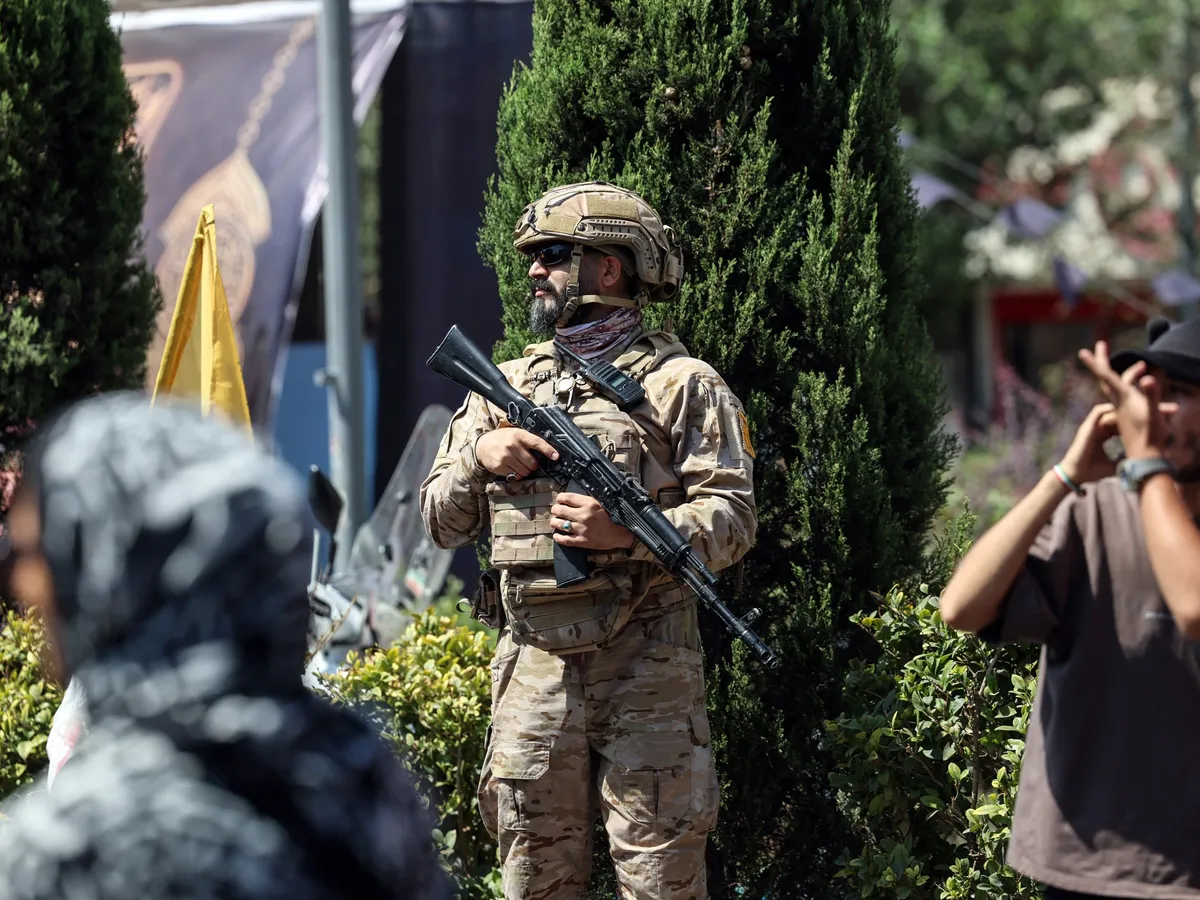
IRGC spokesman Hossein Mohebbi said last month that Iran’s missile production rate increased during the ceasefire.A member of the Iranian security forces stands guard as Shia Muslim devotees take part in a mourning procession marking Arbaeen in Tehran, Iran [AFP]Published On 4 Aug 2026Tehran, Iran – Iran’s military authorities say they are prepared to resume war with the United States if negotiations again fall through, emphasising that they have adapted and recovered.Washington has signalled that an agreement over the Strait of Hormuz may be imminent, and US President Donald Trump renewed his demand for a deal, or “total surrender” this week.Recommended Stories list of 4 itemslist 1 of 4‘One last chance’: The times Trump threatened Iran, said deal imminentlist 2 of 4Can Pakistan keep US-Iran diplomacy alive as mistrust deepens?list 3 of 4Why are oil companies posting record profits amid Iran war disruption?list 4 of 4Misread as passive, the Gulf is quietly ending fifty years of dependenceend of listBut the Islamic Republic has said while talks are ongoing with Oman and other mediators to end the US-Israel war on Iran, work on boosting military strength has only intensified.“We have made maximum use of the opportunity of the memorandum of understanding and every moment of the ceasefire,” army spokesman Mohammad Akraminia told state television this week, referring to a now-suspended MoU signed with the US in June.He said attempts were made to induct existing equipment into the armed forces and import new equipment, as well as repairing and recovering damaged systems or manufacturing new systems.The brigadier general also said new-generation drones have been used in combat, and their specifications would be announced later.Last month, Iran’s acting Defence Minister Majid Ebn-e Reza said that missile and drone production had “not stopped for a single day” and that drone production had reached three times its pre-war levels. But he did not provide any figures.“Despite the martyrdom of top commanders, the armed forces not only did not lose their cohesion, but confronted the enemy with many surprises through their speed, initiative and high tactical ability,” the acting minister said.The Islamic Revolutionary Guard Corps (IRGC), the force driving politics in Iran and also launching ballistic missile and drone attacks, has reported similar accounts.IRGC spokesman Hossein Mohebbi said late last month that Iran’s missile production increased during the ceasefire, while missile accuracy had improved using the knowledge gained in battle. The IRGC has not disclosed any information about its stockpiles of weapons, or the extent of damage inflicted against the country’s domestic arms production capacities or air defences.‘Improving domestic production and quality’US media reports in June said Iran retained approximately 70 percent of its pre-war missile stockpile and about 40 percent of its drone arsenal – an indication that Tehran could outlast months more of asymmetric warfare in the Strait of Hormuz and other arenas.Meanwhile, manned and unmanned aircraft operated by the US, Israel and a number of regional countries have carried out thousands of sorties inside Iranian airspace since the start of the war on February 28, while some have been spotted or shot down.Iran’s air defences have been degraded, but the IRGC and the army have reported shooting down cruise missiles, as well as MQ-9, MQ-1 combat and surveillance drones and the one-way “Lucas” drones of the US Army across southern Iran over the past month.Last week, the Reuters news agency, citing unnamed sources, said Iran could soon receive the first shipment of up to 400 Chinese-made shoulder-fired air defence missile launchers, reportedly to be transited through Pakistan. China and Pakistan rejected the report, while Iran did not comment.Hossein Kanani Moghaddam, a former senior IRGC commander, told Al Jazeera that thousands of strikes by the US and Israel have failed to deter the force.“We have been improving domestic production and quality. Our previous missiles have been improved in terms of range and warhead destructive power,” he said.“We also have stockpiles in our underground missile and drone cities, new parts of which are gradually entering our operational lines,” Kanani Moghaddam said, adding that this was one of the reasons why Trump has repeatedly called off larger strikes against Iran.Earlier this month, the Trump administration once again threatened imminent strikes on Iran’s civilian infrastructure, including power plants and petrochemical companies, in an attempt to force Tehran into a deal.Trump then abruptly cancelled the strikes and raised the prospects of a fresh deal, repeating his pattern over recent months.But while the US halt to attacks has positively impacted global oil prices and US stocks in the short term, tensions across the region continue.The Iran-aligned Houthis in Yemen on Tuesday said they launched a successful drone attack on the Najran Airport in Saudi Arabia in response to Saudi drones flying in Yemen’s Saada and Hajjah governorates.An India-flagged cargo vessel was also struck by an explosives-rigged boat and was reported to be sinking some 13 nautical miles (24km) north of Yemen’s Hodeidah in the Red Sea. New Delhi said all 14 seafarers on the vessel were safely rescued.Explosions and a fire were seen overnight in Kuwait near the border with Iraq, with some reports saying Iranian drones struck a US military base there. Kuwait, the US Central Command and the IRGC have not yet officially commented.On Monday, a Liberian-flagged bulker suffered damage to its engine room after being hit by an unidentified projectile 20 nautical miles (37km) northeast of Khasab in Oman.The IRGC has successfully hit or turned back more vessels in the Strait of Hormuz since the June MoU faltered last month, but some have passed through.Iran has allowed some ships to take the northern route in its territorial waters, with Iraq’s Oil Ministry on Tuesday announcing that tankers carrying Iraqi crude had passed after coordination with Tehran.Other vessels have attempted to take the southern route in Oman’s waters, which Iran has warned cannot be used safely during war conditions.Kanani Moghaddam said continued attacks by the US and Israel cannot fully destroy Iran’s military infrastructure.“Our missile capabilities have been distributed across this vast country. Missile components are being manufactured in places where they can’t even imagine,” the former IRGC commander said.Kanani Moghaddam said even if a US ground assault manages to temporarily occupy Iranian islands in the south, the operation could be costly for the US, and Iran will retake the islands later.“The Strait of Hormuz will not be reopened through military attacks,” he said.
SRCAl Jazeera
LANGEN
LEANCenter
WORDS1 057
ENT12
TUE · 2026-08-04 · 18:34 GMTBRIEF NSR-2026-0804-99125
NSR-2026-0804-99125News Report·EN·National Security
‘Maximum use’: Iran boosts military strength during ceasefire with US
Iran's military authorities state they have significantly boosted their military strength during a ceasefire with the United States, utilizing the period to enhance missile and drone production and repair damaged systems. Army spokesman Mohammad Akraminia indicated that existing equipment has been integrated, new equipment imported, and damaged systems repaired or new ones manufactured.
Maziar MotamediAl JazeeraFiled 2026-08-04 · 18:34 GMTLean · CenterRead · 5 min
Al JazeeraFIG 01
Reading time
5min
Word count
1 057words
Sources cited
3cited
Entities identified
12entities
Quality score
100%
§ 01
Briefing Summary
AI-generatedNEWSAR · AI
Iran's military authorities state they have significantly boosted their military strength during a ceasefire with the United States, utilizing the period to enhance missile and drone production and repair damaged systems. Army spokesman Mohammad Akraminia indicated that existing equipment has been integrated, new equipment imported, and damaged systems repaired or new ones manufactured. Iran's acting Defence Minister reported that drone production has tripled, and the IRGC spokesman noted an increase in missile production and improved accuracy. This military buildup comes amid ongoing negotiations with mediators to end the US-Israel war on Iran, with Washington signaling a potential agreement over the Strait of Hormuz. Despite US threats of renewed strikes, Iran asserts its forces have adapted and recovered, with underground stockpiles of improved missiles and drones.
Confidence 0.90Sources 3Claims 5Entities 12
§ 02
Article analysis
Model · rule-basedFraming
National Security
Conflict
Tone
Mixed Tone
AI-assessed
CalmNeutralAlarmist
Factuality
0.60 / 1.00
Mixed
LowHigh
Sources cited
3
Well sourced
FewMany
§ 03
Key claims
5 extracted01
IRGC spokesman reported that Iran's missile production increased and missile accuracy improved during the ceasefire.
quoteHossein Mohebbi
Confidence
0.90
02
Iran's army spokesman stated that Iran has made 'maximum use' of the ceasefire period to boost military strength.
quoteMohammad Akraminia
Confidence
0.90
03
Iran's military authorities state they are prepared to resume war with the United States if negotiations fall through.
quoteIran's military authorities
Confidence
0.90
04
US media reports suggested Iran retained approximately 70% of its pre-war missile stockpile and 40% of its drone arsenal.
statisticUS media reports
Confidence
0.70
05
Iran's acting Defence Minister claimed drone production has reached three times its pre-war levels.
statisticMajid Ebn-e Reza
Confidence
0.70
§ 04
Full report
5 min read · 1 057 words§ 05
Entities
12 identifiedKey playerOppositionContextPositiveNeutralNegative
People4
Locations5
§ 06
Keywords & salience
9 termsiran military strength
1.00
us-iran relations
0.90
missile production
0.80
drone production
0.80
ceasefire
0.70
strait of hormuz
0.60
islamic revolutionary guard corps
0.50
military negotiations
0.50
donald trump
0.40
§ 07
Topic connections
Interactive graph Network visualization showing 51 related topics
View Full Graph Person Organization Location Event|Click node to navigate|Edge numbers = shared articles