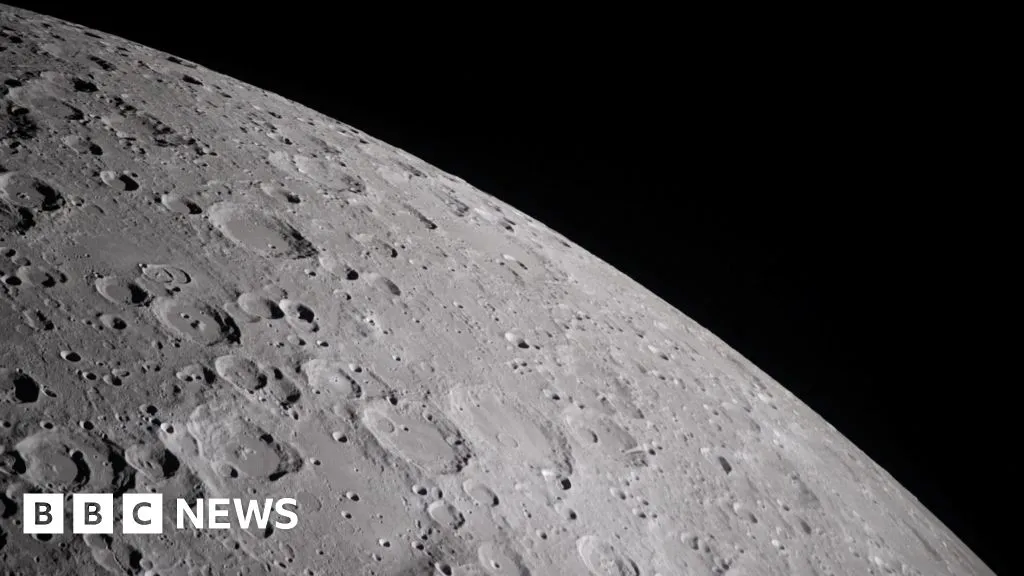
The spent stage - which is about the size of a five-storey building and weighs at least 4,000kg - was left drifting in a long, looping orbit that swung out towards the Moon and back again. Over the next 18 months, the gentle gravitational tug of the Earth, Moon and Sun, along with even light from the Sun, gave a faint push. Astronomers tracking the rocket part eventually worked out that those small nudges had put it on a course towards the Moon and was picking up speed every day.The impact at around 07:35 BST (06:35 GMT) on Wednesday happened in broad daylight for many parts of the world, but the tiny flash it produced would have been far too faint to see, even through a telescope. Amateur astronomers observing in darkness would also have had little realistic chance of seeing the flash, given that it would have lasted a fraction of a second. But they may have seen a plume of dust stretching as far as 100km (62 miles) that lasted for several minutes.Even spacecraft orbiting the Moon were not in the right place at the right time to watch the impact happen live. South Korea's Danuri orbiter had the best chance, having passed near the crash site shortly beforehand. Its team has told Korean media that any footage will only be released once researchers have completed their analysis.Over the next few days, Nasa's Lunar Reconnaissance Orbiter will be in position to photograph the site, allowing images before and after the crash to be compared.
SRCBBC News - World
LANGEN
LEANCenter
WORDS256
ENT10
WED · 2026-08-05 · 11:19 GMTBRIEF NSR-2026-0805-99398
NSR-2026-0805-99398News Report·EN·Technology
What can scientists learn from a stray SpaceX rocket hitting the Moon?
A spent SpaceX rocket stage, approximately the size of a five-storey building and weighing at least 4,000kg, accidentally collided with the Moon on Wednesday. This event, a result of gravitational nudges from Earth, Moon, and Sun over 18 months, was not directly observed live by any spacecraft.
3 hours agoShareSaveAdd as preferred on GooglePallab GhoshScience CorrespondentBBC News - WorldFiled 2026-08-05 · 11:19 GMTLean · CenterRead · 2 min
BBC News - WorldFIG 01
Reading time
2min
Word count
256words
Sources cited
1cited
Entities identified
10entities
Quality score
100%
§ 01
Briefing Summary
AI-generatedNEWSAR · AI
A spent SpaceX rocket stage, approximately the size of a five-storey building and weighing at least 4,000kg, accidentally collided with the Moon on Wednesday. This event, a result of gravitational nudges from Earth, Moon, and Sun over 18 months, was not directly observed live by any spacecraft. However, South Korea's Danuri orbiter passed near the crash site beforehand and may release footage after analysis. NASA's Lunar Reconnaissance Orbiter is expected to photograph the impact site in the coming days, enabling comparison with pre-impact images. Planetary geologists anticipate this unique scientific occurrence will provide valuable data for future space missions.
Confidence 0.90Sources 1Claims 5Entities 10
§ 02
Article analysis
Model · rule-basedFraming
Technology
Human Interest
Tone
Measured
AI-assessed
CalmNeutralAlarmist
Factuality
0.90 / 1.00
Factual
LowHigh
Sources cited
1
Limited
FewMany
§ 03
Key claims
5 extracted01
South Korea's Danuri orbiter passed near the crash site shortly before impact, and its team is analyzing potential footage.
factualSouth Korea's Danuri orbiter team
Confidence
1.00
02
The impact flash was too faint to be seen, even with telescopes, but a dust plume up to 100km long might have been visible for several minutes.
factual
Confidence
1.00
03
Astronomers tracking the rocket determined it was on a course to impact the Moon and was accelerating.
factual
Confidence
1.00
04
The rocket part was left drifting in orbit for 18 months, influenced by the gravitational pull of Earth, Moon, and Sun, and solar light.
factual
Confidence
1.00
05
A spent SpaceX rocket stage, approximately the size of a five-storey building and weighing at least 4,000kg, impacted the Moon.
factual
Confidence
1.00
§ 04
Full report
2 min read · 256 words§ 05
Entities
10 identifiedKey playerOppositionContextPositiveNeutralNegative
People1
§ 06
Keywords & salience
10 termsmoon impact
1.00
spacex rocket
1.00
orbital mechanics
0.80
spent rocket stage
0.70
astronomical observation
0.60
space debris
0.50
lunar surface
0.50
spacecraft
0.40
nasa
0.40
scientific learning
0.40
§ 07
Topic connections
Interactive graph No topic relationship data available yet. This graph will appear once topic relationships have been computed.