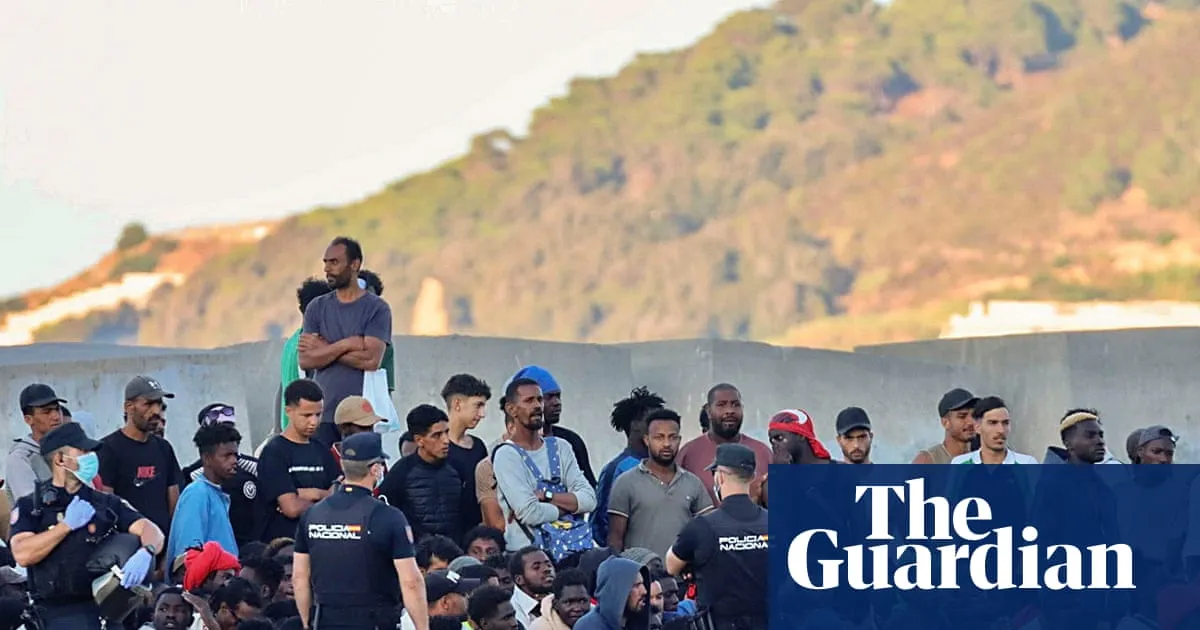
It was over almost as quickly as it began. But the human cost of the mayhem in Ceuta over the last seven days, and the disunity it exposed within the EU, will take a lot longer to fix.To recap: more than 70,000 people swam or waded into the tiny Spanish enclave in north Africa from neighbouring Morocco in a matter of hours at the end of last week. The exact circumstances in which the heavily securitised border came suddenly to be open are still unclear.What is clear is that at least 88 people died. Some drowned, others were trampled in the crush. Social media hyped a distorted version of events. Far-right parties, already driving the agenda on migration across Europe, weaponised the story. And Spain’s EU allies engaged in a war of words – not over the plight of those caught up in the tragedy, but over who let them into EU territory.Italy and Denmark jointly led the way there, accusing Madrid of failing to secure the EU’s only land border with Africa. Although Ceuta is not even in the EU’s Schengen passport-free travel area, Giorgia Meloni, the Far-right Italian prime minister, performatively suspended Schengen rights for travellers entering Italy from Spain.Meloni and her Danish counterpart, Mette Frederiksen (although a Social Democrat, is another migration hardliner), wrote to the EU demanding emergency talks on tightening the bloc’s external borders. They enlisted the backing of all but five of the 27 EU leaders.Faced with such an unusual lack of support, Spain’s Pedro Sánchez could only protest about the “selfish, polarising and unlawful” response of his EU allies.By Monday the vast majority who arrived in Ceuta had gone back to Morocco. None attempted to reach the Spanish mainland or to abscond towards any other country’s borders. Of those left stranded on the streets of the city, many were unaccompanied children.By then, Donald Trump, Elon Musk and Israeli ministers had weighed in to decry Europe’s “migrant invasion”, and Ceuta had begun to function, wrote Jonathan Liew, “as a kind of border porn for the global far right: a locus upon which to project their most vivid and apocalyptic fantasies”. The spectacle of left-liberal Spain facing a migration crisis of its own making was, for the European hard right and the White House “almost too good to be true”, Ruben Andersson wrote.But why the frenzy among European governments? Paul Taylor, a senior fellow with the European Policy Centre, says there was a shamelessly cynical interest for some EU leaders to pile on and isolate Madrid. The reaction was very different in the past, when Poland and Lithuania faced migrant incursions weaponised by Belarus.“Most EU governments are conservative or rightwing-led and have an interest in scapegoating Spain, which is governed by a socialist-leftist coalition, and in helping Spain’s rightwing opposition ahead of a general election due next year, and in trying to win back voters in their own countries who are defecting to rightwing populists,” Taylor said.Within the EU, Sanchez has swum against the tide, standing up to the Trump administration over Gaza, the war in Iran and Nato defence spending. During the recent wildfires he was vocal about climate backsliding. In an EU where policy has been hardening since 2015, he bucks the trend on migration, too.“Spain has been an outlier, welcoming migration and actively working to integrate migrants into the economy and society,” Taylor said. “This is seen as an affront by many conservative politicians but also as a ‘pull factor’ encouraging would-be migrants to try their luck in Europe at a time when official EU policy is to combat irregular migration, crack down on abuses of the asylum system and park asylum seekers offshore in countries outside the bloc.”And this is exactly the bigger political bone Meloni, Frederiksen and others wanted to pick with Spain. In their letter to the EU, ostensibly about the immediate crisis in Ceuta, they targeted Madrid’s recent policy of allowing undocumented people working in mainland Spain to regularise their migration status, even though this was irrelevant for those involved in the Ceuta situation.What is most striking about this, Taylor said, is the hypocrisy and double standards of Spain’s critics.“Many of those criticising Spain’s amnesty allowing irregular migrants to apply for residence permits have introduced similar schemes in their own countries. Italy and Germany have both given work permits and/or the right to remain to irregular migrants already working there in programmes supported by employers plagued by labour shortages.”Why Ceuta? Why now?skip past newsletter promotionafter newsletter promotionPrime minister Pedro Sánchez is increasingly under fire for his humanitarian policies towards migrants in Spain. Photograph: Borja Puig de la Bellacasa/MoncloaWhat actually provoked the Ceuta surge remains unexplained.One theory is that misleading posts circulated on Instagram, TikTok and Facebook following a 29 June Spanish supreme court ruling that clarified that under international law, the state cannot summarily deport migrants who arrive by sea without due process.But many suspect geopolitical mischief by Morocco – possibly to extract payback for Spain’s recent detente with its regional rival Algeria. If this is the case then the EU’s controversial strategy of outsourcing migration to regimes such as Morocco’s, looks even more problematic. Ashifa Kassam recalled in this Guardian podcast how Morocco weaponised migrants in a previous incident in 2021, allowing 10,000 people to cross into Ceuta during a diplomatic standoff with Spain over Western Sahara.By Tuesday, EU justice and home affairs ministers were publicly papering over their split, although Brussels criticised Spain’s amnesty for undocumented migrants as “not a good signal for the rest of Europe”.Ministers endorsed a plan to strengthen Europe’s external borders, including an early warning system and better “cooperation” with non-EU countries on migration: possibly code for more “cash for migration” deals with often unsavoury regimes.The Ceuta episode could also lead to the acceleration of ICE-style deportations from the EU. The Italian government in particular wants to see offshore migration centres, or “return hubs”, made possible under the EU’s new return regulation.Yet in a Europe devoid of safe and legal routes for asylum seekers, this is a direction that some of the most senior European legal experts have warned could create a “human rights black hole”.When the European parliament voted to approve the return regulation last month, there was some dismay as Far-right and rightwing MEPs celebrated in the chamber with raucous chants of “send them back!” On the evidence of the last week, it seems that Europe’s mainstream leaders have normalised the same chilling sentiment.To receive the complete version of This Is Europe in your inbox every Wednesday, please subscribe here.
SRCThe Guardian - World News
LANGEN
LEANCenter-Left
WORDS1 090
ENT12
WED · 2026-08-05 · 14:30 GMTBRIEF NSR-2026-0805-99414
NSR-2026-0805-99414Analysis·EN·Political Strategy
The events at Ceuta show how Europe’s hard right now set the tone on immigration
The recent events in Ceuta, where over 70,000 people entered the Spanish enclave from Morocco, exposed disunity within the EU regarding immigration policy. Far-right leaders, including Italy's Giorgia Meloni and Denmark's Mette Frederiksen, used the crisis to push for stricter border controls, accusing Spain of failing to secure the EU's external border.
Katherine Butler associate editor, EuropeThe Guardian - World NewsFiled 2026-08-05 · 14:30 GMTLean · Center-LeftRead · 5 min
The Guardian - World NewsFIG 01
Reading time
5min
Word count
1 090words
Sources cited
3cited
Entities identified
12entities
Quality score
100%
§ 01
Briefing Summary
AI-generatedNEWSAR · AI
The recent events in Ceuta, where over 70,000 people entered the Spanish enclave from Morocco, exposed disunity within the EU regarding immigration policy. Far-right leaders, including Italy's Giorgia Meloni and Denmark's Mette Frederiksen, used the crisis to push for stricter border controls, accusing Spain of failing to secure the EU's external border. This reaction contrasted with past responses to similar situations and was seen by some as a cynical attempt to isolate Spain's socialist-led government and appeal to voters shifting towards right-wing populists. Spain's humanitarian approach to migration, including policies allowing undocumented workers to regularize their status, was criticized by these leaders, despite some having implemented similar schemes themselves. The article suggests the hard right is setting the tone on immigration policy within the EU, influencing mainstream discourse and policy.
Confidence 0.90Sources 3Claims 5Entities 12
§ 02
Article analysis
Model · rule-basedFraming
Political Strategy
Human Interest
Tone
Mixed Tone
AI-assessed
CalmNeutralAlarmist
Factuality
0.40 / 1.00
Mixed
LowHigh
Sources cited
3
Well sourced
FewMany
§ 03
Key claims
5 extracted01
Paul Taylor suggests EU leaders cynically isolated Madrid to scapegoat Spain's socialist-leftist coalition and aid Spain's rightwing opposition.
quotePaul Taylor
Confidence
0.90
02
Giorgia Meloni and Mette Frederiksen demanded emergency talks on tightening the EU's external borders.
factual
Confidence
0.90
03
At least 88 people died during the events in Ceuta, with some drowning or being trampled.
statistic
Confidence
0.90
04
More than 70,000 people entered the Spanish enclave of Ceuta from Morocco in a matter of hours.
statistic
Confidence
0.90
05
Far-right parties weaponized the Ceuta story, and Spain's EU allies engaged in a war of words over who allowed migrants into EU territory.
factual
Confidence
0.80
§ 04
Full report
5 min read · 1 090 words§ 05
Entities
12 identifiedKey playerOppositionContextPositiveNeutralNegative
People4
Organizations1
Locations5
§ 06
Keywords & salience
10 termsimmigration
1.00
europe's hard right
1.00
ceuta
0.90
eu borders
0.80
migration crisis
0.70
far-right parties
0.70
eu disunity
0.60
giorgia meloni
0.50
schengen
0.40
human cost
0.40
§ 07
Topic connections
Interactive graph Network visualization showing 51 related topics
View Full Graph Person Organization Location Event|Click node to navigate|Edge numbers = shared articles