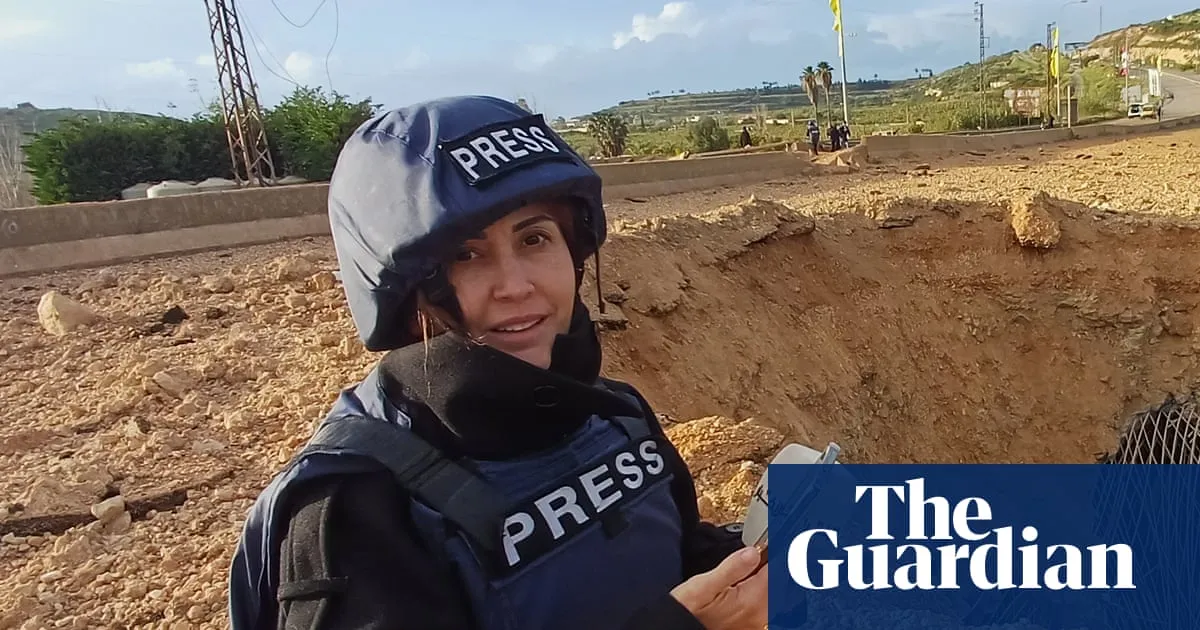
An Israeli strike that killed Lebanese journalist Amal Khalil and injured her colleague Zeinab Faraj in April was a war crime, three rights organisations said on Thursday.Investigations from Human Rights Watch (HRW), Amnesty International and Legal Agenda showed that Israel deliberately and directly attacked Khalil and Faraj, with apparent knowledge that they were civilians. The organisations called for the attacks to be investigated as war crimes, while HRW called for states to halt arm sales to Israel and put targeted sanctions on Israeli officials responsible for ongoing crimes.Deliberate attacks on civilians, which both journalists were, is a war crime. Israel has killed at least 15 journalists in Lebanon and 210 in Gaza since 2023, according to the UN human rights office.The reports also indicated that Israel delayed Lebanese ambulances from reaching Khalil and Faraj for hours – at one pointing dropping stun grenades on Lebanese Red Cross workers and firing on their ambulances.The delay in rescue might have led to Khalil’s death, as hospital reports indicate that she might have still been alive hours after an Israeli strike toppled a building on top of her and Faraj.“The evidence is clear that the Israeli military knew, or should have, that Faraj and Khalil were civilians, but attacked them anyway, and then prevented paramedics from rescuing them for hours,” said Ramzi Kaiss, Lebanon researcher at Human Rights Watch.Israel said it “regrets any harm caused to journalists,” and that the journalists were killed “as part of a series of events” during which two Hezbollah military operatives were killed. There was about two hours between the initial strike that killed the two men Israel said were in Hezbollah, and a second strike that targeted a building the journalists were sheltering in.Amal Khalil was a 42-year-old journalist working for al-Akhbar, a Lebanese newspaper, while Zeinab Faraj was a 21-year-old freelance camerawoman and photojournalist. Both had been active in covering the war in Lebanon over the last three years.Zainab, the sister of Amal Khalil, mourns over her coffin in Baysariyeh, southern Lebanon. Photograph: Mohammed Zaatari/APOn 22 April 2026, the pair drove to the village of al-Tiri, south Lebanon, to verify reports that Israeli troops had left the area. They drove behind a car carrying Ali Nabil Bazzi, a municipal official of the city of Bint Jbeil, as well as Mohammed Hourani, a friend of the mayor.Al-Tiri was in what Israel calls its “security zone” in southern Lebanon, which its troops occupy. Amnesty said that despite the Israeli military calling it a military zone and barring people from going there, it is still required to distinguish between civilians and combatants.At 2.25pm, after entering al-Tiri, the car carrying Bazzi and Hournai was struck, killing the men. Khalil called the Lebanese civil defence and requested assistance.The civil defence drove to the entry of the village, where they were told to stop at a military checkpoint while they waited for authorisation from the Israeli military to enter the village safely.Rescue crews operating in areas of south Lebanon where fighting is taking place or which the Israeli military occupies must coordinate with the “mechanism”, a deconfliction channel, to get safe passage. Among others, the Israeli military must give approval for requests for civil defence to get safe passage.By 5pm, the UN peacekeeping force in Lebanon had given a safe route for civil defence to follow to enter the town, but Israel had not yet given its approval.While waiting for the civil defence to arrive, Faraj and Khalil left their car and sought shelter elsewhere. Israeli quadcopters circled low overhead while the two journalists waited, Faraj said.“The drones came extremely close through the roof, less than a metre from my face and Amal’s,” she said.At 3.31pm, a member of the Lebanese civil defence called Khalil and urged her to get into her car and drive out of the village, as he had not yet received permission from the mechanism to enter the village. Around nine minutes later, Israel struck the journalists’ car, injuring both women.“Glass and debris flew towards us. My ear felt like it burst. She [Amal Khalil] was bleeding heavily from the nose and head and had shrapnel wounds in her arm and thigh; she couldn’t move her leg,” Farj said.The two women crawled into a nearby building for shelter. They both continued calling people, asking for assistance, but were told they could not be rescued until authorisation was given from the mechanism.At 4.25pm, Israel conducted a third strike, bombing the building where they were sheltering, collapsing it and burying both women under the rubble.At 5pm, permission was given to the Lebanese Red Cross to enter the village. They were able to evacuate Faraj, who had a fractured skull, severe injuries to her right leg and eye, and a crushed hand. Rescuers could not rescue Khalil, who was trapped under rubble.The rescuers came under attack by an Israeli quadcopter, which dropped a stun grenade near them. Witnesses also said they heard bursts of gunfire during the evacuations, and HRW reviewed photographs of bulletholes in the ambulances consistent with small arms fire.The rescuers were forced to withdraw with only Faraj.The Israeli military finally granted the request for rescue crews to re-enter the town at 8.15pm. Khalil’s body was recovered at 11pm. An examination of her body at the nearby Tebnine hospital showed that she probably died at 7pm – two-and-a-half hours after she was struck for the last time. She was trapped under the rubble during that time, waiting to be rescued, while the Israeli military prevented rescue crews from saving her life.All three organisations have demanded accountability for Khalil’s killing, and described it as part of a larger pattern of impunity by the Israeli military towards civilians.“The impunity enjoyed by Israeli forces for the killing of journalists and other civilians in Lebanon over the past three years has enabled the Israeli military to continue with its unlawful airstrikes, including direct attacks on civilians,” said Heba Morayef, director for the Middle East and north Africa at Amnesty International.“It is well past time that the international community impose a comprehensive arms embargo on Israel,” Morayef added.
SRCThe Guardian - World News
LANGEN
LEANCenter-Left
WORDS1 014
ENT12
THU · 2026-08-06 · 06:00 GMTBRIEF NSR-2026-0806-99643
NSR-2026-0806-99643News Report·EN·Human Rights
Israeli strike that killed journalist in Lebanon was war crime, say rights groups
Three human rights organizations, Human Rights Watch, Amnesty International, and Legal Agenda, have concluded that an Israeli strike in April that killed Lebanese journalist Amal Khalil and injured her colleague Zeinab Faraj constituted a war crime. Investigations indicate Israel deliberately attacked Khalil and Faraj, apparently knowing they were civilians.
William ChristouThe Guardian - World NewsFiled 2026-08-06 · 06:00 GMTLean · Center-LeftRead · 5 min
The Guardian - World NewsFIG 01
Reading time
5min
Word count
1 014words
Sources cited
4cited
Entities identified
12entities
Quality score
100%
§ 01
Briefing Summary
AI-generatedNEWSAR · AI
Three human rights organizations, Human Rights Watch, Amnesty International, and Legal Agenda, have concluded that an Israeli strike in April that killed Lebanese journalist Amal Khalil and injured her colleague Zeinab Faraj constituted a war crime. Investigations indicate Israel deliberately attacked Khalil and Faraj, apparently knowing they were civilians. The organizations are calling for these attacks to be investigated as war crimes and for a halt to arms sales to Israel, with Human Rights Watch also advocating for targeted sanctions on Israeli officials. Reports suggest Israeli forces delayed Lebanese ambulances and paramedics from reaching the journalists for hours, potentially contributing to Khalil's death. Israel stated it regrets harm to journalists and that the incident occurred during an operation where Hezbollah operatives were killed, noting a time gap between initial strikes and the one targeting the journalists' location.
Confidence 0.90Sources 4Claims 5Entities 12
§ 02
Article analysis
Model · rule-basedFraming
Human Rights
Conflict
Tone
Measured
AI-assessed
CalmNeutralAlarmist
Factuality
0.70 / 1.00
Factual
LowHigh
Sources cited
4
Well sourced
FewMany
§ 03
Key claims
5 extracted01
Israel said it “regrets any harm caused to journalists,” and that the journalists were killed “as part of a series of events” during which two Hezbollah military operatives were killed.
quoteIsrael
Confidence
1.00
02
Israel has killed at least 15 journalists in Lebanon and 210 in Gaza since 2023.
statisticUN human rights office
Confidence
1.00
03
Israel delayed Lebanese ambulances from reaching Khalil and Faraj for hours, possibly leading to Khalil’s death.
factualHuman Rights Watch, Amnesty International, and Legal Agenda
Confidence
1.00
04
Investigations showed that Israel deliberately and directly attacked Khalil and Faraj, with apparent knowledge that they were civilians.
factualHuman Rights Watch, Amnesty International, and Legal Agenda
Confidence
1.00
05
An Israeli strike that killed Lebanese journalist Amal Khalil and injured her colleague Zeinab Faraj in April was a war crime, three rights organisations said.
factualHuman Rights Watch, Amnesty International, and Legal Agenda
Confidence
1.00
§ 04
Full report
5 min read · 1 014 words§ 05
Entities
12 identifiedKey playerOppositionContextPositiveNeutralNegative
Organizations6
§ 06
Keywords & salience
10 termswar crime
1.00
israeli strike
0.90
journalists
0.80
human rights
0.70
civilian targeting
0.70
lebanon
0.60
human rights watch
0.50
amnesty international
0.50
gaza
0.50
hezbollah
0.40
§ 07
Topic connections
Interactive graph Network visualization showing 27 related topics
View Full Graph Person Organization Location Event|Click node to navigate|Edge numbers = shared articles