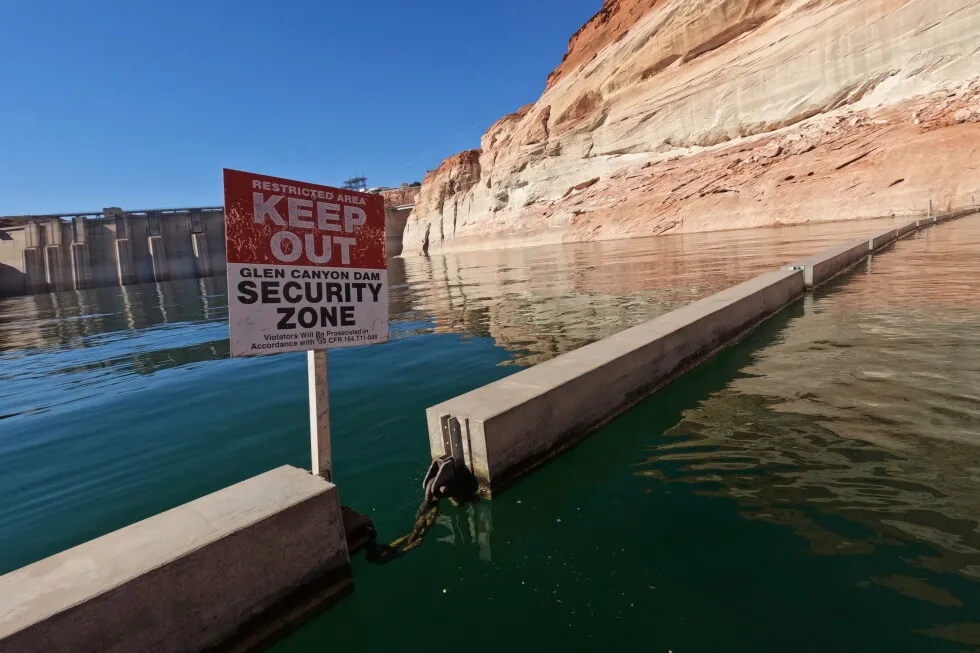
Officials will not release cool water from a Colorado-river" class="entity-link entity-location" data-entity-id="28983" data-entity-type="location">Colorado River reservoir to protect threatened fish 1 of 2 | A sign reading “keep out” is displayed just upstream of Glen Canyon Dam at Lake Powell, June 8, 2022, in Page, Ariz. (AP Photo/Brittany Peterson, File) 2 of 2 | A Utah State University research team works at Lake Powell on June 7, 2022, in Page, Ariz. (AP Photo/Brittany Peterson, File) 1 of 2 | A sign reading “keep out” is displayed just upstream of Glen Canyon Dam at Lake Powell, June 8, 2022, in Page, Ariz. (AP Photo/Brittany Peterson, File) 1 of 2 A sign reading “keep out” is displayed just upstream of Glen Canyon Dam at Lake Powell, June 8, 2022, in Page, Ariz. (AP Photo/Brittany Peterson, File) Add AP News on Google Add AP News as your preferred source to see more of our stories on Google. Share 2 of 2 | A Utah State University research team works at Lake Powell on June 7, 2022, in Page, Ariz. (AP Photo/Brittany Peterson, File) 2 of 2 A Utah State University research team works at Lake Powell on June 7, 2022, in Page, Ariz. (AP Photo/Brittany Peterson, File) Add AP News on Google Add AP News as your preferred source to see more of our stories on Google. Share Updated [hour]:[minute] [AMPM] [timezone], [monthFull] [day], [year] Federal officials said Thursday they will not release cool water this year from one of the Colorado-river" class="entity-link entity-location" data-entity-id="28983" data-entity-type="location">Colorado River’s major reservoirs, which would have protected a threatened native fish downstream but put more strain on already struggling hydropower production.In an email obtained by The Associated Press, the Bureau of Reclamation told various groups that water from Glen Canyon Dam in northern Arizona would not be released “due to significant hydropower generation concerns under already strained system conditions.” As the Colorado-river" class="entity-link entity-location" data-entity-id="28983" data-entity-type="location">Colorado River and its once massive reservoirs shrink from overuse and climate change, officials were faced with a decision that pits conservation of the humpback chub — a threatened fish native to the river — against ratepayer costs for electricity.The decision comes after the worst snowpack on record for the Colorado-river-basin" class="entity-link entity-location" data-entity-id="180231" data-entity-type="location">Colorado-river" class="entity-link entity-location" data-entity-id="28983" data-entity-type="location">Colorado River Basin, relied upon by farmers, industries, wildlife, hydropower and more than 40 million people in seven U.S. states, tribal nations and Mexico. It also comes a week after federal officials announced a proposal to stave off a crisis in the beleaguered waterway. Officials stepped in after states that rely on the river — California, Colorado, Arizona, Nevada, New Mexico, Wyoming and Utah — failed to reach an agreement on how to share the dwindling resource long-term. Under the proposal, California, Nevada and Arizona would share water cuts. A “cool mix flow” is when cold water is released from deep in a reservoir — in this case Lake Powell — to cool the river below. There are no hydropower turbines in the cool, deep section, so significant power generation would have been lost. 2 MIN READ 4 MIN READ 11 MIN READ Lake Powell is about 23% full after decades of overuse and evaporation of water as average temperatures rise because of climate change. With such a low reservoir, warm water near the surface gets sucked through the generators and sent downstream. Smallmouth bass, introduced in Lake Powell in the 1980s for sport fishing, live at that warm surface and also get sucked through the hydropower generators and into the river below, and if it’s warm enough, they spawn. That’s a problem for the humpback chub and other federally protected fish farther south on the river. Officials say cool water releases from Lake Powell in 2024 and 2025 successfully prevented smallmouth bass spawning.The river downstream of the dam is about 69 degrees Fahrenheit (20.5 degrees Celsius). The Bureau says it considers recommending cold water releases when the average daily temperature there exceeds about 60 F (15.5 C) for three consecutive days. Those temperatures have regularly exceeded that threshold for more than a month.“Our efforts this year will continue to focus on expanded rapid response removal actions, additional backwater modifications, evaluation of innovative tools, and advancement of durable structural solutions,” wrote Wayne G. Pullan, the agency’s regional director of the Upper Colorado Basin, in the email. Matt Rice, director for the southwest region for the conservation group American Rivers, said the decision was not unexpected but still disappointing. “We’ve proven that the cool mix flows are the most effective way to mitigate the smallmouth bass invasion in the Grand Canyon,” he said. “Hopefully it’s not a death sentence to humpback chub.” He added that the elevated temperatures are also life-threatening for the nearby rainbow trout fishery. He said American Rivers hopes for collaborative and innovative solutions in the future that balance protecting the environment while managing the river for the people who rely on it for power.Utilities that buy hydropower from Glen Canyon Dam said releases would have forced them to spend millions of dollars to buy alternative energy that is more costly and less likely to be renewable, and could increase electricity bills for customers. “We’re very pleased with the decision and appreciate Reclamation’s deliberate and thoughtful approach to this, just recognizing the challenges that we’re facing on the river,” said Andy Colosimo, executive director of the Colorado-river" class="entity-link entity-location" data-entity-id="28983" data-entity-type="location">Colorado River Energy Distributors Association, which represents about 155 customers who buy federal hydropower generated from the river. “I think this was the right call, given the conditions that we’re all facing.”The Associated Press receives support from the Walton Family Foundation for coverage of water and environmental policy. The AP is solely responsible for all content. For all of AP’s environmental coverage, visit https://apnews.com/hub/climate-and-environment Pineda writes about water, climate and the environment in Latino communities across the U.S. Peterson is an Associated Press video journalist based in Denver. She covers water in the western U.S. for AP’s global climate team.
SRCAssociated Press (AP)
LANGEN
LEANCenter
WORDS973
ENT12
FRI · 2026-08-07 · 03:23 GMTBRIEF NSR-2026-0807-99979
NSR-2026-0807-99979News Report·EN·Environmental
Officials will not release cool water from a Colorado River reservoir to protect threatened fish
Federal officials will not release cool water from Lake Powell this year, a measure previously used to protect the threatened humpback chub fish downstream. The Bureau of Reclamation cited concerns about hydropower generation under already strained system conditions.
By
DORANY PINEDA and BRITTANY PETERSONAssociated Press (AP)Filed 2026-08-07 · 03:23 GMTLean · CenterRead · 4 min
Associated Press (AP)FIG 01
Reading time
4min
Word count
973words
Sources cited
1cited
Entities identified
12entities
Quality score
100%
§ 01
Briefing Summary
AI-generatedNEWSAR · AI
Federal officials will not release cool water from Lake Powell this year, a measure previously used to protect the threatened humpback chub fish downstream. The Bureau of Reclamation cited concerns about hydropower generation under already strained system conditions. This decision comes amid critically low water levels in the Colorado River due to overuse and climate change, forcing a choice between fish conservation and electricity costs for ratepayers. While cool water releases have historically prevented the spawning of invasive smallmouth bass, which threaten native fish, such releases would significantly reduce hydropower output. The Bureau will instead focus on other methods to manage the invasive species. Environmental groups expressed disappointment, while hydropower distributors supported the decision.
Confidence 0.90Sources 1Claims 5Entities 12
§ 02
Article analysis
Model · rule-basedFraming
Environmental
Economic Impact
Tone
Measured
AI-assessed
CalmNeutralAlarmist
Factuality
0.90 / 1.00
Factual
LowHigh
Sources cited
1
Limited
FewMany
§ 03
Key claims
5 extracted01
Officials stepped in after states failed to reach an agreement on how to share the dwindling resource long-term.
factual
Confidence
1.00
02
Lake Powell is about 23% full after decades of overuse and evaporation.
statistic
Confidence
1.00
03
A "cool mix flow" involves releasing cold water from deep in Lake Powell to cool the river below, which would have resulted in lost hydropower generation.
factual
Confidence
1.00
04
The decision was made due to significant hydropower generation concerns under already strained system conditions.
factualBureau of Reclamation
Confidence
1.00
05
Federal officials will not release cool water this year from one of the Colorado River’s major reservoirs.
factualBureau of Reclamation
Confidence
1.00
§ 04
Full report
4 min read · 973 words§ 05
Entities
12 identifiedKey playerOppositionContextPositiveNeutralNegative
Organizations1
Locations10
§ 06
Keywords & salience
10 termscolorado river
1.00
glen canyon dam
0.90
threatened fish
0.90
hydropower production
0.80
climate change
0.70
water release
0.60
lake powell
0.50
humpback chub
0.50
bureau of reclamation
0.50
water conservation
0.40
§ 07
Topic connections
Interactive graph Network visualization showing 21 related topics
View Full Graph Person Organization Location Event|Click node to navigate|Edge numbers = shared articles