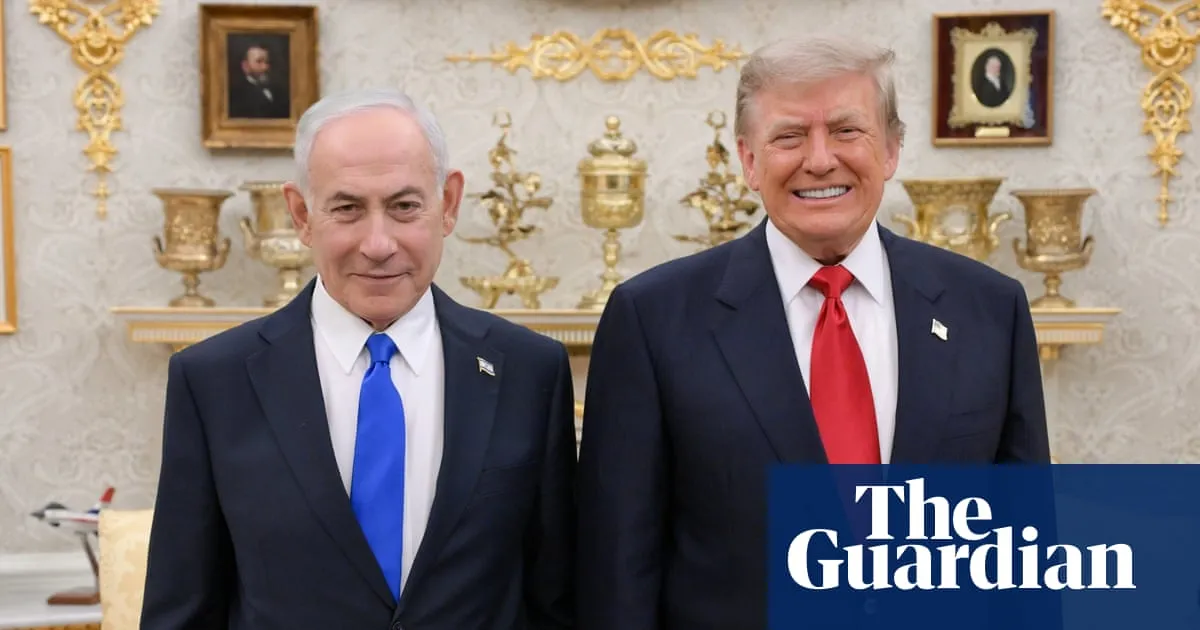
Israel’s prime minister, Benjamin Netanyahu, has rejected a US-backed 15-point peace plan for Gaza in a rare public break with Donald Trump.In a statement on Sunday, Netanyahu said that he was confronting a “wave of rumours about Israeli weakness and Israeli withdrawals on all fronts” and rebuked US pressure to end wars in Gaza, Lebanon, and Iran without Israel’s buy-in.On Gaza, he said: “Israel does not accept the 15-point document. The IDF will not carry out any withdrawal until Hamas is disarmed. And when I say the disarming of Hamas, it means heavy weaponry, lighter weaponry, all weaponry. And we are talking about genuine disarmament, not fictitious disarmament. Right now, we are talking with the Americans about this issue.”Trump’s Board of Peace in July proposed the 15-point plan, which mandated that Hamas disarm in exchange for providing a full Israeli military withdrawal from the Gaza Strip and an eventual transition of power to an independent Palestinian National Committee. Trump had said that the agreement would be implemented in stages, but Netanyahu on Sunday said that he wanted a full disarmament first in order to implement the deal.Israeli attacks have continued on Gaza despite a ceasefire brokered last October. Photograph: Anadolu/Getty ImagesThe Israeli leader’s main target in his remarks was the US. Israel has emerged as a key stumbling block in the Trump White House’s plans to broker peace in the region, both in Israel’s conflicts in Gaza and Lebanon, as well as in the war begun by joint US-Israeli strikes on Iran. And Netanyahu, who is facing tough elections in October and pressure from hardliners in his own government, appears ready to test his relationship with Trump in public in order to shore up his reputation as a defender of Israel at home.Israel had already signalled that it would reject the US-led plan. Soon after Trump announced it last month, Israel stepped up its bombing campaign in the Palestinian territory, with strikes killing 18 people last Sunday. Netanyahu’s office had previously indicated it would not back the plan, saying: “The version that has been made public does not reflect Israel’s positions.”But Sunday’s rejection was far more forceful and direct, and appeared targeted at the Trump White House, as Trump and Netanyahu both face difficult upcoming elections. “Unlike all those who lecture us, we do what needs to be done for Israel’s security,” Netanyahu said, “and we can and know how to stand our ground, even against our best friends when necessary.”The head of Trump’s Board of Peace hit back on Sunday, saying the plan remained the “only way forward”. Nickolay Mladenov, the board’s high representative for Gaza, told Israeli television: “The option we are offering today is the only way forward that ensures this tragedy does not happen again.”skip past newsletter promotionafter newsletter promotionNetanyahu’s rejection is a blow to Trump’s desire to be seen as a broker of peace in foreign conflicts. With midterm elections set for October, the White House is desperate to negotiate a peace in Iran in order to reopen the strait of Hormuz and help bring down oil and petrol prices.But the conflicts in the Middle East are interconnected and US efforts have continued parallel to bringing peace to Lebanon, where Israel has occupied land in what it says is a buffer zone against Hezbollah, and in Gaza, where Gulf allies of the US have decried what they say is an ethnic cleansing campaign being carried out by Israel.Like US presidents before him, Trump has found that Netanyahu can be a difficult ally. Bill Clinton, after meeting Netanyahu for the first time in 1996, is reported to have said: “Who’s the fucking superpower here?”More recently, the Biden administration found that its concerns about the human toll in Gaza were ignored, but continued to publicly back Netanyahu and did not significantly suspend military aid to the country for fear of the political blowback that Netanyahu and his allies in the US could cause.But in Trump, Netanyahu has found a far more unorthodox and unpredictable counterpart in the White House. Netanyahu is a natural ally for Trump, and he has attacked Democrats before the midterm elections for being weak on supporting Israel.But more broadly, support for Israel and its war in Gaza is eroding in the Democratic party, and the Republicans have a presidential frontrunner for 2028 in vice-president JD Vance, who is publicly sceptical of Israel and the war in Gaza.Trump will have to decide whether to increase pressure on Netanyahu, potentially alienating some pro-Israel allies, or to allow his efforts for a Gaza peace plan to stall, perhaps indefinitely.The answer will depend heavily in the US president’s own political instincts – are US voters hoping to see Trump emerge as a statesman capable of ending one of the world’s bloodiest recent wars in Gaza, or would the potential political backlash of a public clash with Netanyahu provoke a revolt among his base? With both countries entering tumultuous election cycles and a generational shift in support for Israel among US voters, the result could redraw the alliance between Israel and the US.
SRCThe Guardian - World News
LANGEN
LEANCenter-Left
WORDS845
ENT10
SUN · 2026-08-09 · 18:35 GMTBRIEF NSR-2026-0809-100675
NSR-2026-0809-100675News Report·EN·Diplomatic
Israel rejects US-led 15-point Gaza peace plan, says Netanyahu
Israeli Prime Minister Benjamin Netanyahu has publicly rejected a 15-point peace plan for Gaza, developed by the Trump administration. Netanyahu stated that Israel will not withdraw from Gaza until Hamas is disarmed of all weaponry, emphasizing a need for genuine disarmament.
Andrew Roth in WashingtonThe Guardian - World NewsFiled 2026-08-09 · 18:35 GMTLean · Center-LeftRead · 4 min
The Guardian - World NewsFIG 01
Reading time
4min
Word count
845words
Sources cited
3cited
Entities identified
10entities
Quality score
100%
§ 01
Briefing Summary
AI-generatedNEWSAR · AI
Israeli Prime Minister Benjamin Netanyahu has publicly rejected a 15-point peace plan for Gaza, developed by the Trump administration. Netanyahu stated that Israel will not withdraw from Gaza until Hamas is disarmed of all weaponry, emphasizing a need for genuine disarmament. This marks a rare public disagreement with President Trump. The plan, proposed in July, stipulated Hamas disarmament in exchange for an Israeli military withdrawal and a Palestinian National Committee transition of power. Netanyahu's rejection comes amid ongoing Israeli attacks in Gaza and ahead of upcoming elections, as he seeks to project strength on national security. The head of Trump's Board of Peace maintained the plan is the "only way forward."
Confidence 0.90Sources 3Claims 5Entities 10
§ 02
Article analysis
Model · rule-basedFraming
Diplomatic
Political Strategy
Tone
Measured
AI-assessed
CalmNeutralAlarmist
Factuality
0.70 / 1.00
Factual
LowHigh
Sources cited
3
Well sourced
FewMany
§ 03
Key claims
5 extracted01
The plan offered remains the 'only way forward' to prevent future tragedy.
quoteNickolay Mladenov
Confidence
1.00
02
Israel does not accept the 15-point document and the IDF will not carry out any withdrawal until Hamas is disarmed.
factualBenjamin Netanyahu
Confidence
1.00
03
Israel rejects a US-backed 15-point peace plan for Gaza.
factualBenjamin Netanyahu
Confidence
1.00
04
The US-backed plan mandated Hamas disarm in exchange for Israeli withdrawal and transition of power to an independent Palestinian National Committee.
factualArticle
Confidence
0.90
05
Netanyahu appears ready to test his relationship with Trump in public to shore up his reputation ahead of tough elections.
factualArticle
Confidence
0.70
§ 04
Full report
4 min read · 845 words§ 05
Entities
10 identifiedKey playerOppositionContextPositiveNeutralNegative
Organizations3
§ 06
Keywords & salience
10 termsgaza peace plan
1.00
benjamin netanyahu
0.90
us pressure
0.80
hamas disarmament
0.80
israeli withdrawal
0.70
donald trump
0.70
israel security
0.60
middle east peace
0.50
upcoming elections
0.40
military conflict
0.40
§ 07
Topic connections
Interactive graph Network visualization showing 51 related topics
View Full Graph Person Organization Location Event|Click node to navigate|Edge numbers = shared articles