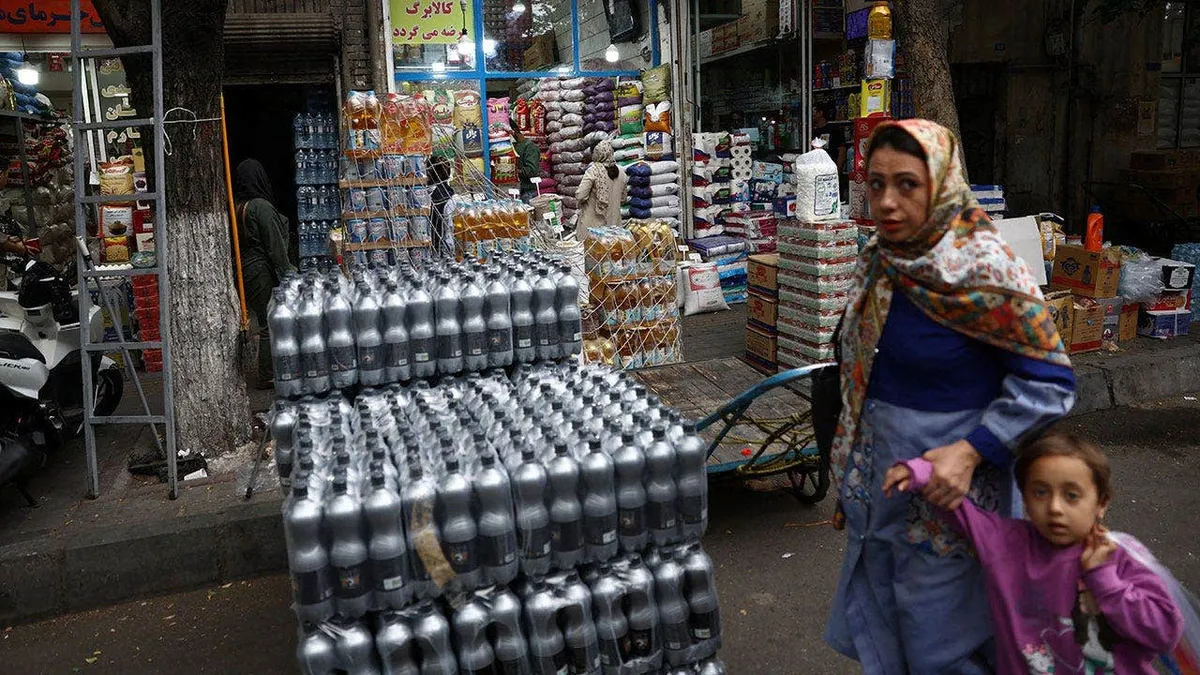
close Video Former Iran detainee says sanctions created ‘huge franchise’ for regime power brokers Former Iran detainee Morad Tahbaz says sanctions have pushed Iranian trade into opaque channels, hurting ordinary Iranians while enriching those who control the flow of money and goods. NEWYou can now listen to Fox News articles! Hören Sie sich diesen Artikel an 9 Min President Donald Trump is signaling, at least for now, he is prepared to let mounting economic pressure on Iran do more of the work rather than immediately expand military action against Tehran. "We are only semi-negotiating with them. We are just watching Iran with its huge inflation and the fact they have no money," Trump told Axios’ Barak Ravid in a phone interview Sunday. Axios reported Aug. 9 that Trump described the U.S. approach as "low-keying it" and said Iran was in severe economic distress and struggling to pay its troops. Trump has argued that the U.S. naval blockade on the Strait of Hormuz has compounded Iran’s financial crisis. His comments come after weeks in which the administration repeatedly raised the possibility of renewed large-scale military action. But as the administration increasingly points to Iran’s financial distress as leverage, a more complicated question is emerging: How much of Iran’s economic crisis is the result of U.S. sanctions, the war and blockade — and how much stems from decades of corruption, economic mismanagement and spending decisions by the Islamic Republic itself? Iran’S DEEPEST WEAKNESS IS GETTING EXPOSED THROUGH AMERICA’S MAXIMUM PRESSURE CAMPAIGN An Iranian woman shops in a local market in Tehran, Iran, April 28, 2026. (Majid Asgaripour/WANA (West Asia News Agency) via Reuters) Trump reinforced the message on Truth Social Sunday, writing that Iran had shown "51 years of bad behaviour" while sharing a graphic depicting the Iranian rial’s steep decline. The graphic was titled "Iran has NO MONEY" and described the currency as "trash." The economic pressure is increasingly visible in the daily lives of ordinary Iranians. An investigation published by the Iranian newspaper Jahan-e Sanat last week described supermarket workers encountering customers who allegedly shoplifted basic groceries including bread, cheese and meat, or ate packaged food inside stores because they could no longer afford it. The accounts offered a stark glimpse of the strain on Iranian households as prices rise and purchasing power erodes. Washington, meanwhile, has intensified its campaign against Tehran’s revenue streams. Under what the Treasury Department calls Economic Fury, the administration has targeted Iran’s oil trade, shadow banking networks, weapons procurement operations, cryptocurrency holdings and sanctions-evasion infrastructure. Treasury said June 10 that the campaign had prevented "tens of billions of dollars" in revenue from being accessible to the Iranian regime and its proxies. On July 29, Treasury said OFAC had sanctioned more than 100 vessels linked to Iran’s shadow fleet since the beginning of 2026. A Treasury spokesperson told Fox News Digital on background that "Economic Fury has left the regime desperate for cash." "Iran’s economy is in freefall, inflation has skyrocketed, and as President Trump said on Sunday, the regime’s ability to pay its troops has been decimated," the spokesperson said. WHO IS AHMAD VAHIDI? Iran’S NEW IRGC CHIEF TIED TO GLOBAL ATTACKS AND ‘DEATH TO AMERICA’ IDEOLOGY A person walks past a sign at a currency exchange, as the value of the Iranian Rial drops, in Tehran, Iran, December 30, 2025. (Majid Asgaripour/WANA (West Asia News Agency) via Reuters) A U.S. official told Fox News Digital on background that the administration still views economic pressure as one part of a broader strategy. "President Trump has always been clear that he will never allow Iran to have a nuclear weapon. While he has been consistent in saying he prefers a diplomatic solution, he continues to retain all options if Iran continues to engage in terrorism and refuses to make a deal," the official said. "The United States is strangling what’s left of Iran’s economy with one of the most successful naval blockades in history – and Iran would be wise to make a deal. Otherwise, they know what will happen." Miad Maleki, a senior fellow at the Foundation for Defense of Democracies and former Treasury Department sanctions official, said the pressure has accelerated Iran’s economic decline, but argued that Tehran’s own policies created many of the underlying vulnerabilities. "sanctions and the war have accelerated Iran's economic decline, but both are consequences of the regime's own troublemaking; its nuclear brinkmanship, missile and drone attacks on tankers, and support for terror proxies, not causes imposed on an innocent bystander," Maleki told Fox News Digital. "It's a government's basic responsibility to provide for and serve its nation — this regime has instead served a failed revolutionary ideology that has produced nothing but suffering for ordinary Iranians," he added. Maleki said the deeper story can be seen over decades, arguing that even when sanctions eased and oil revenues increased, Iran continued directing significant resources toward its security establishment and the Islamic Revolutionary Guard Corps. Iran’S REVOLUTIONARY GUARD SIDELINES PRESIDENT AS MILITARY GRIP EXPANDS An armed member of the Islamic Revolutionary Guard Corps (IRGC) monitors the area while mourners participate in the funeral for the late Supreme Leader Ayatollah Ali Khamenei and his family in Tehran, Iran, on July 6, 2026. (Morteza Nikoubazl/NurPhoto via Getty Images) According to Central Bank of Iran national accounts data provided by Maleki to Fox News Digital, Iran’s military share of total government spending rose from 16% in 1993 to 52% by 2006, while education spending fell from 27% to 15%. Spending on health and social affairs also declined as a share of government expenditures, he said. Maleki pointed to the 2020 budget as another example of the disparity. The IRGC received approximately $6.96 billion, compared with $2.73 billion for Iran’s larger conventional military, known as the Artesh — roughly 2.5 times as much, according to an analysis published by the United States Institute of Peace’s Iran Primer based on figures from Iran’s parliamentary research center. "The issue is not simply that Iran spends heavily on defense," Maleki said. "It is that an oil-dependent economy repeatedly directed enormous resources toward the military and the IRGC while basic public services and ordinary households were under increasing pressure." And the official budget captures only part of that spending. Maleki, citing both his experience at the Treasury Department and outside research, said the IRGC benefits from significant commercial and off-budget resources. A 2017 American Enterprise Institute study estimated that the IRGC’s so-called "gray budget" could add another 50% to 100% to its military outlays. An Islamic Revolutionary Guard Corps speedboat sails in the Persian Gulf during an IRGC marine parade marking Persian Gulf National Day near the Bushehr nuclear power plant in Bushehr, Iran, on April 29, 2024. (Morteza Nikoubazl/NurPhoto via Getty Images) "Ultimately, the responsibility lies not with external pressure but with structural corruption, chronic economic mismanagement, and spending priorities fundamentally detached from ordinary Iranians' needs and the country's genuine economic potential," Maleki said. That influence extends far beyond military spending. The IRGC has also built a sprawling economic apparatus that gives it control over major sources of revenue and, critics argue, leaves it particularly well positioned to profit from the opaque channels sanctions create. Its economic arm, Khatam al-Anbiya Construction Headquarters, became a major force in the Iranian economy after the Iran-Iraq War and expanded across construction, energy and infrastructure. The Treasury Department designated Khatam al-Anbiya in October 2007, describing it as an IRGC engineering arm used to generate income and fund the organization’s operations. Treasury acknowledged that Iran is increasingly turning to opaque financial channels to circumvent U.S. pressure, but argued that those networks are themselves becoming targets of the campaign. "The regime is increasingly having to invent new ways to try to evade U.S. sanctions through shadow banking networks, including through exploiting crypto," the Treasury spokesperson said. "Treasury continues to monitor and aggressively dismantle these networks to ensure Iran cannot sustain its campaign of terror and regional destabilization." On Aug. 7, Treasury announced separate actions against cryptocurrency exchanges it said were being used to finance the IRGC and against international currency networks that it said were moving hundreds of millions of dollars for Iran. FREED AMERICAN REVEALS BRUTAL Iran PRISON ORDEAL, WARNS HOSTAGES FACE GREATER DANGER People walk in a local market in Tehran, Iran, April 28, 2026. (Majid Asgaripour/WANA (West Asia News Agency) via Reuters) Morad Tahbaz, an Iranian-American conservationist who spent nearly six years imprisoned in Iran’s Evin Prison before being released with four other Americans in September 2023, said sanctions have effectively created what he described as a lucrative "franchise" for those controlling the channels through which money and goods move. "They have created a huge franchise for themselves because of these sanctions," Tahbaz told Fox News Digital. "Money can't flow freely to the Iranian government's treasury because of the sanctions. So what happens, everything is like a black market, gray market, illegal smuggling from the oil to everything else coming in and out." "And of course, the people who are hurt most by all of this are the people of Iran," he added. "They're unfortunately, very unfortunately, taking the brunt of all of these in their daily lives." Tahbaz said the entrenchment of the IRGC-linked economy may itself complicate efforts to end the confrontation because those profiting from restricted financial channels have an incentive to preserve them. People shop in a local market in Tehran, Iran, April 28, 2026. (Majid Asgaripour/WANA (West Asia News Agency) via Reuters) "They don't want to see the sanctions go away, because they will lose their franchise, if you will," he said. "They will lose their power, their control over the money and everything that goes along with it." Tahbaz said the economic interests created by the sanctions also help explain some of the internal tensions within Iran. "This is the battle going on inside Iran when you hear there is tension within factions," he said. "And I think to see a solution to this war, if you will, we have to look to what's happening in Iran," he said. Treasury said it maintains standing authorizations intended to limit sanctions’ effects on ordinary Iranians, including certain humanitarian trade involving agricultural products, medicine and medical devices; noncommercial personal remittances; and communications-related software, hardware and services. OFAC also considers additional requests on a case-by-case basis, the spokesperson said. The authorizations are contained in OFAC regulations and General License 8A. Efrat (Effie) Lachter is a reporter for Fox News Digital with more than 15 years of experience covering conflict, global affairs, human rights and political accountability. She has directed and produced more than 200 documentary segments across more than 40 countries, documenting conflicts, humanitarian crises, corruption, human trafficking, gender-based violence and the human stories behind major world events. Lachter’s reporting has taken her into conflict zones and crisis areas across the Middle East, Europe, Asia and Africa. Her work has included uncovering human trafficking networks, revealing an ISIS underground torture prison in Syria, documenting the war in Ukraine and interviewing senior political figures and world leaders. She was also among the Western journalists who entered Russia after the war began to bring testimonies from Putin’s opposition. Lachter is the recipient of the 2022 Peres Center for Peace Award and was a 2023–2024 Knight-Wallace Journalism Fellow at the University of Michigan. She also won two Rockower Awards for Excellence in Reporting. She holds a bachelor's degree in communication and a master's degree in political science.
SRCFox News - World
LANGEN
LEANCenter-Right
WORDS1 905
ENT12
MON · 2026-08-10 · 18:45 GMTBRIEF NSR-2026-0810-100991
NSR-2026-0810-100991News Report·EN·Political Strategy
Trump bets economic pressure can squeeze Iran as regime’s own failures deepen the pain
President Trump is currently prioritizing economic pressure over immediate military action against Iran, viewing the nation's severe economic distress as leverage. He stated that the U.S.
Fox News - WorldFiled 2026-08-10 · 18:45 GMTLean · Center-RightRead · 8 min
Fox News - WorldFIG 01
Reading time
8min
Word count
1 905words
Sources cited
4cited
Entities identified
12entities
Quality score
100%
§ 01
Briefing Summary
AI-generatedNEWSAR · AI
President Trump is currently prioritizing economic pressure over immediate military action against Iran, viewing the nation's severe economic distress as leverage. He stated that the U.S. is "semi-negotiating" and observing Iran's high inflation and lack of funds, exacerbated by U.S. sanctions and the naval blockade of the Strait of Hormuz. However, the article questions how much of Iran's economic crisis stems from U.S. actions versus decades of internal corruption and mismanagement. The U.S. Treasury's "Economic Fury" campaign targets Iran's revenue streams, including oil trade and cryptocurrency. Experts suggest that while sanctions accelerate Iran's decline, the regime's own policies and spending priorities, particularly on the military and IRGC, have created deep vulnerabilities.
Confidence 0.90Sources 4Claims 5Entities 12
§ 02
Article analysis
Model · rule-basedFraming
Political Strategy
Economic Impact
Tone
Mixed Tone
AI-assessed
CalmNeutralAlarmist
Factuality
0.70 / 1.00
Factual
LowHigh
Sources cited
4
Well sourced
FewMany
§ 03
Key claims
5 extracted01
U.S. sanctions have prevented tens of billions of dollars in revenue from being accessible to the Iranian regime.
statisticTreasury Department
Confidence
0.90
02
Iran is experiencing severe economic distress, including huge inflation and a lack of money.
quoteDonald Trump
Confidence
0.90
03
President Trump is prepared to let economic pressure on Iran do more work rather than immediately expand military action.
quoteDonald Trump
Confidence
0.90
04
The U.S. naval blockade on the Strait of Hormuz has compounded Iran’s financial crisis.
quoteDonald Trump
Confidence
0.80
05
Supermarket workers in Iran have encountered customers allegedly shoplifting basic groceries.
factualJahan-e Sanat newspaper
Confidence
0.70
§ 04
Full report
8 min read · 1 905 words§ 05
Entities
12 identifiedKey playerOppositionContextPositiveNeutralNegative
Organizations4
Locations4
§ 06
Keywords & salience
10 termsiran
1.00
economic pressure
1.00
sanctions
0.90
trump
0.80
economic crisis
0.80
regime failures
0.70
inflation
0.60
strait of hormuz
0.50
economic mismanagement
0.50
maximum pressure campaign
0.40
§ 07
Topic connections
Interactive graph Network visualization showing 51 related topics
View Full Graph Person Organization Location Event|Click node to navigate|Edge numbers = shared articles