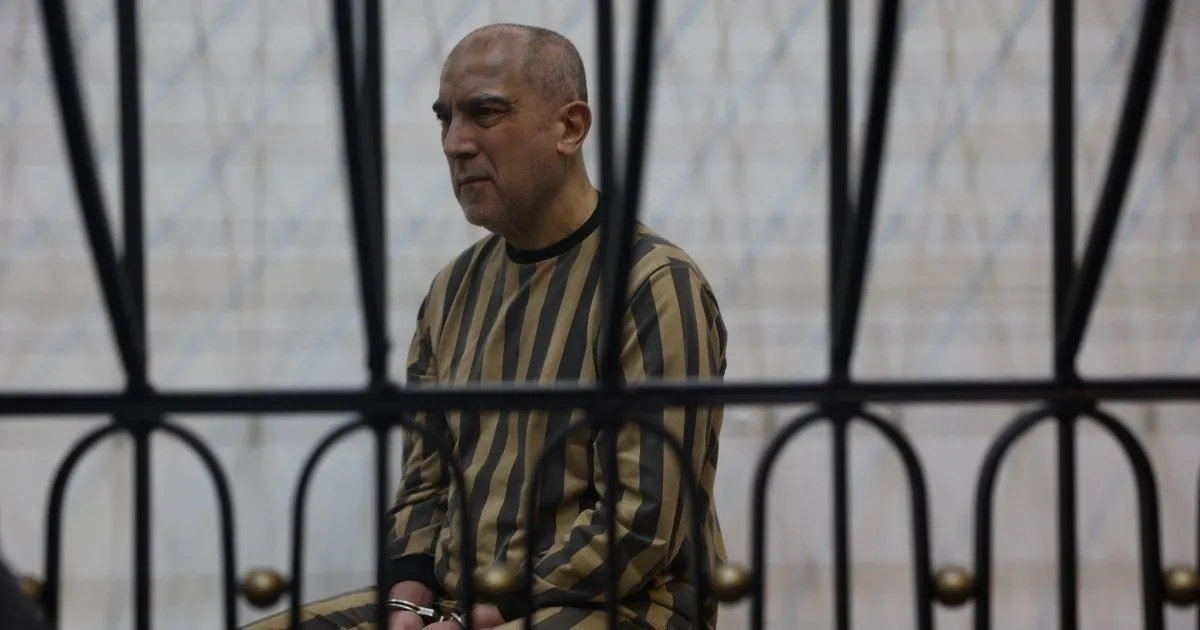
EXPLAINERExperts say this trial has been a test of Syria’s transitional justice.Published On 11 Aug 2026Atef Najib, the former Syrian security official widely seen as the man who oversaw a regime of murder, torture and forced disappearances against Syrians during the country’s brutal 14-year civil war, has been sentenced to death by a court in Damascus.On Tuesday, Najib was sentenced alongside ousted Syrian leader Bashar al-Assad and his younger brother, Maher al-Assad, who also received the death penalty in absentia for crimes including premeditated murder.The Fourth Criminal Court found that crimes committed by al-Assad’s government in Deraa province in 2011 amounted to crimes against humanity.Unlike al-Assad and members of his family who fled to Russia when the regime fell in December 2024, Najib has been in detention in Syria since January 2025. During his trial, he was charged with at least 10 crimes, including murder, torture and responsibility for massacres, as well as crimes against humanity linked to the 2011 Deraa crackdown on protesters.We unpack who Najib is, what he is charged with and what we know about his trial and verdict.Who is Atef Najib?Najib, 66, is the first cousin of former President Bashar al-Assad and the former head of political security in southern Syria’s Deraa province.Al-Assad was overthrown in early December 2024, when a coalition of armed opposition groups seized Damascus in a lightning advance and toppled his government. Since his ousting, al-Assad has lived in exile in Moscow under tight Russian supervision, far from any formal role in Syria’s new transitional authorities.Al-Assad had been in power since 2000 until he fled. He took over after his father, Hafez al-Assad, who had been in power since 1970, died.In the early 1980s, Najib joined the Military Academy in Homs after graduating from school. After completing his training at the academy, he became the head of political security in Deraa. The exact date he officially assumed his role is not documented in public state archives.He remained in his role leading up to and during the initial outbreak of the Syrian uprising in March 2011. Accused of violently quashing this uprising, the al-Assad regime officially removed him from his post in April 2011.Najib oversaw political security in Deraa when teenagers who scrawled antigovernment graffiti on a school wall were arrested and tortured. The case became a catalyst for a broader uprising, which ultimately morphed into a bloody civil war.The Ministry of Interior’s general security forces arrested Najib in January 2025 during a campaign targeting remnants of the former government in Latakia province. Najib had fled the country after al-Assad’s ousting, but then returned to Syria, Al Jazeera’s Obaida Hitto said, reporting from Damascus on Tuesday.Najib’s arrest was considered one of the most significant detentions of former security officials because he held a sensitive security position in Deraa at the beginning of the Syrian uprising.Najib’s sentence was issued by the Fourth Criminal Court in Damascus on Tuesday, which oversaw the final review of his case and judgement. Closing arguments and his final statement had already been heard in the eighth session. The proceedings began on April 26.What has the court decided?Najib was sentenced to death, alongside al-Assad and his brother.According to the court ruling, Najib was involved in the torture of a large number of detainees, including of children, and was responsible for the deaths of many of them during their detention.This marks the first decision by a Syrian court against a senior al-Assad‑era figure under the current transitional authorities.“This is a historic moment, here in Syria. Atef Najib is the only one of the codefendants who is actually standing trial here physically inside the country. The other codefendants are all being sentenced in absentia,” Al Jazeera’s Hitto said.What was Najib accused of?He was accused of overseeing a violent crackdown on antigovernment protesters in Deraa during the 2011 uprising, which led to the 14-year civil war.Overall, he was charged with at least 10 crimes, including murder, torture and responsibility for the 2011 massacre in Deraa, which the court ruled was a crime against humanity.According to an Al Jazeera Mubasher report, 75 plaintiffs filed cases against Najib and were understood to have provided testimony during the trial.Why is this significant?This trial was a test case for Syria’s transitional justice system and for the new government’s ability to hold al-Assad regime officials to account for abuses under his rule.The government of interim President Ahmed al-Sharaa has faced criticism for delays in launching a promised transitional justice process following the war, in which an estimated half a million people were killed.According to a 2025 report by the Syrian Network for Human Rights, more than 181,000 people were forcibly disappeared or arbitrarily detained during the war, 90 percent of them by the al-Assad regime.“The legal issues that were discussed today are going to set the precedent for future legal actions taken against anyone that was involved in these crimes,” Hitto said.The verdict is therefore being seen by many as a test of how far al-Sharaa’s government will go to mete out justice for past crimes.“What is at stake in these proceedings is not confined to the question of whether Najib will be held to account for his actions … Rather, the true significance of this trial lies in the legal foundation of the judicial record that these proceedings will leave behind,” Fadel Abdulghany, the founder and head of the Syrian Network for Human Rights, wrote in an opinion piece for The New Arab last month.Hitto reported that people had gathered around the court in Damascus when the verdict was announced, and they were “relieved that this is happening in this way”.Syrians could be seen celebrating the verdicts in the streets outside.“The country has been trying to reconcile more than five decades of dictatorship led by the al-Assad family over the last 18 months or so,” Hitto added.
SRCAl Jazeera
LANGEN
LEANCenter
WORDS970
ENT12
TUE · 2026-08-11 · 10:03 GMTBRIEF NSR-2026-0811-101179
NSR-2026-0811-101179News Report·EN·Legal & Judicial
Who is Atef Najib, former Syrian official sentenced to death with al-Assad?
Former Syrian security official Atef Najib has been sentenced to death by a court in Damascus for crimes including murder and torture. Najib, a cousin of ousted leader Bashar al-Assad, was found responsible for crimes against humanity related to the 2011 crackdown on protesters in Deraa province.
Sarah ShamimAl JazeeraFiled 2026-08-11 · 10:03 GMTLean · CenterRead · 4 min
Al JazeeraFIG 01
Reading time
4min
Word count
970words
Sources cited
1cited
Entities identified
12entities
Quality score
100%
§ 01
Briefing Summary
AI-generatedNEWSAR · AI
Former Syrian security official Atef Najib has been sentenced to death by a court in Damascus for crimes including murder and torture. Najib, a cousin of ousted leader Bashar al-Assad, was found responsible for crimes against humanity related to the 2011 crackdown on protesters in Deraa province. He is the only defendant physically present at the trial, with al-Assad and his brother Maher also receiving death sentences in absentia. Najib, who previously headed political security in Deraa, was arrested in January 2025. This trial is seen as a test for Syria's transitional justice system and the new government's accountability efforts.
Confidence 0.90Sources 1Claims 5Entities 12
§ 02
Article analysis
Model · rule-basedFraming
Legal & Judicial
Human Rights
Tone
Mixed Tone
AI-assessed
CalmNeutralAlarmist
Factuality
0.70 / 1.00
Factual
LowHigh
Sources cited
1
Limited
FewMany
§ 03
Key claims
5 extracted01
Najib was arrested in January 2025 during a campaign targeting remnants of the former government.
factual
Confidence
1.00
02
Najib was the former head of political security in southern Syria’s Deraa province.
factual
Confidence
1.00
03
The Fourth Criminal Court found that crimes committed by al-Assad’s government in Deraa province in 2011 amounted to crimes against humanity.
factual
Confidence
1.00
04
Najib was sentenced alongside Bashar al-Assad and Maher al-Assad for crimes including premeditated murder.
factual
Confidence
1.00
05
Atef Najib, former Syrian security official, was sentenced to death by a court in Damascus.
factual
Confidence
1.00
§ 04
Full report
4 min read · 970 words§ 05
Entities
12 identifiedKey playerOppositionContextPositiveNeutralNegative
People4
Locations5
§ 06
Keywords & salience
10 termssyrian civil war
0.90
transitional justice
0.90
crimes against humanity
0.80
bashar al-assad
0.70
atef najib
0.70
death penalty
0.60
deraa crackdown
0.50
political security
0.40
torture
0.40
forced disappearances
0.40
§ 07
Topic connections
Interactive graph No topic relationship data available yet. This graph will appear once topic relationships have been computed.