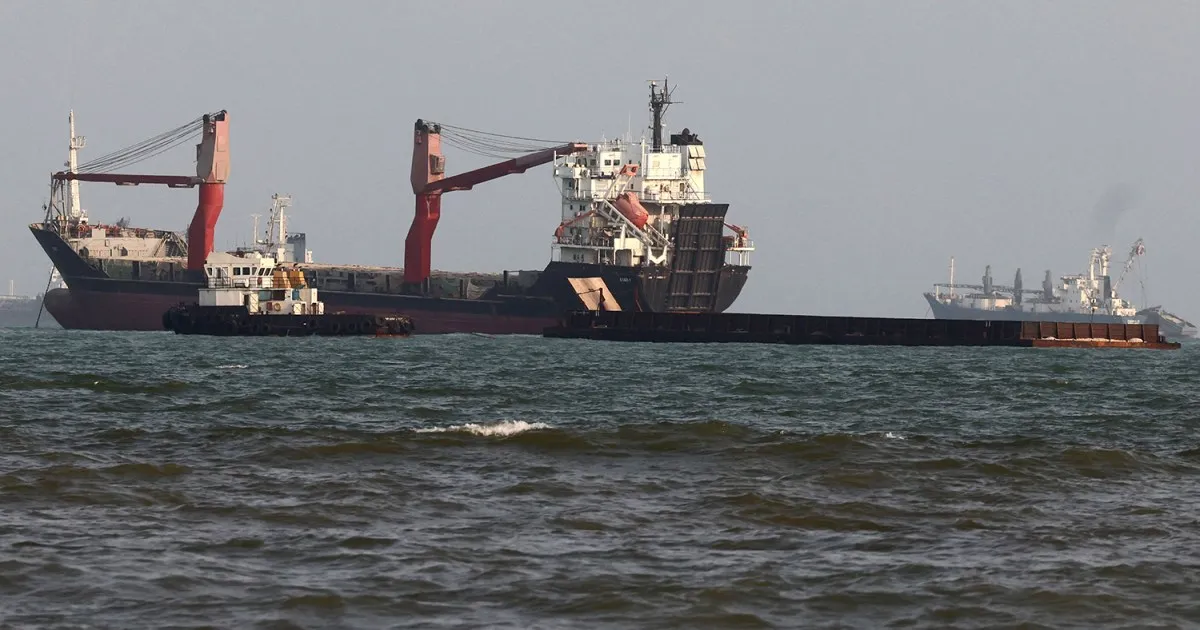
EXPLAINERIran declares Hormuz closure until US meets its demands and changes its ‘behaviour’ as global energy prices tick higher.Two youth sit on the shoreline as ships are seen anchored in the Strait of Hormuz on August 10, 2026, off the coast of Bandar Abbas, Iran [Ali Saeedi/Getty Images]Published On 12 Aug 2026Iran has refuted President Donald Trump’s claim that Washington has “total control” of the Strait of Hormuz, saying the critical waterway will remain closed until the United States accepts its demands and changes its “behaviour”.According to the semi-official Tasnim news agency, Mohsen Rezaie, the newly appointed head of Iran’s Supreme National Security Council, told China’s ambassador to Tehran, Cong Peiwu: “As long as America does not change its behaviour and does not accept Iran’s conditions, the Strait of Hormuz will not be opened.”Recommended Stories list of 3 itemslist 1 of 3Iran holds firm on Hormuz conditions as Pakistan’s Naqvi visits Tehranlist 2 of 3US military fires on cargo vessel it said sought to break Iran blockadelist 3 of 3War on Iran: Mojtaba Khamenei is in ‘perfect health’, Iran saysend of listThe Strait of Hormuz, through which one-fifth of global oil and natural gas is shipped during peacetime, has emerged as a key flashpoint in the US-Israel war on Iran, with peace talks stalled until the question of its management is resolved. Iran closed the strait shortly after US-Israeli bombing of Iran began at the end of February.It currently says it is only talking to Oman, whose territorial waters the strait also passes through, about the future management of the waterway.Commercial shipping remains severely disrupted in the strait, with attacks on vessels continuing on Tuesday when US forces targeted a vessel they said was headed for an Iranian port, in the Oman" class="entity-link entity-location" data-entity-id="2457" data-entity-type="location">Gulf of Oman.At the same time, six people were killed in a Houthi attack on a Saudi cargo vessel in the Bab al-Mandeb Strait, according to Yemeni authorities, in what is being described as the first deaths from Houthi attacks on shipping since the US-Israel war on Iran began.So, is the war entering another dangerous phase? And is there still a diplomatic route out?AJWhat has Trump said about the Strait of Hormuz?“We totally control the Strait of Hormuz. We have control over it; nobody else, only us,” Trump told reporters at Joint Base Andrews on Tuesday.On the ground, however, the situation is more complicated. United Kingdom Maritime Trade Operations said shipping remained at reduced levels and attacks and “harassment activity” persisted in the Strait of Hormuz as Iran and the US both maintain blockades in and around it.Iran, meanwhile, has made clear that it does not intend to reopen the waterway unless Washington meets its demands for the lifting of sanctions, the release of frozen Iranian assets and compensation for attacks, among other things.Writing on X, Rezaei also demanded an end to the US’s naval blockade on Iranian ports as well as a region-wide ceasefire, including in Gaza and Lebanon.What has happened in Hormuz and Bab al-Mandeb?A US Navy MH-60 helicopter fired two Hellfire missiles at a Panama-flagged cargo ship in the Oman" class="entity-link entity-location" data-entity-id="2457" data-entity-type="location">Gulf of Oman after the vessel allegedly attempted to violate the US blockade of Iranian ports, US Central Command (CENTCOM) reported. The strike disabled the ship’s steering gear.The M/V Vela Nova had ignored warnings before a helicopter fired missiles into its engine room, disabling it, CENTCOM said. The US military did not report any casualties among the crew.The war has now also spilt into another key maritime passageway in the region, the Bab al-Mandeb at the entrance to the Red Sea off Yemen and Saudi Arabia’s western coast, where the Iran-backed Houthis have been targeting Saudi shipping amid renewed fighting in Yemen. Saudi Arabia has announced a new maritime alliance in a bid to secure the waterway.On Tuesday, six people were killed in a Houthi attack on a cargo vessel in the strait, Yemeni authorities claimed.Four crew members on board the Egyptian-owned Tihamah were killed, along with two Yemeni rescuers who were responding to the attack. Ten others were injured. The Houthis have yet to directly comment on the attack.Later in the day, Houthi-affiliated media reported that the ship was carrying Saudi military equipment.Hormuz and Bab al-Mandeb are both critical maritime chokepoints. Besides the one-fifth of global oil and natural gas trade through Hormuz, about 11 percent of global oil and 8 percent of liquefied natural gas (LNG) trade passes through Bab al-Mandeb.The conflict has badly affected traffic through the waterways, sending oil prices spiralling.The number of vessels tracked passing through the Strait of Hormuz fell to a one-week low on Tuesday.Shipping data from Kpler, cited by the Reuters news agency, showed eight vessels transiting the strait, below the 10-day average of about 12 and the lowest daily tally since August 5. Before the war, about 130 ships passed through the strait daily.Could open warfare begin again?The latest attacks in Hormuz and Bab al-Mandeb strongly indicate that the conflict is not winding down.Despite both appearing open to talks last week, the US and Iran have escalated their rhetoric in the past few days.On Monday, US President Donald Trump said he would demand compensation from Iran for deaths and injuries linked to conflicts and attacks over several decades after Iran last week issued new demands for reparations for the US-Israel war.However, US media have reported that the country may be running low on weapons, particularly air defence interceptors used in Patriot and Terminal High Altitude Area Defense (THAAD) air defence systems, which could pose a threat to US forces and its allies in the region.Trump and other US officials have denied this.Meanwhile, on Tuesday, an Iranian Islamic Revolutionary Guard Corps (IRGC) adviser said it was developing the capability to conduct operations on “enemy soil”. Until now, Iran has been limited to carrying out strikes on US military assets and energy infrastructure in neighbouring Gulf countries and Jordan.“We need to be able to move the operations to the enemy’s soil, whenever this is needed and ordered,” he said, according to Iranian state TV.What’s the latest on Oman-Iran talks for Hormuz?Last week, Iranian Foreign Minister Abbas Araghchi said negotiations with Oman for future management of the Strait of Hormuz, with new shipping lanes, have made progress and are in their “final stages”.Iran says it is not talking directly to the US about this – only Oman, with which it proposes sharing management of the strait.On Tuesday, Qatar’s Ministry of Foreign Affairs spokesperson Majed al-Ansari said he had heard positive messages from both Tehran and Muscat regarding the reopening of Hormuz.What are the prospects for a broader US-Iran peace deal?Pakistani Interior Minister Mohsin Naqvi travelled to Tehran on Tuesday to meet Iranian officials as part of efforts to persuade Tehran to resume negotiations with Washington under the interim Memorandum of Understanding (MoU) brokered by Islamabad and Qatar in June. This is due to expire next week.The vague wording of the MoU, under which Iran had agreed to keep Hormuz open for at least 60 days, caused it to fall apart because of disagreements about who had control over the strait. Iran then fired on several ships taking a route through the channel that it had not approved.The visit is Naqvi’s sixth trip to Iran as part of diplomatic efforts to end the US-Iran war.On whether any future talks between the longtime foes will succeed, analyst Negar Mortazavi said the key question is whether the escalatory rhetoric from both sides is “opening negotiating positions or actual red lines”.“If both sides are prepared to compromise, there is still a path towards ending the conflict and reopening the strait,” Mortazavi, senior fellow at the Center for International Policy, told Al Jazeera.“If they are not, Hormuz could remain restricted and the confrontation risks becoming another prolonged, open-ended conflict in the Middle East.”
SRCAl Jazeera
LANGEN
LEANCenter
WORDS1 297
ENT12
WED · 2026-08-12 · 10:27 GMTBRIEF NSR-2026-0812-101558
NSR-2026-0812-101558News Report·EN·Conflict
Iran refutes Trump’s claim to ‘control’ Hormuz: What’s the latest in talks?
Iran has refuted US President Donald Trump's claim of "total control" over the Strait of Hormuz, stating the waterway will remain closed until the US meets its demands, including sanctions relief and compensation. Iran's Supreme National Security Council head, Mohsen Rezaie, conveyed this to China's ambassador, emphasizing that the strait will not reopen until US behavior changes.
Usaid SiddiquiAl JazeeraFiled 2026-08-12 · 10:27 GMTLean · CenterRead · 6 min
Al JazeeraFIG 01
Reading time
6min
Word count
1 297words
Sources cited
4cited
Entities identified
12entities
Quality score
100%
§ 01
Briefing Summary
AI-generatedNEWSAR · AI
Iran has refuted US President Donald Trump's claim of "total control" over the Strait of Hormuz, stating the waterway will remain closed until the US meets its demands, including sanctions relief and compensation. Iran's Supreme National Security Council head, Mohsen Rezaie, conveyed this to China's ambassador, emphasizing that the strait will not reopen until US behavior changes. The Strait of Hormuz, crucial for global energy shipments, has been closed by Iran since late February amid the US-Israel war on Iran, disrupting commercial shipping. Concurrently, the Bab al-Mandeb Strait has seen increased Houthi attacks on shipping, resulting in casualties and further impacting maritime trade routes.
Confidence 0.90Sources 4Claims 5Entities 12
§ 02
Article analysis
Model · rule-basedFraming
Conflict
Diplomatic
Tone
Mixed Tone
AI-assessed
CalmNeutralAlarmist
Factuality
0.70 / 1.00
Factual
LowHigh
Sources cited
4
Well sourced
FewMany
§ 03
Key claims
5 extracted01
One-fifth of global oil and natural gas is shipped through the Strait of Hormuz during peacetime.
factual
Confidence
1.00
02
US forces targeted a vessel they said was headed for an Iranian port in the Gulf of Oman.
factual
Confidence
0.90
03
Iran closed the strait shortly after US-Israeli bombing of Iran began at the end of February.
factual
Confidence
0.90
04
The Strait of Hormuz will remain closed until the United States accepts Iran's demands and changes its 'behaviour'.
quoteMohsen Rezaie (via Tasnim news agency)
Confidence
0.90
05
Iran refutes President Donald Trump’s claim that Washington has “total control” of the Strait of Hormuz.
quoteIran
Confidence
0.90
§ 04
Full report
6 min read · 1 297 words§ 05
Entities
12 identifiedKey playerOppositionContextPositiveNeutralNegative
People3
§ 06
Keywords & salience
10 termsiran
1.00
strait of hormuz
1.00
us-iran relations
0.90
energy prices
0.80
global energy
0.70
us-israel war on iran
0.70
peace talks
0.60
commercial shipping
0.50
houthi attack
0.40
diplomatic route
0.40
§ 07
Topic connections
Interactive graph Network visualization showing 51 related topics
View Full Graph Person Organization Location Event|Click node to navigate|Edge numbers = shared articles