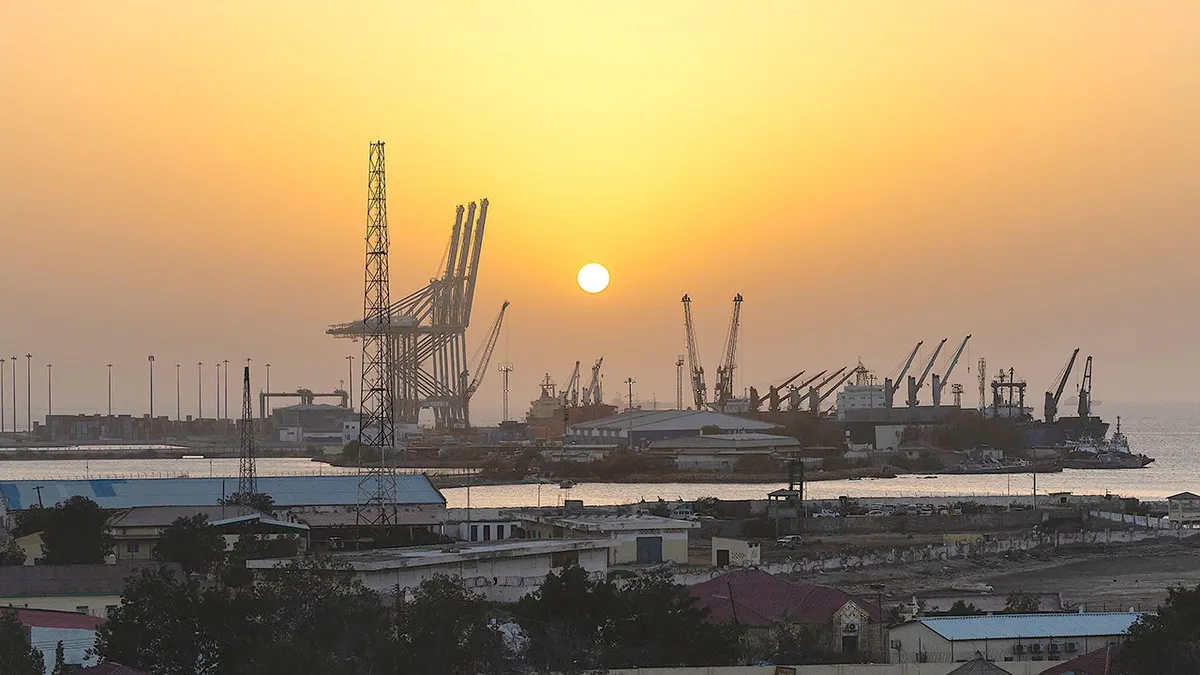
close Video Iran-backed Houthis target another strategic Middle East shipping route Fox News chief national security correspondent Jennifer Griffin explains how attacks by Iran-backed Houthis in the Bab el-Mandab Strait could complicate U.S. military operations in the Middle East on ‘The Story.’ NEWYou can now listen to Fox News articles! Hören Sie sich diesen Artikel an 6 Min JOHANNESBURG: As the Iran-backed Houthis step up their threat to Red Sea shipping, analysts say the U.S. could consider a major change in strategy. Houthi attacks on ships passing through a vital chokepoint may lead Washington to cement relations with more reliable partners along Africa’s coastline. Somaliland is a pro-U.S. outpost, having broken away from war-torn Somalia in 1991, and is offering the U.S. the use of one of the longest runways in Africa, an air base and a deep sea port on the Red Sea. Iran AND HOUTHI TERROR PROXY FACING Red Sea THREAT FROM PRO-US AFRICAN NATION An aerial view of The Bab el-Mandeb Strait, a sea route connecting the Indian Ocean and the Mediterranean Sea via the Suez Canal. (Gallo Images/Orbital Horizon/Copernicus Sentinel Data 2021) The Houthis have vowed to close the Bab-el-Mandeb Strait, a narrow waterway through which Saudi Arabia exports up to 7 million barrels of oil a day, now that access to the Strait of Hormuz is severely restricted. In the past month in the Red Sea, the Houthis have reportedly attacked Saudi-flagged ships, are said to have sunk an Indian commercial cargo vessel and, on Aug. 13, an Egyptian cargo ship was hit, with at least four of its crew killed. The U.S. already has a large military base on the Red Sea in Djibouti, but this is claimed to be increasingly problematic. "China is significantly expanding its military and commercial presence in Djibouti," Edmund Fitton-Brown previously told Fox News Digital. Fitton-Brown, the former British ambassador to the Houthis’ home country, Yemen, and a senior fellow at the Foundation for Defense of Democracies, (FDD), added, "There is a sense that Djibouti is not a reliable ally for the U.S. So Somaliland’s time has probably come." Major General Ken Ekman, who retired last year from being the Department of War’s West Africa Coordination Element Lead, said, in essence, the Houthis could force the U.S. into recognizing Somaliland as an independent state. "The Houthis could compel a different U.S. strategy in Africa." TRUMP THREATENS 'MAJOR MILITARY PUNISHMENT' FOR Iran OVER FUTURE HOUTHI ATTACKS This handout screen grab captured from a video shows Yemen's Houthi fighters' takeover of the Galaxy Leader Cargo in the Red Sea coast off Hudaydah, on Nov. 20, 2023 in the Red Sea, Yemen. (Photo by Houthi Movement via Getty Images) Ekman said the Houthis are building up a second front in this Middle East conflict. "It distracts the U.S. and stretches our assets," he added. "The Houthis have a strategy of their own. They are testing U.S. military ability, and are likely to pull the trigger in a major way when Iranian influence in the Strait of Hormuz wanes in leverage." He said that recently the U.S. Africa Command, AFRICOM, has concentrated on looking at land-based threats. "To date, our Africa strategy is driven by counterterrorism missions against Islamist al Qaeda and ISIS-linked groups based in Africa." He continued, "These groups pose a limited and not immediate threat to the U.S. homeland. Overall, Red Sea basing to date has focused more on crisis response in East Africa, countering and competing against Russia and China." COULD THIS AFRICAN NATION BECOME TRUMP'S NEXT TERROR TARGET AS JIHADISTS CLOSE IN ON POWER? U.S. Air Force Gen. Dagvin Anderson, commander, U.S. Africa Command (AFRICOM), meets with President Abdirahman Mohamed Abdullahi, president of Somaliland, in Hargeisa, Somaliland, on Nov. 26, 2025. The meeting was part of Gen. Anderson’s trip in East Africa to meet with government and defense leaders to strengthen America’s strategic approach to confronting terrorism through mutual engagement, stronger cooperation, and aligned security priorities. (U.S. Army photo by Cpt. Ubon Mendie) Ekman added, "orienting a Horn of Africa strategy against the Houthis would place a premium on freedom of navigation. Somaliland is proximate and overcomes some of the limitations imposed by other regional hosts like Djibouti and Middle East partners." Limitations and an apparent sense of frustration with Somalia, Somaliland’s neighbor and rival, have been expressed in a warning from U.S. Air Force Gen. Dagvin Anderson, commander of U.S. Africa Command (AFRICOM). In a recent interview with a Somali journalist, he was asked whether the U.S. was pulling out of the nation and turning its back on it. Anderson said the U.S. has not turned its back on Somalia, having been committed to the country for several years, he noted the success of its counterterrorism group known as DANAB, which he said is "one of the most capable forces on the continent." He noted that "it was up to Somalia to sustain that force… to build it and continue to make it effective going into the future and use it as it was designed to counterterrorism." A general view of the Berbera Port at dusk, the official seaport of Berbera, the commercial capital of Somaliland, on Feb. 18, 2026. (Tony Karumba / AFP via Getty Images) Referring to the Somali government’s apparent lack of ability to deal decisively with Islamist al-Shabab terrorists, Anderson seemingly hinted at pulling some or even all military support. "If Somalia steps up and the government steps up and takes the lead on this, we will continue to be there because there is mutual interest." He continued, "But if we can’t see that in, the political instability and political infighting continues, then it’s going to be very hard for us to continue to stay engaged." Bill Roggio, editor of the Long War Journal, said Washington is fed up with Mogadishu, but currently not enough for the U.S. to change allegiance to Somaliland. He told Fox News Digital, "The U.S. has expressed displeasure with the Somali government's rampant corruption and internal infighting with local and regional governments, and with various clans. However, full recognition of Somaliland independence would create a major rift between the U.S. and Somalia." U.S. forces conclude an operation targeting ISIS in Somalia in August 2025. (Hannah Kantner/AFRICOM) Roggio didn’t rule out the U.S. operating a second Red Sea base in Somaliland, saying "U.S. forces situated at Camp Lemonnier in Djibouti are far better situated geographically to deter the Houthis from shutting down the Bab el Mandeb Strait than a potential base in Somaliland. That being said, redundancy (back up plan) is a good thing in military operations." "The United States needs reliable partners on Africa's coastline," Bashir Goth, Somaliland Representative to the United States, told Fox News Digital. Goth said, "Somaliland is that partner and our defense officials have been in active dialogue with AFRICOM on Red Sea security. Somaliland has the geography, the stability and the will to work closely with Washington — and will continue to do so." TRUMP SAYS Iran WILL PAY — WHAT IT TAKES TO END THE WAR REMAINS UNCLEAR A Houthi follower looks on, during a pro-Iran demonstration, as the U.S.-Israel conflict with Iran continues, in Sanaa, Yemen April 6, 2026. (Khaled Abdullah/Reuters) Officially, the U.S. still stands with Somalia, in preference to Somaliland. A State Department spokesperson told Fox News Digital, "The United States works with Somali and international partners to address terrorist threats in Somalia when necessary and appropriate to protect U.S. national security interests." In the Red Sea, Saudi Arabia and 13 other nations established a new maritime defense coalition to combat the Houthi threat. Publicly, at least, the U.S. is not part of this coalition. Responding to questioning on this issue, a State Department spokesperson told Fox News Digital, "The United States stands firmly with the Kingdom of Saudi Arabia against Houthi terrorism. We are in close consultation with our Saudi allies and remain committed to their security." The U.S. does appear though to be stepping up interaction with Somaliland. AFRICOM Commander Anderson again visited Somaliland this past week, with an official statement saying he "traveled to the port city of Berbera to assess the security environment and review the port’s operational capacity." Somaliland's Minister of Defense Mohamned Yusuf Ali led a delegation to meet U.S. Africa Command (AFRICOM) at their headquarters in Stuttgart, Germany, Aug 2. Red Sea security was discussed. (Somaliland Ministry of Defense.) In the same week, the U.S. reportedly hosted a delegation of Somalilanders led by the state’s defense minister at AFRICOM HQ in Stuttgart, Germany, where Red Sea security was reportedly again discussed. AFRICOM and the Department of War did not respond to Fox News Digital requests for information about the visits. Paul Tilsley is a veteran correspondent who has reported from four continents for more than three decades. Based in Johannesburg, South Africa, he can be followed on X @paultilsley.
SRCFox News - World
LANGEN
LEANCenter-Right
WORDS1 477
ENT12
WED · 2026-08-12 · 13:15 GMTBRIEF NSR-2026-0812-101589
NSR-2026-0812-101589Analysis·EN·Political Strategy
Iran-backed Houthi threat in Red Sea could lead to major US policy shift, analysts say
Analysts suggest that escalating Houthi attacks on Red Sea shipping could prompt a significant shift in U.S. policy.
Fox News - WorldFiled 2026-08-12 · 13:15 GMTLean · Center-RightRead · 6 min
Fox News - WorldFIG 01
Reading time
6min
Word count
1 477words
Sources cited
2cited
Entities identified
12entities
Quality score
100%
§ 01
Briefing Summary
AI-generatedNEWSAR · AI
Analysts suggest that escalating Houthi attacks on Red Sea shipping could prompt a significant shift in U.S. policy. The Houthis' threats to close the Bab-el-Mandeb Strait, a crucial oil export route, and recent attacks on commercial vessels are leading the U.S. to consider strengthening ties with reliable partners along Africa's coast. Somaliland, a self-declared state that broke from Somalia, is offering the U.S. access to strategic military facilities, including a long runway, air base, and deep-sea port. This potential pivot is partly driven by concerns about China's growing presence in Djibouti, where the U.S. currently has a military base, making Djibouti seem less reliable. The Houthis' actions are seen as stretching U.S. assets and potentially forcing a reevaluation of its Africa strategy, possibly leading to recognition of Somaliland's independence.
Confidence 0.90Sources 2Claims 5Entities 12
§ 02
Article analysis
Model · rule-basedFraming
Political Strategy
Conflict
Tone
Mixed Tone
AI-assessed
CalmNeutralAlarmist
Factuality
0.40 / 1.00
Mixed
LowHigh
Sources cited
2
Limited
FewMany
§ 03
Key claims
5 extracted01
Iran-backed Houthis are stepping up threats to Red Sea shipping.
factual
Confidence
0.90
02
Djibouti is claimed to be increasingly problematic for the U.S. due to China's expanding presence.
factualEdmund Fitton-Brown
Confidence
0.80
03
Somaliland is offering the U.S. the use of a long runway, an air base, and a deep sea port on the Red Sea.
factual
Confidence
0.80
04
The Houthis could compel a different U.S. strategy in Africa, potentially leading to recognition of Somaliland.
predictionMajor General Ken Ekman
Confidence
0.70
05
Houthi attacks could lead Washington to cement relations with more reliable partners along Africa’s coastline.
predictionanalysts
Confidence
0.70
§ 04
Full report
6 min read · 1 477 words§ 05
Entities
12 identifiedKey playerOppositionContextPositiveNeutralNegative
Organizations1
Locations11
US
United States
CountryKey Player
6x
90
I
Iran
CountryContext
3x
80
RS
Red Sea
StrategicContext
5x
80
BE
Bab el-Mandab Strait
StrategicContext
3x
70
S
Somaliland
RegionContext
3x
70
D
Djibouti
CountryContext
2x
50
SA
Saudi Arabia
CountryContext
2x
40
C
China
CountryContext
40
I
India
CountryContext
30
E
Egypt
CountryContext
30
S
Somalia
CountryContext
30
§ 06
Keywords & salience
10 termsred sea shipping
1.00
houthi threat
1.00
us policy shift
0.90
bab el-mandeb strait
0.80
iran-backed houthis
0.80
somaliland
0.70
us military operations
0.60
djibouti
0.50
maritime security
0.40
geopolitical strategy
0.40
§ 07
Topic connections
Interactive graph Network visualization showing 51 related topics
View Full Graph Person Organization Location Event|Click node to navigate|Edge numbers = shared articles