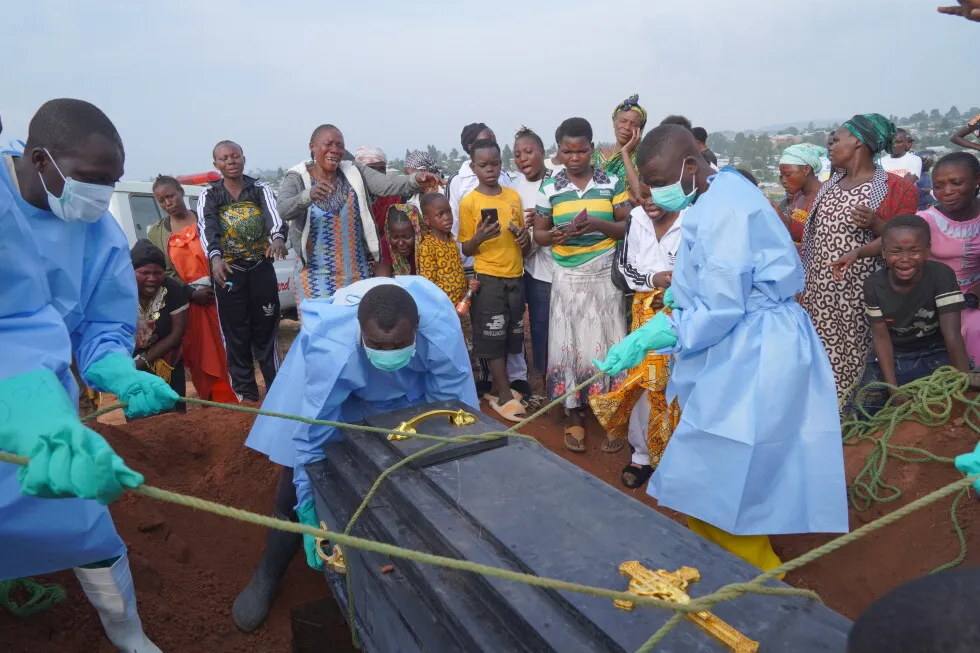
People dressed in protective gear lower into a grave the coffin containing the remains of Jeannine Katusabe, who died of Ebola, during a burial service in Bunia, Ituri province, eastern Congo, Tuesday, Aug. 11, 2026. (AP Photo/Dieudonne Dirole) Updated [hour]:[minute] [AMPM] [timezone], [monthFull] [day], [year] GENEVA (AP) — The ongoing Ebola outbreak in Congo is on track to surpass the deadliest one in history that killed over 11,000 people out of more than 28,000 cases, the head of the World Health Organization said Wednesday.“At its current pace, it’s on track to eclipse the Ebola-outbreak" class="entity-link entity-event" data-entity-id="183866" data-entity-type="event">West African Ebola outbreak of 2014 to 2016,” Tedros Adhanom Ghebreyesus told reporters. That outbreak horrified the world and jolted efforts to develop a vaccine.The outbreak in eastern Congo, considered the fastest-growing in history, has killed over 2,000 people out of more than 4,300 cases. The outbreak was declared on May 15, but health authorities now say sequencing showed it began months earlier, in February.It is unlike most previous Ebola outbreaks because the rare Bundibugyo virus responsible for it has no approved vaccines or treatments, though efforts to address that are underway. Experts say this outbreak is moving faster than efforts to track and manage it in a remote part of eastern Congo facing ongoing conflict, near the borders with South Sudan, Uganda and Rwanda.Most of the new cases and deaths are still being reported in communities outside the reach of health workers in a region of poor infrastructure and ill-equipped health centers. Some health workers have gone on strike over lack of pay. Misinformation about the virus continues to circulate in communities where some are wary of outsiders, keeping some people from clinics.“The outbreak had a big head start, still way ahead of us. and we’re playing catch-up,” Tedros said. 3 MIN READ 3 MIN READ Dr. Abdirahman Mahamud, WHO’s director for health emergency alert and response operations, said the agency expects the peak of the outbreak to be reached in six months. “But ... that’s the moderate scenario,” Mahamud added. “There is a one-case scenario where this outbreak may last nine months to 12 months.”
SRCAssociated Press (AP)
LANGEN
LEANCenter
WORDS350
ENT12
WED · 2026-08-12 · 15:23 GMTBRIEF NSR-2026-0812-101631
NSR-2026-0812-101631News Report·EN·Public Health
WHO says Congo’s Ebola outbreak is on track to eclipse the deadliest one in history
The World Health Organization (WHO) head stated that the current Ebola outbreak in eastern Congo is on track to surpass the deadliest outbreak in history, which occurred in West Africa from 2014 to 2016. This outbreak, caused by the rare Bundibugyo virus, has resulted in over 2,000 deaths out of more than 4,300 cases since its declaration on May 15, though it is believed to have started in February.
2 MIN READAssociated Press (AP)Filed 2026-08-12 · 15:23 GMTLean · CenterRead · 2 min
Associated Press (AP)FIG 01
Reading time
2min
Word count
350words
Sources cited
2cited
Entities identified
12entities
Quality score
100%
§ 01
Briefing Summary
AI-generatedNEWSAR · AI
The World Health Organization (WHO) head stated that the current Ebola outbreak in eastern Congo is on track to surpass the deadliest outbreak in history, which occurred in West Africa from 2014 to 2016. This outbreak, caused by the rare Bundibugyo virus, has resulted in over 2,000 deaths out of more than 4,300 cases since its declaration on May 15, though it is believed to have started in February. The outbreak is characterized by its rapid spread in a remote, conflict-affected region, outpacing containment efforts. Unlike previous outbreaks, there are no approved vaccines or treatments for the Bundibugyo virus, and many new cases are occurring in communities inaccessible to health workers due to poor infrastructure, ongoing conflict, and misinformation. The WHO anticipates the outbreak's peak in approximately six months, with a possibility of it lasting up to a year.
Confidence 0.90Sources 2Claims 5Entities 12
§ 02
Article analysis
Model · rule-basedFraming
Public Health
Conflict
Tone
Mixed Tone
AI-assessed
CalmNeutralAlarmist
Factuality
0.80 / 1.00
Factual
LowHigh
Sources cited
2
Limited
FewMany
§ 03
Key claims
5 extracted01
The Bundibugyo virus responsible for this outbreak has no approved vaccines or treatments.
factual
Confidence
1.00
02
The outbreak in eastern Congo has killed over 2,000 people out of more than 4,300 cases.
statistic
Confidence
1.00
03
The ongoing Ebola outbreak in Congo is on track to surpass the deadliest one in history.
predictionTedros Adhanom Ghebreyesus
Confidence
0.90
04
WHO expects the peak of the outbreak to be reached in six months, with a moderate scenario.
predictionDr. Abdirahman Mahamud
Confidence
0.70
05
There is a one-case scenario where this outbreak may last nine months to 12 months.
predictionDr. Abdirahman Mahamud
Confidence
0.60
§ 04
Full report
2 min read · 350 words§ 05
Entities
12 identifiedKey playerOppositionContextPositiveNeutralNegative
Organizations1
Locations6
§ 06
Keywords & salience
10 termsebola outbreak
1.00
world health organization
0.90
congo
0.80
deadliest outbreak
0.70
west african ebola outbreak
0.60
vaccines or treatments
0.50
bundibugyo virus
0.50
health workers
0.40
misinformation
0.40
health authorities
0.40
§ 07
Topic connections
Interactive graph Network visualization showing 51 related topics
View Full Graph Person Organization Location Event|Click node to navigate|Edge numbers = shared articles