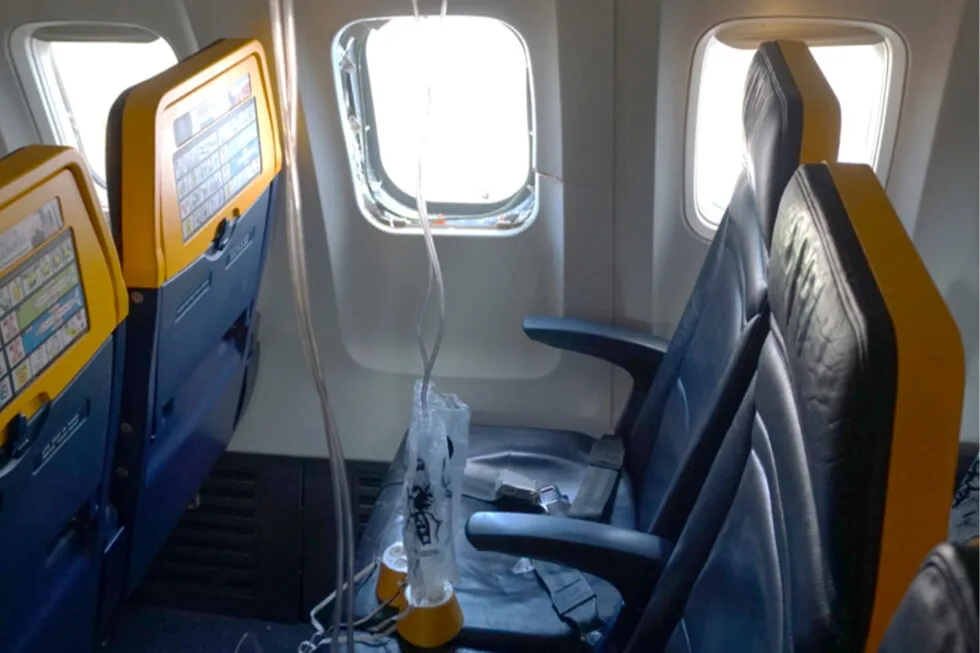
The Ryanair desk is seen, Aug. 10, 2018, at the Barajas airport in Madrid, Spain. (AP Photo/Paul White, File) By Josh Funk, Rio Yamat, AP Transportation and Airlines Writers Updated 9:17 PM MESZ, August 13, 2026 Leer en español Add AP News on Google Add AP News as your preferred source to see more of our stories on Google. Share Share Facebook Copy Link copied Print Email X LinkedIn Bluesky Flipboard Pinterest Reddit Broken engine parts shattered a window on a Ryanair plane shortly after takeoff in Greece last month, causing a man’s head to be sucked into the hole in the fuselage before his fellow passengers pulled him to safety, U.S. investigators said Thursday. The parts that flew out of the engine after a fan blade broke the window and damaged the fuselage in several other places, the National Transportation Safety Board said in its report. The incident happened shortly after the flight took off from the northern Greek city of Thessaloniki on July 10. The NTSB said it found bird remains inside the engine, suggesting the plane may have struck birds as it took off. The 61-year-old man who was nearly sucked out of the plane suffered neck and shoulder injuries and friction burns before his fellow passenger pulled him back inside the Boeing 737-800. Panicked passengers helped the man after the window broke The flight attendants told investigators that they heard and felt loud continuous vibration and saw smoke or fog inside the cabin before the oxygen masks dropped from the ceiling. One of the flight attendants then noticed some passengers standing up and calling for help because the man who was sitting in a row 11 window seat was partially lodged in a damaged window. The other passengers managed to pull him back into the cabin. US investigators lead probe into Ryanair flight where man was partly sucked out of broken window 1 MIN READ Probe cites history of overweight flights, inadequate oversight in crash that killed 10 off Alaska 3 MIN READ 31 NYC sightseeing helicopter likely hit birds before its fatal plunge into Hudson River, report shows 3 MIN READ 31 The injured passenger was moved to row 12, where a passenger who is a doctor tended to him. Other passengers got a metal box from the flight attendants, which they used to try to block the broken window until the plane could land. A series of short videos recorded from inside the plane and shared by Radio Thessaloniki showed passengers wearing oxygen masks after the cabin lost pressure. Another appeared to show the blown-out window, with a man seated nearby wearing an oxygen mask. A third video, apparently filmed after the aircraft landed, showed first responders working in the aisle. Last month, Ryanair said in a statement that the flight “returned to Thessaloniki shortly after takeoff when a passenger window dislodged in-flight.” International aviation rules allow Greece’s Hellenic Air and Rail Safety Investigation Authority to hand over investigations to the NTSB, which they did in this case, with Greece participating. The NTSB reprimanded Ryanair CEO Michael O’Leary after he told investors last month that the investigation was focused on foreign object damage and not the plane’s age or maintenance history. The NTSB said investigators hadn’t ruled anything out and O’Leary wasn’t authorized to discuss it. Maintenance records show that the fan blades on the right engine that failed had undergone ultrasonic inspections in May 2026 and November 2025 without finding damage. But the NTSB said that four suspected bird strikes to the same engine had been reported by the flight crews over the past year. Bird remains were found after two of those suspected strikes. The Associated Press sent emailed requests for comment on NTSB’s findings to Ryanair, Boeing and CFM International, the maker of the engine. There have been at least two previous incidents where parts of an engine made by CFM failed and breached the plane’s cabin. In 2018, a woman was killed on a Southwest Airlines flight after she was partially sucked out of a broken window. Another Southwest jet had suffered a similar blade-related engine breakup in 2016 over Florida. The narrow-body plane that can seat up to 189 passengers was delivered new to Ryanair in 2008, according to flight-tracking site Flightradar24. Flight records show that the aircraft climbed past 15,000 feet (4,570 meters) about six minutes after departure and then immediately descended to about 6,000 feet (1,830 meters) “to burn fuel for 30 minutes” before returning to Thessaloniki about an hour after taking off, Flightradar24 said. The flight was operated by Malta Air, a subsidiary of Ryanair, Europe’s largest budget carrier. The plane landed normally and passengers returned to the terminal. One passenger requested and received medical assistance on the ground in Thessaloniki, the airline said in a statement at the time. Josh Funk Funk covers transportation including aviation safety, trucking and airlines along with the major freight railroads. Funk also covers Warren Buffett’s Berkshire Hathaway, drones, the effort to break China’s stranglehold on rare earth elements and agriculture. twitter mailto Rio Yamat Yamat is a national business reporter for The Associated Press. Based in Las Vegas, she covers airlines, travel and tourism. twitter mailto
SRCAssociated Press (AP)
LANGEN
LEANCenter
WORDS867
ENT10
THU · 2026-08-13 · 18:53 GMTBRIEF NSR-2026-0813-102064
NSR-2026-0813-102064News Report·EN·Human Interest
Broken engine part shattered the Ryanair flight window that a passenger’s head got sucked into: NTSB
A broken engine fan blade on a Ryanair flight in Greece last month sent parts flying that shattered a window, causing a passenger's head to be partially sucked out of the fuselage before other passengers pulled him to safety. U.S.
Associated Press (AP)Filed 2026-08-13 · 18:53 GMTLean · CenterRead · 4 min
Associated Press (AP)FIG 01
Reading time
4min
Word count
867words
Sources cited
2cited
Entities identified
10entities
Quality score
100%
§ 01
Briefing Summary
AI-generatedNEWSAR · AI
A broken engine fan blade on a Ryanair flight in Greece last month sent parts flying that shattered a window, causing a passenger's head to be partially sucked out of the fuselage before other passengers pulled him to safety. U.S. investigators from the National Transportation Safety Board (NTSB) found bird remains in the engine, suggesting a bird strike may have caused the incident shortly after takeoff from Thessaloniki on July 10. The 61-year-old passenger sustained injuries, and other passengers used a metal box to temporarily block the broken window until the plane could land. The NTSB is leading the investigation, with Greece participating, and noted that the engine's fan blades had been inspected previously without damage, despite multiple reported suspected bird strikes. Ryanair's CEO was reprimanded by the NTSB for commenting on the investigation prematurely.
Confidence 0.90Sources 2Claims 5Entities 10
§ 02
Article analysis
Model · rule-basedFraming
Human Interest
Technology
Tone
Mixed Tone
AI-assessed
CalmNeutralAlarmist
Factuality
0.90 / 1.00
Factual
LowHigh
Sources cited
2
Limited
FewMany
§ 03
Key claims
5 extracted01
Flight attendants reported hearing and feeling loud continuous vibration and seeing smoke or fog inside the cabin before oxygen masks dropped.
factualflight attendants
Confidence
1.00
02
A 61-year-old man suffered neck and shoulder injuries and friction burns after the incident.
factualarticle
Confidence
1.00
03
The National Transportation Safety Board (NTSB) stated that broken engine parts flew out of the engine after a fan blade broke the window and damaged the fuselage.
factualNational Transportation Safety Board
Confidence
1.00
04
Broken engine parts shattered a window on a Ryanair plane shortly after takeoff in Greece, causing a man's head to be sucked into the hole.
factualU.S. investigators
Confidence
1.00
05
The NTSB found bird remains inside the engine, suggesting the plane may have struck birds as it took off.
factualNational Transportation Safety Board
Confidence
0.90
§ 04
Full report
4 min read · 867 words§ 05
Entities
10 identifiedKey playerOppositionContextPositiveNeutralNegative
Organizations3
§ 06
Keywords & salience
9 termsengine failure
1.00
cabin depressurization
0.90
bird strike
0.80
ryanair flight
0.70
window damage
0.70
ntsb investigation
0.60
passenger injuries
0.50
boeing 737-800
0.50
fan blade failure
0.40
§ 07
Topic connections
Interactive graph Network visualization showing 16 related topics
View Full Graph Person Organization Location Event|Click node to navigate|Edge numbers = shared articles