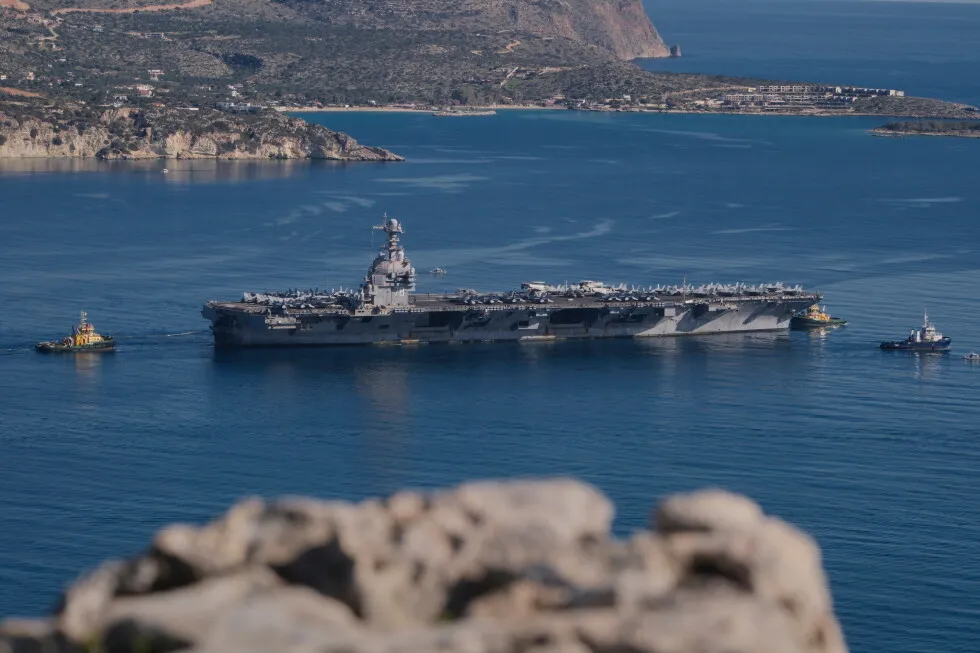
US pulls last aircraft carrier in Asia as Trump focuses on Iran and the Western Hemisphere 1 of 3 | The USS Gerald R. Ford departs from Souda Naval Base near Chania on the island of Crete, Greece, Feb. 26, 2026. (AP Photo/Giannis Angelakis, File) 2 of 3 | The USS Gerald R. Ford aircraft carrier is docked at Souda Naval Base near Chania on the island of Crete, Monday, March 23, 2026. (AP Photo/Giannis Angelakis). 3 of 3 | Sailors and Marines line the deck of aircraft carrier USS Abraham Lincoln (CVN-72) as it deploys from San Diego, Jan. 3, 2021. (K.C. Alfred/The San Diego Union-Tribune via AP, File) 1 of 3 | The USS Gerald R. Ford departs from Souda Naval Base near Chania on the island of Crete, Greece, Feb. 26, 2026. (AP Photo/Giannis Angelakis, File) 1 of 3 The USS Gerald R. Ford departs from Souda Naval Base near Chania on the island of Crete, Greece, Feb. 26, 2026. (AP Photo/Giannis Angelakis, File) Add AP News on Google Add AP News as your preferred source to see more of our stories on Google. Share 2 of 3 | The USS Gerald R. Ford aircraft carrier is docked at Souda Naval Base near Chania on the island of Crete, Monday, March 23, 2026. (AP Photo/Giannis Angelakis). 2 of 3 The USS Gerald R. Ford aircraft carrier is docked at Souda Naval Base near Chania on the island of Crete, Monday, March 23, 2026. (AP Photo/Giannis Angelakis). Add AP News on Google Add AP News as your preferred source to see more of our stories on Google. Share 3 of 3 | Sailors and Marines line the deck of aircraft carrier USS Abraham Lincoln (CVN-72) as it deploys from San Diego, Jan. 3, 2021. (K.C. Alfred/The San Diego Union-Tribune via AP, File) 3 of 3 Sailors and Marines line the deck of aircraft carrier USS Abraham Lincoln (CVN-72) as it deploys from San Diego, Jan. 3, 2021. (K.C. Alfred/The San Diego Union-Tribune via AP, File) Add AP News on Google Add AP News as your preferred source to see more of our stories on Google. Share Updated [hour]:[minute] [AMPM] [timezone], [monthFull] [day], [year] WASHINGTON (AP) — President Donald Trump’s war against Iran is stretching the limits of U.S. aircraft carriers and leaving the western Pacific without one of the key American warships as China shows more signs of aggression. The USS George Washington is departing the Pacific and expected to replace the USS Abraham Lincoln in the Middle East amid growing concerns about mental health and supply issues aboard the long-deployed carrier. The Lincoln has had its time at sea extended from its original May return date to support operations against Iran. The lack of a U.S. carrier in the Pacific may be short-lived if the Navy deploys another in the next couple of months. But it shows how the open-ended operations with Iran are running some American sailors ragged, analysts say, while the Trump administration further retreats from the Asia-Pacific region and focuses on the Western Hemisphere.“The administration says that the Pacific is supposed to be the most important behind the Western Hemisphere,” said Greg Poling, director of the Southeast Asia Program at the Center for Strategic and International Studies. Instead, the U.S. is “doing the exact opposite” of its previously expressed goal of pulling out of the Middle East.American allies in the Pacific are unsettled over the unpredictability of the Republican administration, Poling said, while Beijing “is quite happy with U.S. distraction, with the frustration of U.S. allies and partners.” China may take advantage of US carrier’s absenceBeijing sees the U.S. military presence in the region as a threat to China’s rise and an obstacle to its ambition to seize Taiwan, the self-governing island it claims as its own. But the United States has argued that the Pacific region is too important economically to lose.No one expects China to invade Taiwan because an American aircraft carrier has left the region. But the carrier’s absence gives the Chinese another opportunity to show its strength, said Bryan Clark, a former Navy submariner who is a defense analyst at the Hudson Institute. 6 MIN READ 6 MIN READ 5 MIN READ “They’re using this as part of the narrative to demonstrate to the Philippines, to Japan, to Indonesia and others that the U.S. is not the big dog in the western Pacific anymore,” Clark said. “They would just prefer that countries in the region decide that China is the bigger power and the U.S. is not able to guarantee their security anymore.” China conducted naval exercises this week with Indonesia and recently has shown signs of aggression toward Japan and the Philippines, two key U.S. allies that also have territorial disputes with Beijing. China carried out military drills this month near the Scarborough Shoal in the South China Sea. Both China and the Philippines have claims over the shoal. Last month, a Chinese guided-missile destroyer conducted a live-fire exercise off Japan’s southernmost island of Okinotori. Adm. Frank Bradley, head of the U.S. Special Operations Command, has been trying to reassure regional allies of Washington’s commitment. He was in Manila on Thursday, telling his Filipino counterparts that U.S. special operations forces are ready to step up joint exercises to strengthen the countries’ alliance. He also is expected to travel to Japan.Evan Sankey, a policy analyst at the Cato Institute who focuses on U.S. policy toward China, said aircraft carriers provide psychological assurance to U.S. allies. The absence of carriers in the region, he said, “adds to the general sense that the U.S. is distracted by events in the Middle East.” Trump has relied on aircraft carriers for military actionsTrump has relied heavily on aircraft carriers to support military operations during his second term. For example, the USS Gerald R. Ford returned home in mid-May after an 11-month deployment, the longest since the Vietnam War, during which it supported the U.S. fight against Iran and the capture of Venezuela’s then-leader, Nicolás Maduro.The Ford had experienced a fire in a laundry space that forced the carrier to turn around and return to the Mediterranean Sea for repairs and left hundreds of sailors without places to sleep. Meanwhile, the Lincoln has spent a record uninterrupted time at sea of more than 240 days. Democratic lawmakers have been calling for investigations and greater visibility into conditions aboard the ship.Warships and their crews can only handle so much, said Robert Farley, who teaches national security and diplomacy at the University of Kentucky and often writes about aircraft carriers. “People don’t get enough rest. It’s psychologically exhausting. And R&R is part of keeping the crew healthy,” Farley said. “Sometimes it’s framed as, ‘These people haven’t had a vacation.’ But we are dealing with well-known limits on the capacity of a crew to operate at top efficiency over time. And that just declines.”Clark, of the Hudson Institute, said the squeeze on the nation’s aircraft carriers stems from the lack of preparation and planning for the Iran war. “If we were going to mobilize to do this kind of conflict, and we anticipated it might go this long, we might have done some changes to the carrier schedule to make sure more would be available,” Clark said. Clark said the Navy has 11 aircraft carriers and typically deploys two or three at a time. But it could soon deploy four if the USS Theodore Roosevelt leaves San Diego for the Middle East, allowing the Washington to return to Pacific. But the massive warships will need maintenance, likely causing a bottleneck at the nation’s only two carrier shipyards. “We’ll end up with a maintenance debt that needs to be paid for the next few years,” Clark said. “We’ll probably have less carrier presence than we’ve had in the previous years because carriers will be lined up to get into the shipyard.” There are questions about the use of aircraft carriers in modern warfareMichael Swaine, a senior research fellow in the Quincy Institute’s East Asia Program, questions the future need for aircraft carriers as warfare rapidly changes.Carriers can be more easily targeted with drones and missiles, particularly by an adversary such as China, Swaine said, while smaller ships and submarines can be as effective in striking targets as the fighter jets that launch off a carrier. Top Navy officials have indicated a desire to move away from a heavy reliance on carriers. Adm. Daryl Caudle, chief of naval operations, told The Associated Press in February that he wants to convince commanders to use smaller, newer ships and other assets instead of consistently turning to huge aircraft carriers. Tang joined the AP Washington bureau in 2023 after spending 11 years in Beijing as a China correspondent. She covers anything related to the Indo-Pacific region with a focus on U.S.-China competitions
SRCAssociated Press (AP)
LANGEN
LEANCenter
WORDS1 469
ENT12
SAT · 2026-08-15 · 12:53 GMTBRIEF NSR-2026-0815-102595
NSR-2026-0815-102595News Report·EN·Political Strategy
US pulls last aircraft carrier in Asia as Trump focuses on Iran and the Western Hemisphere
The U.S. has withdrawn its last aircraft carrier from the western Pacific, a move analysts attribute to President Trump's focus on Iran and the Western Hemisphere.
By
BEN FINLEY and DIDI TANGAssociated Press (AP)Filed 2026-08-15 · 12:53 GMTLean · CenterRead · 6 min
Associated Press (AP)FIG 01
Reading time
6min
Word count
1 469words
Sources cited
1cited
Entities identified
12entities
Quality score
100%
§ 01
Briefing Summary
AI-generatedNEWSAR · AI
The U.S. has withdrawn its last aircraft carrier from the western Pacific, a move analysts attribute to President Trump's focus on Iran and the Western Hemisphere. The USS George Washington is redeploying to the Middle East to replace the USS Abraham Lincoln, whose deployment was extended to support operations against Iran. This absence of a U.S. carrier in the Pacific occurs as China exhibits increased aggression and may exploit the situation to assert its regional dominance. Allies in the Pacific are reportedly unsettled by the U.S. administration's unpredictability, while China views the U.S. military presence as an obstacle to its ambitions. The strain on U.S. aircraft carriers is also highlighted by extended deployments and concerns over sailor well-being.
Confidence 0.90Sources 1Claims 5Entities 12
§ 02
Article analysis
Model · rule-basedFraming
Political Strategy
Conflict
Tone
Mixed Tone
AI-assessed
CalmNeutralAlarmist
Factuality
0.60 / 1.00
Mixed
LowHigh
Sources cited
1
Limited
FewMany
§ 03
Key claims
5 extracted01
The Lincoln has had its time at sea extended from its original May return date to support operations against Iran.
factual
Confidence
0.90
02
US pulls last aircraft carrier in Asia as Trump focuses on Iran and the Western Hemisphere.
factual
Confidence
0.90
03
The Trump administration further retreats from the Asia-Pacific region and focuses on the Western Hemisphere.
factual
Confidence
0.80
04
The USS George Washington is departing the Pacific and expected to replace the USS Abraham Lincoln in the Middle East.
factual
Confidence
0.80
05
The open-ended operations with Iran are running some American sailors ragged, analysts say.
quoteanalysts
Confidence
0.70
§ 04
Full report
6 min read · 1 469 words§ 05
Entities
12 identifiedKey playerOppositionContextPositiveNeutralNegative
Organizations3
§ 06
Keywords & salience
8 termsaircraft carrier
1.00
us military
0.90
iran
0.80
western hemisphere
0.70
asia
0.60
china
0.50
uss abraham lincoln
0.40
uss george washington
0.40
§ 07
Topic connections
Interactive graph Network visualization showing 51 related topics
View Full Graph Person Organization Location Event|Click node to navigate|Edge numbers = shared articles