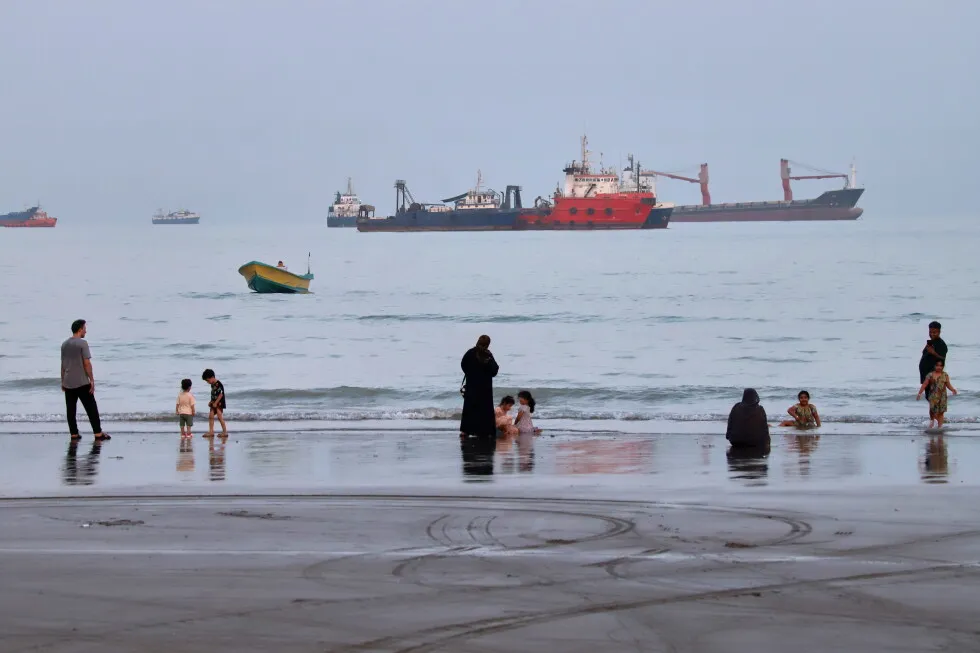
The 60-day deadline for an Iran peace deal is expiring. Here’s where things stand 1 of 5 | People spend time at a beach as commercial vessels are anchored in the Strait of Hormuz off Bandar Abbas, Iran, Wednesday, Aug. 5, 2026. (Amirhosein Khorgooi/ISNA via AP) 2 of 5 | President Donald Trump gestures as he walks to board Marine One on the Ellipse, Friday, Aug. 14, 2026, near the White House in Washington. (AP Photo/Mark Schiefelbein) 3 of 5 | A woman holds up a poster of Iranian Supreme Leader Ayatollah Mojtaba Khamenei and waves a flag during a pro-government gathering at a square in Tehran, Iran, Tuesday, Aug. 11, 2026. (AP Photo/Vahid Salemi) 4 of 5 | Sailors and Marines line the deck of aircraft carrier USS Abraham Lincoln (CVN-72) as it deploys from San Diego, Jan. 3, 2021. (K.C. Alfred/The San Diego Union-Tribune via AP, File) 5 of 5 | In this photo released by the Iranian Presidency Office, Iranian President Masoud Pezeshkian, right, greets Pakistan’s Interior Minister Mohsin Naqvi at the start of their meeting in Tehran, Iran, Tuesday, Aug. 11, 2026. (Iranian Presidency Office via AP) By JOSEPH KRAUSS Updated 10:33 AM MESZ, August 17, 2026 Leer en español Add AP News on Google Add AP News as your preferred source to see more of our stories on Google. Share Share Facebook Copy Link copied Print Email X LinkedIn Bluesky Flipboard Pinterest Reddit The deal that U.S. President Donald Trump signed at Versailles in June set an ambitious 60-day deadline for ending the war with Iran and reaching an accord on its nuclear program. The deadline was Monday, and the two sides are further apart than they were then. Talks, such as they are, have focused on reopening the Strait of Hormuz and lifting a U.S. blockade on Iran, both of which were supposed to have happened under the interim deal. There has been no sign of any compromise on the strait, or that detailed nuclear talks have even begun. The U.S., meanwhile, has no good options for getting out of the war it started alongside Israel. Acceding to Iran’s latest demands would mean giving it control over a critical international waterway that carried a fifth of the world’s traded oil and gas before the war — and would be tantamount to admitting defeat. Escalating the deeply unpopular war would further draw down U.S. supplies of advanced missile interceptors, jolt the world economy, and drive up gas prices ahead of U.S. congressional elections. So both sides have dug in, hoping the other will blink first. So far, neither has. The June deal, known as the Memorandum of Understanding, called for a halt to all military operations and set a 60-day deadline for an agreement to permanently end the war and resolve the longstanding dispute over Iran’s nuclear activities. It called for the Strait of Hormuz to be reopened but gave Iran a vaguely defined role in facilitating traffic, leaving open the possibility it could charge fees after the 60-day deadline. Iran has seized on that clause to claim control over the waterway. Airstrikes have paused and talks are pressing forward. But can the US and Iran take the off-ramp? 2 MIN READ Iran and the US say a Strait of Hormuz deal is close, but one or both would have to back down 5 MIN READ Bridges and infrastructure hit as US struck deeper inside Iran 5 MIN READ A week after the deal was signed, Iran began firing on vessels using a route along the coast of Oman, on the other side of the strait, that is overseen by the U.S. military and intended to bypass Tehran’s control. The U.S. responded by striking Iran, which retaliated by attacking Arab countries hosting American forces, like Jordan, Kuwait and Bahrain. The U.S. canceled waivers issued as part of the deal that had allowed Iran to sell its oil internationally and Trump restored a blockade of Iran’s ports. Each side accused the other of violating the June agreement, of which almost nothing remains. The fighting eventually died down. A related truce in Lebanon between Israel and the Iran-backed Hezbollah has mostly held, even as Israeli troops occupy large areas in the country’s south. Lebanon’s “territorial integrity and sovereignty” were to have been ensured under the June deal. Iranian officials say they stopped negotiating with the U.S. in June, while acknowledging that messages have been relayed by intermediaries. Trump says the talks have continued, occasionally claiming progress after pulling back from threatening major strikes. Pakistan, which played a key role in brokering the June agreement, noted last week that the deadline was Monday while expressing hope it would be extended. “We are not closing the chapter,” Foreign Ministry spokesman Tahir Andrabi said. “Pakistan is making all-out efforts to bring the two parties to the negotiating table.” Iran’s leaders think they can force Trump to give up the strait Earlier this month, Iran issued a list of demands for reopening the strait, including the lifting of the American blockade, the withdrawal of U.S. forces from around Iran and the payment of reparations for damage inflicted in the war started by the U.S. and Israel on Feb. 28. Even then, Iran has said it would control the strait — and potentially charge fees — through an agreement it is negotiating with Oman, and that the strait will not go back to being an open, toll-free waterway as it was before the war. Iran-backed Houthi rebels in Yemen have meanwhile begun attacking Saudi oil tankers in the Red Sea, threatening another crucial trade route that had been used to relieve some of the pressure from the strait being closed. Trump has rejected Iran’s demands — saying it’s Tehran that should pay war reparations and claiming the U.S. controls the strait. He appears to be banking on economic pressure — in the form of the blockade and longstanding sanctions — to bring Iran’s rulers to their knees. Iran’s economy has been battered by the war and isolation, and inflation has soared. The crisis could stoke renewed anti-government protests, like those that were brutally crushed in January. Traffic through the Strait of Hormuz, which rose immediately after the interim deal, is back to a small fraction of what it was before the war. Rising prices of fuel and other goods are expected to climb further the longer this continues with effects far beyond the Middle East. Associated Press writer Munir Ahmed in Islamabad contributed.
SRCAssociated Press (AP)
LANGEN
LEANCenter
WORDS1 081
ENT12
MON · 2026-08-17 · 08:53 GMTBRIEF NSR-2026-0817-103031
NSR-2026-0817-103031News Report·EN·Conflict
The 60-day deadline for an Iran peace deal is expiring. Here’s where things stand
A 60-day deadline for a peace deal between the U.S. and Iran, aimed at ending their war and resolving Iran's nuclear program, has expired with the two sides further apart than before.
Associated Press (AP)Filed 2026-08-17 · 08:53 GMTLean · CenterRead · 5 min
Associated Press (AP)FIG 01
Reading time
5min
Word count
1 081words
Sources cited
0cited
Entities identified
12entities
Quality score
100%
§ 01
Briefing Summary
AI-generatedNEWSAR · AI
A 60-day deadline for a peace deal between the U.S. and Iran, aimed at ending their war and resolving Iran's nuclear program, has expired with the two sides further apart than before. The interim deal, signed in June, called for reopening the Strait of Hormuz and lifting a U.S. blockade on Iran, but neither has occurred. Iran has claimed control over the Strait of Hormuz, leading to retaliatory actions and a breakdown of the agreement. The U.S. faces difficult choices, as acceding to Iran's demands would mean conceding control of a vital waterway, while escalating the war has significant economic and political risks. Both nations remain entrenched in their positions, with Pakistan attempting to facilitate renewed negotiations.
Confidence 0.90Claims 5Entities 12
§ 02
Article analysis
Model · rule-basedFraming
Conflict
Diplomatic
Tone
Measured
AI-assessed
CalmNeutralAlarmist
Factuality
0.70 / 1.00
Factual
LowHigh
Sources cited
0
No named sources
FewMany
§ 03
Key claims
5 extracted01
Talks have focused on reopening the Strait of Hormuz and lifting a U.S. blockade on Iran.
factual
Confidence
0.90
02
The 60-day deadline for an Iran peace deal, signed at Versailles, is expiring.
factual
Confidence
0.90
03
Acceding to Iran's demands would mean giving it control over a critical international waterway.
factual
Confidence
0.80
04
The U.S. and Iran are further apart on a peace deal than they were when the deadline was set.
factual
Confidence
0.80
05
Escalating the war would further draw down U.S. missile interceptors and jolt the world economy.
factual
Confidence
0.70
§ 04
Full report
5 min read · 1 081 words§ 05
Entities
12 identifiedKey playerOppositionContextPositiveNeutralNegative
People4
Organizations1
§ 06
Keywords & salience
8 termsiran peace deal
1.00
nuclear program
0.90
strait of hormuz
0.80
us blockade
0.70
international waterway
0.60
oil and gas
0.50
missile interceptors
0.40
congressional elections
0.40
§ 07
Topic connections
Interactive graph Network visualization showing 51 related topics
View Full Graph Person Organization Location Event|Click node to navigate|Edge numbers = shared articles