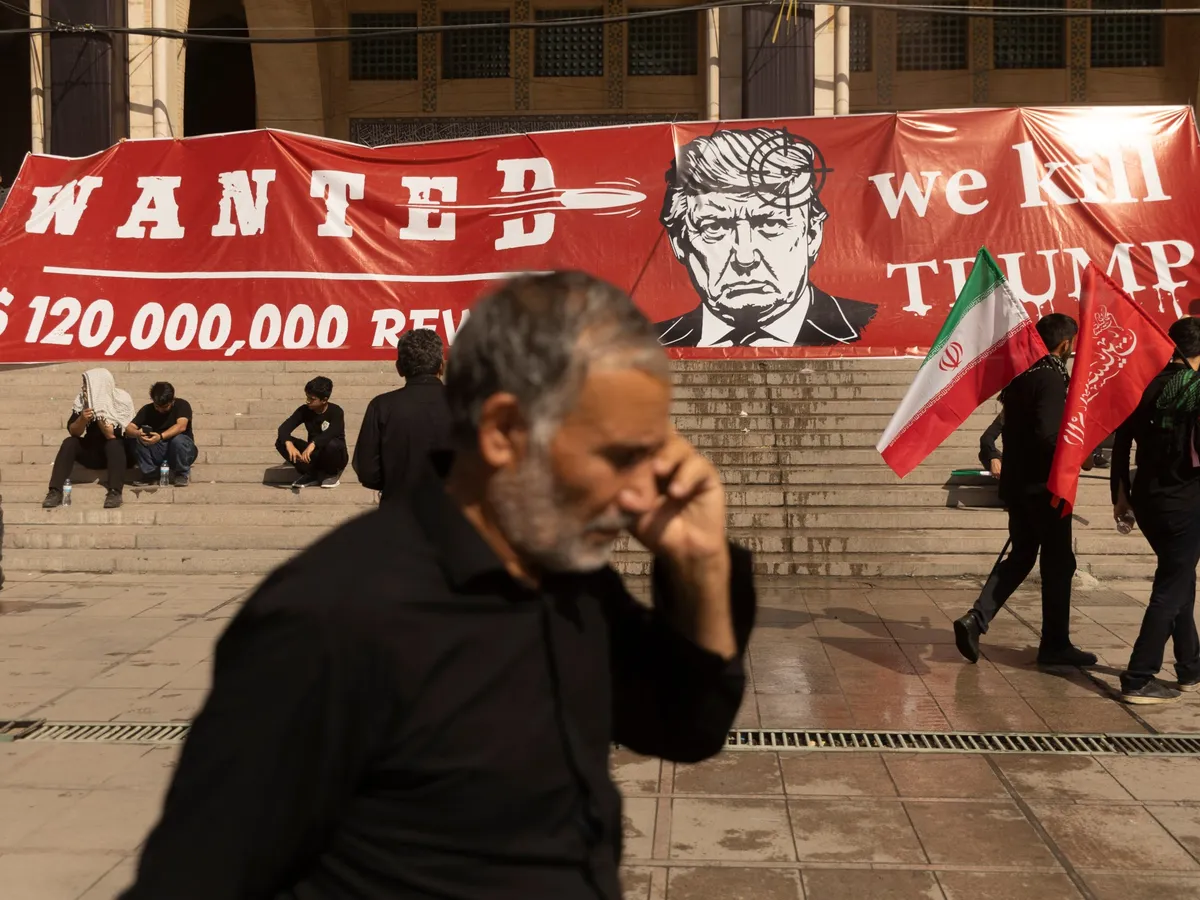
Iran’s more offensive posture comes after Trump commented that the US would soon make the Strait of Hormuz its territory.A banner in Tehran depicting Donald Trump with a target on his head, during funeral ceremonies for Supreme Leader Ayatollah Ali Khamenei, July 5, 2026 [Majid Saeedi/Getty Images]Published On 17 Aug 2026Tehran, Iran – Iranian authorities have signalled they could shift to a more offensive approach to the war with the United States as a Memorandum of Understanding (MoU) with Washington expires.Brigadier General Yadollah Javani, head of the political bureau of the Islamic Revolutionary Guard Corps (IRGC), told state television on Sunday night that his forces were ready to take whatever action is needed to defend the country.Recommended Stories list of 4 itemslist 1 of 4A US territory? Trump unveils proposal to control Strait of Hormuzlist 2 of 4Did the US really destroy Iran’s ballistic missile capability?list 3 of 4Iran says no decision yet on a return to talks with the USlist 4 of 4US aircraft carrier expected to relieve USS Lincoln in Middle Eastend of listTensions between Iran and the US over control of the Strait of Hormuz have continued to rise despite a ceasefire being agreed between them in June. While the MoU effectively collapsed after fighting restarted last month, the agreement officially expires on Monday.“The enemy started the war and our efforts have been defensive, although they might take on an offensive aspect,” said Javani.He did not elaborate on what exactly the offensive measures could entail, but said opponents should expect “strategic surprises”.IRGC spokesman Hossein Mohebbi last week identified US and regional allies’ infrastructure – such as energy networks, power plants and internet-connected systems – as potential targets, if the US hits Iran’s civilian infrastructure.Hardline Iranian politicians and media outlets have discussed the idea of mounting a ground incursion against US interests in Bahrain and Kuwait if Washington invades Iran.Analysts have raised questions over the feasibility of that and the risks involved, while there is no recent indication that the US is planning ground operations in Iran.The Iranian emphasis on offensive deterrence against the US comes after Supreme Leader Mojtaba Khamenei, viewed as a hardliner, consolidated his power by appointing several IRGC old guard and confidants to key military and security positions last week.Khamenei said Major General Ahmad Vahidi’s rise to commander-in-chief of the IRGC must represent a mix of “maximum deterrence” with readiness for “powerful offensive operations against the enemy”.Vahidi said Khamenei’s leadership and the Iranian armed forces had managed to “bring to its knees the most heavily-armed army in world history” after the US and Israel launched strikes in Iran on February 28, starting fierce fighting between the two sides.US President Donald Trump reiterated on Friday his claim that Iran was defeated in the war while facing a naval blockade acting as a “wall of steel”. He also said the Strait of Hormuz would “pretty soon” be declared US territory.The White House later suggested that comment was a joke, but Iran’s army chief, Amir Hatami, reacted by setting a $30,000 reward for any man who kills or captures a US soldier, if they are involved in any ground operation on Iranian soil. Women would be given twice the reward if they managed such a feat, he added.“Our hands are open in terms of reaching the aggressors and they will become more open through our initiatives,” Hatami said, referencing recent Iranian attacks on US forces in Jordan.Mohsen Rezaee, who has the powerful position of secretary of the Supreme National Security Council, suggested that the Trump administration might have been considering ground operations on Iranian territory, but held off as a result of “half-baked plans”.Rezaee said that the US Central Command had refrained from hitting Tehran or northern Iran during the two-week flareup in fighting in July, instead attacking about 50 cities in 15 provinces.He believed that the purpose of the air raids was to prepare for a ground assault to take control of the Strait of Hormuz and potentially reach nuclear facilities in Isfahan, where highly-enriched uranium is suspected of being buried under the rubble of US strikes.Mohsen Rezaee, adviser to Iran’s supreme leader, July 3, 2026 [Reuters]Bridges, roads, maritime control towers, radar and other coastal installations, and military facilities were struck to cut off logistical supplies to southern Iran, Rezaee noted.“They had not calculated that to land troops for the Strait of Hormuz, it’s not doable with 40,000-50,000 soldiers, you must bring at least 100,000 people,” he said. “You must cross the Zagros Mountains and be able to pass the Fars province.”Iranian media and commanders have reported in recent weeks that scenarios are in place to defend individual islands and coastal areas in southern Iran that the US military might consider seizing. They include the critical oil export terminals on Kharg Island.Iranian territories around the Strait of Hormuz have been reinforced with rapid-response units.Army spokesman Mohammad-Reza Akraminia said last week that the aim will be to prevent any foreign troops landing on Iranian territory.“If the Americans enter one of our islands, we will certainly target them on our own islands, let alone on other countries’ soil,” he told state TV.Authorities have also signalled they are ready for any unrest provoked by separatist groups near Iran’s western borders with Iraq and Turkiye, or in the east with Pakistan and Afghanistan.The IRGC has reportedly bolstered defences and continued to launch missile and drone strikes against armed groups based in Iraqi Kurdistan.A U.S. sailor launches an F-35C Lightning II, assigned to Marine Fighter Attack Squadron 314, from the flight deck of Nimitz-class aircraft carrier USS Abraham Lincoln during the ongoing conflict with Iran [U.S. Navy/Handout via Reuters]Iran shrugs off expired MoUJavani, the political chief of the IRGC, said in a separate interview on Monday that the Strait of Hormuz will only fully reopen when Washington implements commitments agreed under the MoU signed in June.Iran’s Ministry of Foreign Affairs said that a two-month window to halt fighting was not specifically mentioned in the MoU text. The ministry also dismissed that the expiration had any particular significance to the war with the US, or Tehran’s ongoing talks with Oman regarding Hormuz.“It has been proven many times that the Islamic Republic of Iran is not a party to devise its policies under pressure, ultimatums and deadlines. We decide based on our evaluations of what guarantees national interests and security,” Baghaei told reporters during a briefing on Monday.He said the talks with Oman have so far been delayed in producing an arrangement on the partial reopening of Hormuz due to legal and technical complexities, the multiple actors involved and “ill-wishing parties” seeking to spoil the process.Parliament speaker and chief negotiator, Mohammad Bagher Ghalibaf said during a speech on Sunday night that the MoU was a “document of pride and victory in the field of diplomacy”.Ghalibaf insisted that the Islamic Republic had emerged “victorious”, both politically and militarily, from the war with the US and Israel.“I don’t mean that we destroyed their armies, I mean that they attacked us while clearly and repeatedly citing nine objectives, but did not achieve any of these goals at any level. That was the biggest abject failure for the US and the Zionist regime,” he said.Ghalibaf has not yet managed to convince the Iranian leadership to agree on a long-term diplomatic resolution with the US to end the war.
SRCAl Jazeera
LANGEN
LEANCenter
WORDS1 221
ENT12
MON · 2026-08-17 · 14:15 GMTBRIEF NSR-2026-0817-103103
NSR-2026-0817-103103News Report·EN·Conflict
Iran signals readiness for ‘US ground operations’ as MoU expires
Iran's Islamic Revolutionary Guard Corps (IRGC) has signaled a potential shift to a more offensive posture against the United States as a Memorandum of Understanding (MoU) expires. This comes after US President Trump's statement that the Strait of Hormuz would soon become US territory.
Maziar MotamediAl JazeeraFiled 2026-08-17 · 14:15 GMTLean · CenterRead · 5 min
Al JazeeraFIG 01
Reading time
5min
Word count
1 221words
Sources cited
5cited
Entities identified
12entities
Quality score
100%
§ 01
Briefing Summary
AI-generatedNEWSAR · AI
Iran's Islamic Revolutionary Guard Corps (IRGC) has signaled a potential shift to a more offensive posture against the United States as a Memorandum of Understanding (MoU) expires. This comes after US President Trump's statement that the Strait of Hormuz would soon become US territory. IRGC officials stated their forces are ready for defensive and potentially offensive actions, warning of "strategic surprises." Iranian media and politicians have discussed potential ground incursions against US interests in Bahrain and Kuwait if the US invades Iran, though analysts question the feasibility. This hardening stance follows Supreme Leader Mojtaba Khamenei consolidating power and appointing hardliners to key positions. Iran's army chief also announced a reward for capturing or killing US soldiers involved in ground operations on Iranian soil.
Confidence 0.90Sources 5Claims 5Entities 12
§ 02
Article analysis
Model · rule-basedFraming
Conflict
Political Strategy
Tone
Mixed Tone
AI-assessed
CalmNeutralAlarmist
Factuality
0.60 / 1.00
Mixed
LowHigh
Sources cited
5
Well sourced
FewMany
§ 03
Key claims
5 extracted01
Brigadier General Yadollah Javani stated that Iranian forces are ready to take whatever action is needed to defend the country and that opponents should expect 'strategic surprises'.
quoteBrigadier General Yadollah Javani
Confidence
1.00
02
Supreme Leader Mojtaba Khamenei appointed several IRGC old guard and confidants to key military and security positions, emphasizing readiness for 'powerful offensive operations against the enemy'.
factualSupreme Leader Mojtaba Khamenei
Confidence
0.90
03
IRGC spokesman Hossein Mohebbi identified US and regional allies’ infrastructure as potential targets if the US hits Iran’s civilian infrastructure.
factualHossein Mohebbi
Confidence
0.90
04
Iran signals readiness for a more offensive approach to the war with the United States as a Memorandum of Understanding (MoU) with Washington expires.
factualIranian authorities
Confidence
0.90
05
Hardline Iranian politicians and media outlets have discussed mounting a ground incursion against US interests in Bahrain and Kuwait if Washington invades Iran.
factualHardline Iranian politicians and media outlets
Confidence
0.80
§ 04
Full report
5 min read · 1 221 words§ 05
Entities
12 identifiedKey playerOppositionContextPositiveNeutralNegative
People6
§ 06
Keywords & salience
8 termsiran us relations
1.00
strait of hormuz
0.90
offensive posture
0.80
islamic revolutionary guard corps
0.70
memorandum of understanding
0.60
us ground operations
0.50
strategic surprises
0.40
iran's civilian infrastructure
0.40
§ 07
Topic connections
Interactive graph Network visualization showing 51 related topics
View Full Graph Person Organization Location Event|Click node to navigate|Edge numbers = shared articles