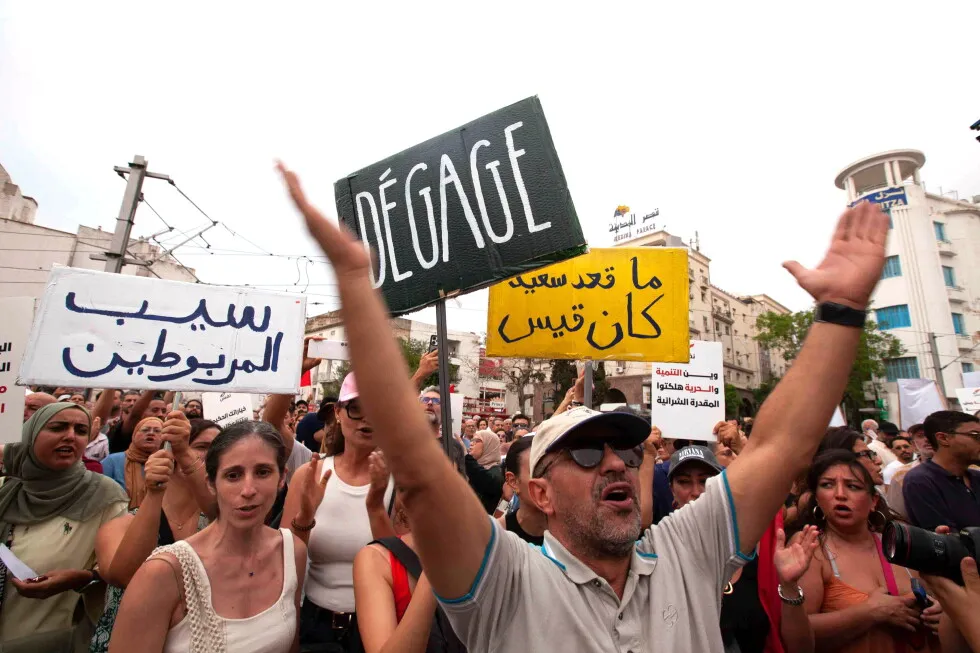
New opposition group plans protest in Tunisia after extreme heat-driven power and water cuts 1 of 2 | Protesters hold signs with messages that read: “Free the prisoners, No one is happy except President Saied and Where is development? Where is freedom? You have destroyed our purchasing power”, during a demonstration against President Kais Saied in downtown Tunis, Tunisia, Saturday, July 25, 2026. (AP Photo/Ons Abid) 2 of 2 | People take part in a demonstration against President Kais Saied in downtown Tunis, Tunisia, Saturday, July 25, 2026. (AP Photo/Ons Abid) 1 of 2 | Protesters hold signs with messages that read: “Free the prisoners, No one is happy except President Saied and Where is development? Where is freedom? You have destroyed our purchasing power”, during a demonstration against President Kais Saied in downtown Tunis, Tunisia, Saturday, July 25, 2026. (AP Photo/Ons Abid) 1 of 2 Protesters hold signs with messages that read: “Free the prisoners, No one is happy except President Saied and Where is development? Where is freedom? You have destroyed our purchasing power”, during a demonstration against President Kais Saied in downtown Tunis, Tunisia, Saturday, July 25, 2026. (AP Photo/Ons Abid) Add AP News on Google Add AP News as your preferred source to see more of our stories on Google. Share 2 of 2 | People take part in a demonstration against President Kais Saied in downtown Tunis, Tunisia, Saturday, July 25, 2026. (AP Photo/Ons Abid) 2 of 2 People take part in a demonstration against President Kais Saied in downtown Tunis, Tunisia, Saturday, July 25, 2026. (AP Photo/Ons Abid) Add AP News on Google Add AP News as your preferred source to see more of our stories on Google. Share Tunis, Tunisia (AP) — A summer of extreme heat has left many Tunisians short of water and electricity — and full of anger at the country’s leadership. A protest is expected in the capital Tunis on Thursday by a new opposition collective tapping into the growing frustration.The protest has been called by the Nafas movement, which seeks to bring together political parties and independent figures beyond the North African country’s traditional opposition to President Kais Saied.The umbrella initiative, launched in May, has been calling for an end to what it describes as government failure and injustice in the country that was the birthplace of the Arab Spring pro-democracy uprisings. Among grievances are repeated cuts to Tunisia’s utility supplies, chronic shortages of essential medicines, rising living costs and unemployment.The protest comes amid a summer of extreme heat, with temperatures reaching up to 50 degrees C (122 F) in some parts of Tunisia. The heat wave pushed electricity demand to record levels and led state-owned utility STEG to introduce rationing measures in several regions. The power cuts also affected water pumping stations, exacerbating long-running concerns over access to drinking water in parts of the country. Shelves of bottled water emptied quickly as lengthened blackouts disrupted factory operations.The production slowdown was deepened by a shortage of raw plastic materials, triggered by ongoing shipping disruptions in the Strait of Hormuz, which cut off petrochemical exports to North Africa for bottle manufacturing. A protest by Nafas in Tunis last month brought together opposition activists alongside citizens who had not previously taken part in political demonstrations. Participants included several social media influencers expressing discontent with the country’s political status quo for the first time, driving a rare surge in turnout among younger people. That protest was held on the fifth anniversary of Saied’s power grab, when he suspended parliament, sacked the government and cemented his rule. Demonstrators called for political change and the release of political prisoners while also raising concerns over deteriorating economic conditions and failing public services. Saied has consolidated power since 2021 and has presided over increasing restrictions on independent media, civil society and any dissenting voices. He notably targets groups he accuses of receiving foreign funding to stir unrest and destabilize Tunisia’s national interests.Recent rallies have seen a distinct shift in tone, as slogans demanding Saied to step down have become more explicit. Among those utilized recently were the 2011 Arab Spring revolutionary chant “the people want the fall of the regime” and “Dégage” (Get Out), a slogan raised in the protests that ousted Tunisia’s long-serving autocratic leader Zine El Abidine Ben Ali.
SRCAssociated Press (AP)
LANGEN
LEANCenter
WORDS716
ENT8
THU · 2026-08-20 · 13:23 GMTBRIEF NSR-2026-0820-104173
NSR-2026-0820-104173News Report·EN·Political Strategy
New opposition group plans protest in Tunisia after extreme heat-driven power and water cuts
A new opposition group, the Nafas movement, is planning a protest in Tunis, Tunisia, due to widespread anger over extreme heat-driven power and water cuts. The movement aims to unite various political factions and independent figures against President Kais Saied's government.
Updated [hour]:[minute] [AMPM] [timezone], [monthFull] [day], [year]Associated Press (AP)Filed 2026-08-20 · 13:23 GMTLean · CenterRead · 3 min
Associated Press (AP)FIG 01
Reading time
3min
Word count
716words
Sources cited
1cited
Entities identified
8entities
Quality score
100%
§ 01
Briefing Summary
AI-generatedNEWSAR · AI
A new opposition group, the Nafas movement, is planning a protest in Tunis, Tunisia, due to widespread anger over extreme heat-driven power and water cuts. The movement aims to unite various political factions and independent figures against President Kais Saied's government. Grievances include utility supply disruptions, medicine shortages, rising living costs, and unemployment. The recent heatwave exacerbated electricity demand, leading to rationing and impacting water supply. Nafas's previous protest attracted a diverse crowd, including younger citizens and social media influencers, highlighting growing discontent with the country's political and economic situation. Demonstrators are calling for political change and the release of prisoners, criticizing the government's perceived failures.
Confidence 0.90Sources 1Claims 5Entities 8
§ 02
Article analysis
Model · rule-basedFraming
Political Strategy
Social Justice
Tone
Measured
AI-assessed
CalmNeutralAlarmist
Factuality
0.70 / 1.00
Factual
LowHigh
Sources cited
1
Limited
FewMany
§ 03
Key claims
5 extracted01
Temperatures reached up to 50 degrees C (122 F) in some parts of Tunisia.
statistic
Confidence
1.00
02
Grievances include utility cuts, medicine shortages, rising costs, and unemployment.
factualNafas movement
Confidence
1.00
03
The Nafas movement seeks to unite traditional opposition parties and independent figures against President Kais Saied.
factualNafas movement
Confidence
1.00
04
Extreme heat has caused power and water cuts in Tunisia.
factual
Confidence
1.00
05
A new opposition group, the Nafas movement, is planning a protest in Tunis.
factualNafas movement
Confidence
1.00
§ 04
Full report
3 min read · 716 words§ 05
Entities
8 identifiedKey playerOppositionContextPositiveNeutralNegative
Organizations1
§ 06
Keywords & salience
9 termswater cuts
1.00
power cuts
1.00
extreme heat
0.90
tunisia
0.80
protest
0.80
opposition group
0.70
president kais saied
0.60
government failure
0.50
purchasing power
0.40
§ 07
Topic connections
Interactive graph Network visualization showing 32 related topics
View Full Graph Person Organization Location Event|Click node to navigate|Edge numbers = shared articles