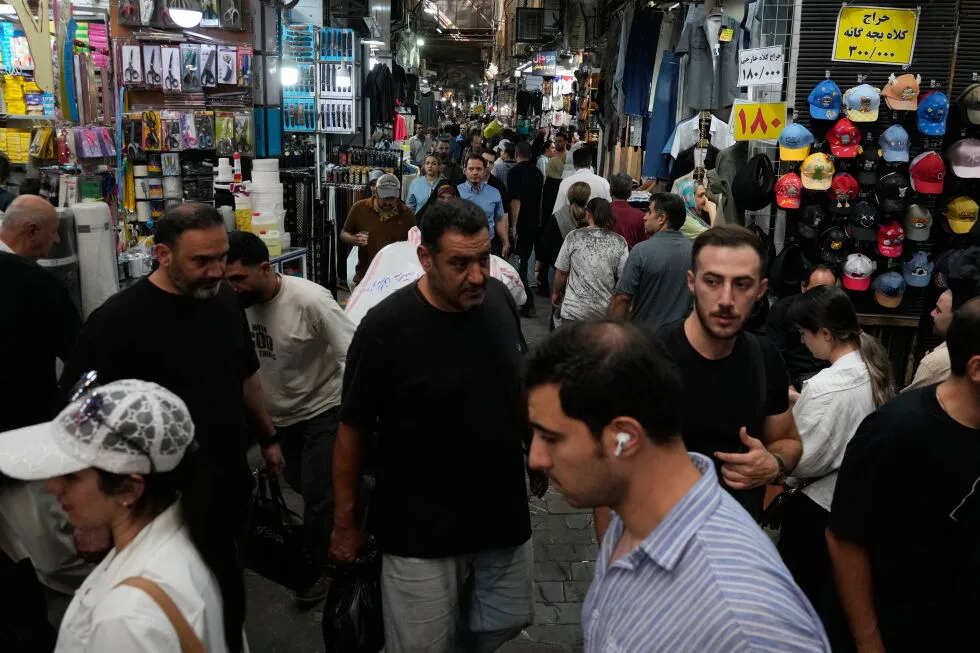
Iranian families struggle to afford the basics as US ratchets up economic warfare 1 of 5 | People walk in Tehran’s traditional main bazaar, Iran, Saturday, Aug. 8, 2026. (AP Photo/Vahid Salemi) 2 of 5 | A shopkeeper arranges nuts at his shop at Tajrish traditional bazaar in northern Tehran, Iran, Sunday, Aug. 2, 2026. (AP Photo/Vahid Salemi) 3 of 5 | Workers prepare sangak, a traditional Iranian flatbread, at a bakery in Tehran, Iran, Tuesday, Aug. 18, 2026. (AP Photo/Vahid Salemi) 4 of 5 | Women walk through the Iran Mall shopping center in Tehran, Iran, Thursday, July 30, 2026. (AP Photo/Vahid Salemi) 5 of 5 | Small boats line the shore as cargo ships and other commercial vessels appear anchored in the Strait of Hormuz off Bandar Abbas, Iran, Monday, July 27, 2026. (Razieh Poudat/ISNA via AP) By MEHDI FATTAHI and DAVID RISING Updated 11:06 AM MESZ, August 21, 2026 Add AP News on Google Add AP News as your preferred source to see more of our stories on Google. Share Share Facebook Copy Link copied Print Email X LinkedIn Bluesky Flipboard Pinterest Reddit Tehran, Iran (AP) — Tehran’s grocery stores are well-stocked, but many families can barely afford the basics. Unemployment is soaring and those with jobs are working more hours for money worth half as much as a year ago, putting food, medicine and everything else — except for heavily subsidized gasoline — further out of reach. “We have virtually given up on many things,” said Ahmad Karimi, 52, a taxi driver and father of two who has been working 15-hour days to make ends meet. “We’re cutting out fruit, we’re cutting out protein, we’ve given up leisure, we even work on weekends.” Nearly six months into the war with the United States and Israel, the Iranian economy is taking a beating under the force of sanctions and a naval blockade that is making it extremely difficult for the country to export oil, its most valuable product. Whether this intensifying economic pressure will translate anytime soon into military or political concessions from Iran remains to be seen — but some experts are skeptical. Since the war began, Iran has been attacking oil-rich neighbors and U.S. bases in the region, and disrupting shipping in the Strait of Hormuz, its biggest strategic advantage. Iran is trying to use this retaliatory pressure — which is driving up energy prices globally — to bring the war to an end on the best terms possible. It is pressing for sanctions relief, and seeking enough control over the strait to demand payment from ships passing through to deliver energy and other goods. The Trump administration — which is stuck fighting over a waterway in a war that was launched to curb Iran’s nuclear program — is now promising to deliver even tougher sanctions to try to squeeze the Islamic Republic into submission. But experts say U.S. President Donald Trump may be underestimating how long Iran can hold out. Trump pivots back to sanctions for Iran as other strategies to end his war fizzle 3 MIN READ Trump scoffs at Iran’s demand for war reparations and other Mideast developments 5 MIN READ 32 Trump warns of ‘economic D-Day’ against Iran, but Tehran is well acquainted with sanctions 5 MIN READ 32 Iran has been subject to Western sanctions for years and has become deft at partially circumventing them. It has expanded domestic production, used informal cross-border trade networks, bought restricted goods through third countries, and used a shadow fleet to transport its oil. “Iran’s resistance capacity not only avoids collapse, it also prevents the economic pain from translating into the political pressure and changes that the U.S. expects,” said Hadi Kahalzadeh, an expert on Iran’s economy at Brandeis University. Tehran’s sprawling Grand Bazaar is regularly packed with shoppers hoping to find more affordable staples than at the country’s grocery stores, where rice is 60% more expensive and beef is 150% more expensive than before the war. A mother of two from northern Iran posted a photo on X this week after purchasing milk, eggs, toilet paper and a few other items, but no meat. She complained that it cost 89 million rials (about $65). “Buying basic necessities has become our main priority, and our shopping basket has gotten smaller and more limited,” the 41-year-old told The Associated Press on condition of anonymity for fear of retribution. “The emotional toll and the pressure we’re under are another story,” she said. “Every time we have to say no to our children, every time we have to go back and forth over a decision, whether it’s a class you’d love your children to take or something they really want you to buy for them, it’s genuinely exhausting.” By the end of the year, inflation in Iran is expected to rise nearly 70%, according to the International Monetary Fund, and the country’s economy — devastated by a decade of sanctions before the war — is forecast to shrink by more than 5%. While gasoline has remained cheap thanks to government subsidies, even that might not last forever as supplies get tighter. A presidential aide told Iranian state television last week that the country is now using more gasoline each day than it produces and may need to raise prices — something that in the past has led to widespread protests. Iranians turn some anger toward countries behind sanctions Iran’s theocratic leaders were already facing economic discontent before the U.S. and Israel started the war on Feb. 28. Protests had spread across the country at the beginning of the year before they were violently put down, with thousands killed and tens of thousands believed to have been arrested. Many Iranians have now turned at least some of their economic frustrations toward the countries behind the sanctions and the attacks that have destroyed factories and critical infrastructure and killed scores of civilians, said Hassan Golmoradi, a Tehran-based economist. “Despite the hardships and difficulties, they have shown considerable patience in putting up with the resulting economic pressures,” Golmoradi said. Iran’s leaders have said it is a treasonous offense — punishable by death — to take part in anti-government protests. “They do suffer, but they do not think that by joining violent protests they can achieve something for themselves and their families,” said Mohammad Farzanegan, a professor of Middle Eastern economics at the University of Marburg in Germany. On Wednesday, Trump vowed on social media to unleash against Iran the “most crushing economic operation ever taken against any country.” He also threatened secondary sanctions on nations and companies that continue to do business with Iran. The United Arab Emirates, which for years had enabled Iran to circumvent sanctions and receive goods from other countries, announced this week it was suspending all trade with Tehran. Trump had called the leader of the UAE, Sheikh Mohammed bin Zayed Al Nahyan, the day before the announcement. With the economic struggles, the elected government of Iranian President Masoud Pezeshkian has said it favors a negotiated end to the war. “What concerns us is people’s livelihoods and their economic situation, and we are doing everything we can to deal with it,” he told reporters last week. But the most powerful force in Iran remains the paramilitary Revolutionary Guard, which has only become stronger after withstanding U.S. and Israeli airstrikes that killed Iran’s top leaders during the war’s opening salvos. The Guard is pressing for greater concessions from the U.S., including Iranian control over the Strait of Hormuz and financial compensation for the war. With negotiations to end the war stalled, Iran’s hard-liners believe their country can endure the conflict’s economic pressures longer than their adversaries. Iran’s supreme leader, Ayatollah Mojtaba Khamenei, this month appointed a former Revolutionary Guard commander to head Iran’s powerful Supreme National Security Council, a sign that he favors the hard-line approach. Official government statistics put Iran’s unemployment rate at 9.1%, though state-affiliated media outlets have said the real figure is most likely many times higher. A Labor Ministry official said last week that by late May, just three months into the war, more than 1 million jobs had been lost. In a sign that Iran’s leaders are at least somewhat concerned about public opinion, the government has refrained from enforcing mandatory hijab regulations as harshly as it had been — a social freedom that has long been sought by many. But these days many Iranians are focused on how their lifestyles are restricted economically. Karimi, the taxi driver, said Iran’s leaders will need to do something soon to alleviate the financial pressures he and others are feeling. “The people won’t be able to continue living like this,” he said. “We’re simply breathing, surviving, and trying to make it from one day to the next.” DAVID RISING Rising covers regional Asia-Pacific stories for The Associated Press. He has worked around the world, including covering the wars in Iraq, Afghanistan and Ukraine, and was based for nearly 20 years in Berlin before moving to Bangkok. twitter mailto
SRCAssociated Press (AP)
LANGEN
LEANCenter
WORDS1 503
ENT12
FRI · 2026-08-21 · 09:23 GMTBRIEF NSR-2026-0821-104469
NSR-2026-0821-104469News Report·EN·Economic Impact
Iranian families struggle to afford the basics as US ratchets up economic warfare
Iranian families are struggling to afford basic necessities due to the ongoing war with the United States and Israel, which has been in effect for nearly six months. The conflict has led to intensified U.S.
Associated Press (AP)Filed 2026-08-21 · 09:23 GMTLean · CenterRead · 7 min
Associated Press (AP)FIG 01
Reading time
7min
Word count
1 503words
Sources cited
1cited
Entities identified
12entities
Quality score
100%
§ 01
Briefing Summary
AI-generatedNEWSAR · AI
Iranian families are struggling to afford basic necessities due to the ongoing war with the United States and Israel, which has been in effect for nearly six months. The conflict has led to intensified U.S. sanctions and a naval blockade, severely impacting Iran's oil exports and causing soaring unemployment and inflation. While grocery stores are stocked, the cost of essential items like rice and beef has significantly increased, forcing families to cut back on food and leisure. Iran is attempting to leverage its strategic advantage by disrupting shipping in the Strait of Hormuz to pressure for sanctions relief. The U.S. administration, however, is threatening even tougher sanctions, though experts question their effectiveness given Iran's history of circumventing such measures. The economic strain is causing significant hardship and emotional toll on Iranian citizens.
Confidence 0.90Sources 1Claims 5Entities 12
§ 02
Article analysis
Model · rule-basedFraming
Economic Impact
Conflict
Tone
Mixed Tone
AI-assessed
CalmNeutralAlarmist
Factuality
0.60 / 1.00
Mixed
LowHigh
Sources cited
1
Limited
FewMany
§ 03
Key claims
5 extracted01
The Iranian economy is significantly impacted by sanctions and a naval blockade, hindering oil exports.
factual
Confidence
0.90
02
Iranian families are struggling to afford basic necessities due to soaring unemployment and devalued currency.
factual
Confidence
0.90
03
The Trump administration is promising even tougher sanctions against Iran.
factual
Confidence
0.80
04
Iran is attacking oil-rich neighbors and U.S. bases, and disrupting shipping in the Strait of Hormuz.
factual
Confidence
0.80
05
Experts are skeptical that intensifying economic pressure will lead to swift military or political concessions from Iran.
quoteexperts
Confidence
0.70
§ 04
Full report
7 min read · 1 503 words§ 05
Entities
12 identifiedKey playerOppositionContextPositiveNeutralNegative
People1
Locations6
§ 06
Keywords & salience
10 termseconomic warfare
1.00
sanctions
0.90
inflation
0.80
iranian economy
0.80
cost of living
0.70
naval blockade
0.60
unemployment
0.60
oil exports
0.50
strait of hormuz
0.50
energy prices
0.40
§ 07
Topic connections
Interactive graph Network visualization showing 51 related topics
View Full Graph Person Organization Location Event|Click node to navigate|Edge numbers = shared articles