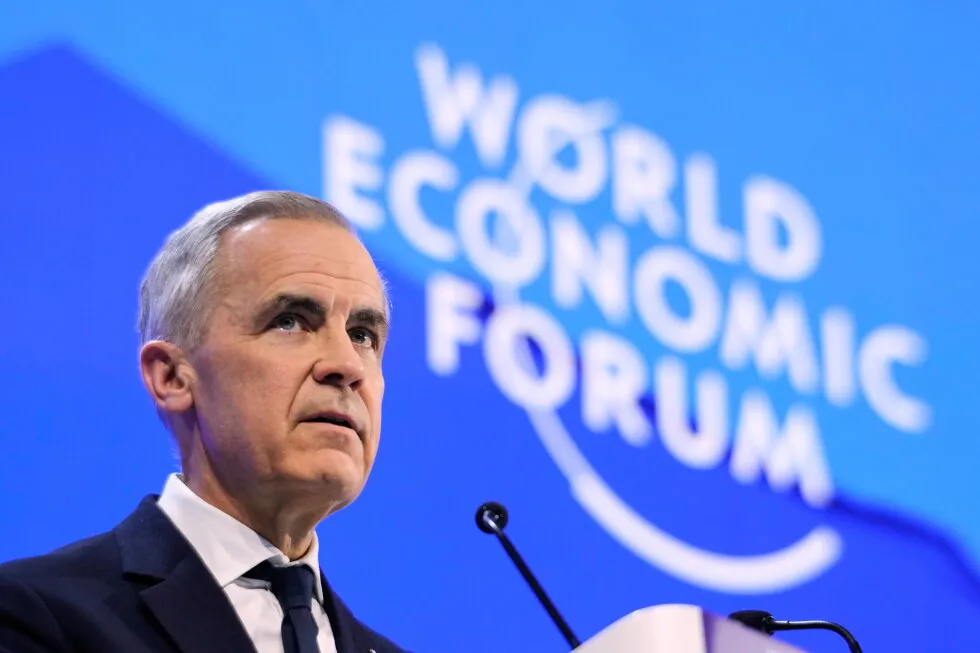
Carney warned about economic coercion. Now Trump is testing the Canadian prime minister 0 seconds of 1 minute, 29 secondsVolume 0% Press shift question mark to access a list of keyboard shortcuts Keyboard ShortcutsEnabledDisabled Shortcuts Open/Close/ or ? Play/PauseSPACE Increase Volume↑ Decrease Volume↓ Seek Forward→ Seek Backward← Captions On/Offc Fullscreen/Exit Fullscreenf Mute/Unmutem Decrease Caption Size- Increase Caption Size+ or = Seek %0-9 Next Up Hayden Panettiere, star of 'Heroes' and 'Nashville,' dies at 36 01:08 Subtitle Settings OffEnglish(US)_v Font Color White Font Opacity 100% Font Size 100% Font Family Arial Character Edge None Edge Color Black Background Color Black Background Opacity 50% Window Color Black Window Opacity 0% Reset WhiteBlackRedGreenBlueYellowMagentaCyan 100%75%50%25% 200%175%150%125%100%75%50% ArialCourierGeorgiaImpactLucida ConsoleTahomaTimes New RomanTrebuchet MSVerdana NoneRaisedDepressedUniformDrop Shadow WhiteBlackRedGreenBlueYellowMagentaCyan WhiteBlackRedGreenBlueYellowMagentaCyan 100%75%50%25%0% WhiteBlackRedGreenBlueYellowMagentaCyan 100%75%50%25%0% 00:00 01:29 01:29 More Videos 01:08 Hayden Panettiere, star of 'Heroes' and 'Nashville,' dies at 36 01:28 Women, men in pink rally in support of Lindsay Clancy at her trial for killing her 3 children 01:25 Trump orders Pentagon to scale back joint exercises with South Korea 01:38 A Tale of Squeals and Purrs: A look inside a sanctuary taking in hundreds of guinea pigs 01:13 Trump threatens Oman as it works with Iran on a Strait of Hormuz deal 01:27 Trump calls concerns about conditions on USS Abraham Lincoln ‘fake’ 01:27 The US and others turn to Brazil for rare earths, raising environmental concerns 01:14 Trump praises deal to stave off Canada tariffs, says he’s going to meet with North Korea’s leader Close 1 of 6 | The United States imposed 50% tariffs on $20 billion worth of Canadian products early Saturday, and Canada said it would retaliate beginning Sept. 8 after last-ditch negotiations failed to resolve the latest strain in relations between the historic allies. 2 of 6 | Canada’s Prime Minister Mark Carney speaks during the Annual Meeting of the World Economic Forum in Davos, Switzerland, Jan. 20, 2026. (AP Photo/Markus Schreiber, File) 3 of 6 | Canada Prime Minister Mark Carney and President Donald Trump hold a press conference at the White House in Washington, D.C., Oct. 7, 2025. (Adrian Wyld/The Canadian Press via AP, File) 4 of 6 | A Canadian flag flies on Parliament Hill in Ottawa on Saturday, Aug. 22, 2026. (Patrick Doyle/The Canadian Press via AP) 5 of 6 | Transport trucks cross the Ambassador Bridge into the United States of America, in Windsor, Ontario, Canada, Saturday, Aug. 22, 2026. (Dax Melmer/The Canadian Press via AP) 6 of 6 | People rally in response to U.S. President Donald Trump’s threats to Canadian sovereignty on Parliament Hill in Ottawa, March 9, 2025. (Justin Tang/The Canadian Press via AP File) By ROB GILLIES Updated 4:36 PM MESZ, August 23, 2026 Leer en español Add AP News on Google Add AP News as your preferred source to see more of our stories on Google. Share Share Facebook Copy Link copied Print Email X LinkedIn Bluesky Flipboard Pinterest Reddit TORONTO (AP) — Mark Carney drew international attention as Canada’s prime minister by warning that middle powers must resist economic coercion by more powerful countries. Now President Donald Trump is putting that warning to the test with sweeping new tariffs that could show how much economic pain Canada can absorb. Tensions escalated late Friday when Canada walked away from negotiations after Carney concluded the United States was demanding too much in exchange for tariff relief. The U.S. imposed 50% duties Saturday on about $20 billion worth of Canadian goods, and Carney announced dollar-for-dollar retaliation beginning Sept. 8. Carney is doing what many other American allies have so far avoided: risking economic pain rather than yielding to tariff pressure. For Carney, the showdown is the clearest test yet of his argument that middle powers must stand up to economic pressure from great powers such as the United States and China, even when it comes at a cost. Canada’s response could show how countries navigate a world in which long-standing alliances offer less protection and economic ties themselves become sources of leverage. It could also shape how Carney is viewed at home and abroad, and how other U.S. allies respond to the Republican president. The trade dispute also has become a test of sovereignty. Carney says US trade talks are ‘nasty’ after Trump criticizes Canada’s leadership 5 MIN READ 496 A trade war between Canada and the US further ruptures a once-close and durable alliance 5 MIN READ Trump says US and Canada have a trade deal, but key terms remain unclear 5 MIN READ Carney said Washington introduced language in the final hours of negotiations that would have restricted Canada’s ability to make trade deals with other countries. He said that demand was “unacceptable” and “a question of sovereignty.” British Columbia Premier David Eby said accepting such a condition would have reduced Canada “to the economic equivalent of the 51st state” — a status Trump has mused about often. Canada becomes a test case for the world Carney warned about Carney’s message resonated in January when he addressed the World Economic Forum in Davos, Switzerland, as Europe braced for Trump’s threats over Greenland and new tariffs. Carney said the international order was undergoing “a rupture, not a transition.” He argued that sovereignty would depend increasingly on a country’s ability to “withstand pressure” and warned that middle powers negotiating alone with great powers do so from weakness. Trump responded a day later by stressing Canada’s dependence on the United States. “ Canada lives because of the United States,” he said. “Remember that, Mark, the next time you make your statements.” The president has repeatedly talked about making Canada the 51st U.S. state and dismissed the allies’ border as artificial. On Sunday, Trump returned to that theme, writing on Truth Social that “Canada wants the benefits of being a State, without being one!!!” and accusing Canada of charging U.S. farmers “massive amounts” of tariffs for years. “No more!!!” he wrote. Seven months since Davos, Canada has become a test case for the world Carney described. “Our government understood, before many, that America would transform all its commercial relationships,” Carney said Saturday. He accused Washington of using “economic integration as a weapon” and said its “signature was written in pencil.” The price of resistance and will Canada show the way? Historian Robert Bothwell said Canada is uniquely vulnerable to U.S. pressure. “No country is more exposed than Canada,” Bothwell said. “Other countries have to fear American misbehavior, but none as much as Canada.” Bothwell said success ultimately means Canada retaining its independence “in the face of Trump’s desire to subordinate it and absorb it.” He said Carney “sees that very well.” But Canada’s dependence on the U.S. market makes that difficult. Nearly three-quarters of Canadian exports go to the United States, whose economy is roughly 10 times larger. Canada can sign new trade agreements, but replacing customers and supply chains built around the enormous U.S. market over decades is considerably harder. Carney acknowledged retaliation would “raise costs and reduce choice for Canadians.” U.S. Trade Representative Jamieson Greer rejected Canada’s account of the breakdown in talks, saying Ottawa introduced new demands and backed away from commitments even after Washington offered to reduce tariffs on steel, autos, lumber and other goods. He said the United States was moving ahead with additional measures in response to Canada’s retaliation, raising the prospect of further escalation. The European Union prepared retaliatory tariffs against the United States last year but repeatedly suspended them while negotiating with Washington. Nelson Wiseman, a professor emeritus of political science at the University of Toronto, said Canada is providing the biggest test yet of whether Carney’s strategy can work and whether resistance by one middle power could change the calculations of others. “Will there be a domino effect? We’ll see,” Wiseman said. Carney tries to hold the line as anger grows among Canadians toward Trump Ian Bremmer, president of the Eurasia Group, said Americans underestimate how angry Canadians are with the Trump administration. “Taking a hard line in response to U.S. policy perceived as predatory — even with major economic cost to Canada — is popular among most Canadians,” he said in a social media post. Manitoba Premier Wab Kinew said Canadians should be prepared for a prolonged confrontation and that Trump could emerge weaker after the U.S. midterm elections in November. “He’s got two more years left in office. We should be prepared to duke it out for two years, and then hopefully, sanity will return,” Kinew said. Carney has framed the confrontation as a test of whether Canada can preserve its independence under U.S. pressure. “Last spring, I warned that America is trying to break us so that they can own us,” Carney said Saturday. “And I promised: ‘That will never, ever happen.’ We are keeping that promise.”
SRCAssociated Press (AP)
LANGEN
LEANCenter
WORDS1 462
ENT12
SUN · 2026-08-23 · 14:23 GMTBRIEF NSR-2026-0823-105101
NSR-2026-0823-105101News Report·EN·Diplomatic
Carney warned about economic coercion. Now Trump is testing the Canadian prime minister
Canadian Prime Minister Mark Carney is facing a significant test of his stance against economic coercion as President Donald Trump has imposed 50% tariffs on approximately $20 billion worth of Canadian goods. Canada has announced dollar-for-dollar retaliation starting September 8th, after walking away from negotiations due to demands Carney deemed unacceptable and a threat to Canadian sovereignty.
Associated Press (AP)Filed 2026-08-23 · 14:23 GMTLean · CenterRead · 6 min
Associated Press (AP)FIG 01
Reading time
6min
Word count
1 462words
Sources cited
3cited
Entities identified
12entities
Quality score
100%
§ 01
Briefing Summary
AI-generatedNEWSAR · AI
Canadian Prime Minister Mark Carney is facing a significant test of his stance against economic coercion as President Donald Trump has imposed 50% tariffs on approximately $20 billion worth of Canadian goods. Canada has announced dollar-for-dollar retaliation starting September 8th, after walking away from negotiations due to demands Carney deemed unacceptable and a threat to Canadian sovereignty. This trade dispute marks a critical moment for Carney's argument that middle powers must resist pressure from larger nations, even at economic cost. The outcome could influence how other U.S. allies respond to Trump and how Canada navigates a world where economic ties are used as leverage. Trump has criticized Canada's leadership and accused it of imposing tariffs on U.S. farmers, while Carney asserts that the U.S. is using economic integration as a weapon.
Confidence 0.90Sources 3Claims 4Entities 12
§ 02
Article analysis
Model · rule-basedFraming
Diplomatic
Economic Impact
Tone
Measured
AI-assessed
CalmNeutralAlarmist
Factuality
0.80 / 1.00
Factual
LowHigh
Sources cited
3
Well sourced
FewMany
§ 03
Key claims
4 extracted01
Carney warned about economic coercion.
factualCarney
Confidence
1.00
02
Last-ditch negotiations failed to resolve the latest strain in relations between the US and Canada.
factual
Confidence
1.00
03
Canada said it would retaliate with its own tariffs beginning Sept. 8.
factualCanada
Confidence
1.00
04
The United States imposed 50% tariffs on $20 billion worth of Canadian products.
factual
Confidence
1.00
§ 04
Full report
6 min read · 1 462 words§ 05
Entities
12 identifiedKey playerOppositionContextPositiveNeutralNegative
Organizations1
Locations7
§ 06
Keywords & salience
9 termseconomic coercion
1.00
tariffs
0.90
canada
0.80
donald trump
0.80
trade relations
0.70
prime minister
0.70
retaliation
0.60
negotiations
0.50
allies
0.40
§ 07
Topic connections
Interactive graph Network visualization showing 51 related topics
View Full Graph Person Organization Location Event|Click node to navigate|Edge numbers = shared articles