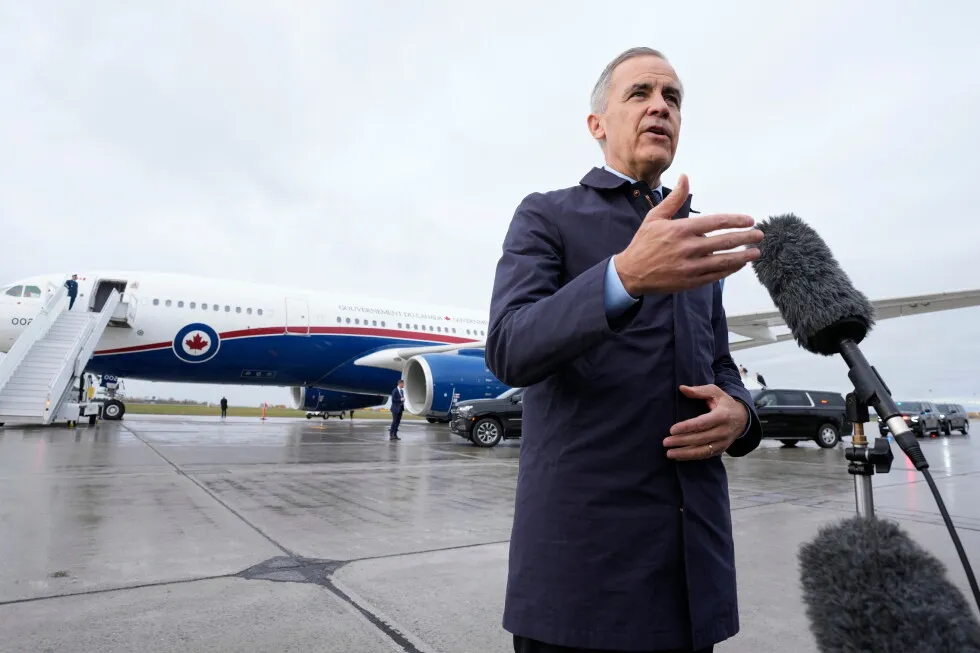
Trump’s trade war with Canada: A timeline of how we got here 0 seconds of 1 minute, 8 secondsVolume 0% Press shift question mark to access a list of keyboard shortcuts Keyboard ShortcutsEnabledDisabled Shortcuts Open/Close/ or ? Play/PauseSPACE Increase Volume↑ Decrease Volume↓ Seek Forward→ Seek Backward← Captions On/Offc Fullscreen/Exit Fullscreenf Mute/Unmutem Decrease Caption Size- Increase Caption Size+ or = Seek %0-9 Next Up Carney says Canada will match US tariffs 'dollar for dollar' after breaking off trade talks 01:29 00:00 01:08 01:08 More Videos 01:29 Carney says Canada will match US tariffs 'dollar for dollar' after breaking off trade talks 01:19 Provincial leader says Trump is a ‘bad person’ as Canada weighs concessions for trade deal 01:14 Trump praises deal to stave off Canada tariffs, says he’s going to meet with North Korea’s leader 01:00 'We want to save jobs': Benedict Wong on opposing Paramount Warner merger 01:13 Trump threatens Oman as it works with Iran on a Strait of Hormuz deal 00:37 Protests held in Pakistan against rising fuel prices, high taxes and soaring inflation 01:41 Trump gives press a tour of latest construction project: a new helipad 00:52 AP Top Stories August 19 Close 1 of 2 | President Donald Trump announced he’s ending all trade negotiations with Canada because of a television ad opposing U.S. tariffs. The ad was paid for by the Ontario provincial government, not the Canadian federal government. 2 of 2 | Canada Prime Minister Mark Carney speaks with members of the media before he boards a government plane in Ottawa on Friday Oct. 24, 2025. (Adrian Wyld/The Canadian Press via AP) By WYATTE GRANTHAM-PHILIPS Updated 10:32 PM MESZ, October 24, 2025 Add AP News on Google Add AP News as your preferred source to see more of our stories on Google. Share Share Facebook Copy Link copied Print Email X LinkedIn Bluesky Flipboard Pinterest Reddit NEW YORK (AP) — President Donald Trump’s barrage of tariffs has quickly strained the United States’ longstanding relationship with Canada over the last year. Since taking office in January, Trump has threatened Canada’s economy and sovereignty with steep import taxes on its goods. He’s even claimed that America’s neighbor to the north could be “the 51st state.” That rhetoric — paired with volleys of on-again, off-again new tariffs — has outraged Canadians and created wider uncertainty for businesses and consumers across both countries. Canada has responded with retaliatory trade measures. And just this week, Canadian Prime Minister Mark Carney outlined plans to double its non-U.S. exports in the next decade. Trump also promised to end “all trade negotiations” with Canada over a television ad from the Ontario government opposing his levies — although the province has since said it will pause that campaign. On his first day in office, Trump says he expects to put 25% tariffs on imports from Canada starting on Feb. 1. Trump signs an executive order to impose 25% tariffs on imports from Canada starting Feb. 4 — invoking this power by declaring a national emergency, ostensibly over undocumented immigration and drug trafficking. Then-Canadian Prime Minister Justin Trudeau promises to respond by matching 25% tariffs on up to $155 billion in U.S. imports. But days later, Trump agrees to a 30-day pause, cooling tensions at least temporarily. Trump’s trade war with Canada: A timeline of how we got here 3 MIN READ 23 Trump says US and Canada have reached last-minute deal to delay 50% US tariffs on Canadian imports 1 MIN READ US and Canada fall deeper into a trade war with new tariffs as talks collapse and blame is spread 1 MIN READ March Trump’s 25% tariffs on imports from Canada go into effect on March 4, though he limits the levy on Canadian energy to 10%. In response, Trudeau announces counter tariffs on more than $100 billion of American goods over the course of 21 days. But Trump soon grants a one-month exemption on these tariffs for U.S. automakers — and later postpones his 25% tariffs on goods that comply with the US-Mexico Canada Agreement, a trade pact from his first term. The action thaws relations with Canada somewhat, which suspends a second wave of its retaliatory tariffs, although uncertainty remains. Worldwide, Trump’s new steel and aluminum tariffs — which now tax imports of both metals at 25% — still go into effect March 12. Canada then imposes more retaliatory tariffs worth $29.8 billion Canadian dollars ($20.7 billion) on U.S. imports, beginning March 13. Trump announces his long-promised “reciprocal” tariffs on nearly all of America’s trading partners April 2, but doesn’t unveil additional levies on Canada. The White House says USMCA-compliant imports can continue to enter the U.S. duty-free — and once Trump’s demands on immigration and drug trafficking are satisfied, the tariff on the rest of their imports may drop from 25% to 12%. Still, as part of further levies impacting trading partners worldwide, Trump’s sweeping 25% tariffs on auto imports begin April 3, starting with taxes on fully-imported cars. In response, Canadian Prime Minister Mark Carney matches the 25% levies with a tariff on non-USMCA compliant vehicles imported from the U.S. starting April 9. Trump later signs an executive order to relax some of his auto tariffs, but relief is limited. On May 28, the U.S. Court of International Trade blocks Trump from imposing the bulk of his most sweeping tariffs — ruling that the president overstepped his authority when he invoked an emergency powers law to slap import taxes on almost every country in the world, including levies imposed on Canada. But just a day later, a federal appeals court temporarily halts the order. Worldwide, Trump’s new 50% tariffs of nearly all foreign steel and aluminum take effect June 4. Carney later threatens to impose new tariffs on U.S. steel and aluminum starting in July, pending progress of trade talks. The Canadian Prime Minister says that Trump’s trade war is running the risk of a global recession. Trump says he’s suspended trade talks with Canada over its plans to continue with a tax on technology firms. But days later, Carney says Canada will rescind implementing that tax, called the Digital Serves Tax, and says that talks will resume. Trump sends a letter to Canada warning that the U.S. will heighten its tariffs against the country to 35% starting Aug. 1, up from 25% imposed in March — although some goods are currently protected under the USCMA pact. At the time, Carney maintains that Canada will continue to work towards a deal by the new deadline. Trump’s heightened 35% tariff rate on a range of Canadian goods take effect on Aug. 1. Globally, the U.S.'s new 50% levy on imported copper also kicks in. Later in the month, Carney says that Canada will drop many of its retaliatory tariffs to match U.S. exemptions for goods covered under the USMCA pact. Critics decry the move as capitulation to Trump, but the prime minister maintains Canada is in a good position and that such exemptions would jump-start further trade talks. Low-value imports coming into the U.S. lose their duty-free status with the end of the “de minimis” rule on Aug. 29. The withdrawal applies to all countries, including Canada. Meanwhile, a federal appeals court rules that Trump illegally used emergency powers to impose sweeping tariffs worldwide — but leaves the import taxes in place for now. The Trump administration later appeals to the Supreme Court. For trading partners worldwide, Trump’s new tariffs on kitchen cabinets, bathroom vanities and upholstered wooden furniture go into effect on Oct. 14, starting with a 25% levy on many of these imports — ahead of steeper rates scheduled for Jan. 1. On Oct. 22, Carney outlines plans for Canada to double its non-U.S. exports in the next decade. He points to Trump’s tariffs — noting that affected jobs across Canada are “under threat” and that the new levies are causing a chill in investment. A day later, Trump says he’s ending “all trade negotiations” with Canada — in an abrupt move over a television ad opposing U.S. tariffs, which Trump claims misstated the facts and was aimed at influencing court decisions. The ad was paid for by the Ontario provincial government, not the Canadian federal government. Ontario Premier Doug Ford later says he’s pulling the TV ad so trade talks may resume. WYATTE GRANTHAM-PHILIPS Grantham-Philips is a business reporter who covers trending news for The Associated Press. She is based in Chicago. twitter mailto
SRCAssociated Press (AP)
LANGEN
LEANCenter
WORDS1 408
ENT12
SAT · 2026-08-22 · 16:53 GMTBRIEF NSR-2026-0822-104900
NSR-2026-0822-104900News Report·EN·Diplomatic
Trump’s trade war with Canada: A timeline of how we got here
President Donald Trump initiated a trade dispute with Canada shortly after taking office in January, imposing tariffs on Canadian goods and threatening further economic measures. Canada responded with retaliatory tariffs, leading to a cycle of escalating trade actions and uncertainty for businesses and consumers in both countries.
Associated Press (AP)Filed 2026-08-22 · 16:53 GMTLean · CenterRead · 6 min
Associated Press (AP)FIG 01
Reading time
6min
Word count
1 408words
Sources cited
2cited
Entities identified
12entities
Quality score
100%
§ 01
Briefing Summary
AI-generatedNEWSAR · AI
President Donald Trump initiated a trade dispute with Canada shortly after taking office in January, imposing tariffs on Canadian goods and threatening further economic measures. Canada responded with retaliatory tariffs, leading to a cycle of escalating trade actions and uncertainty for businesses and consumers in both countries. Key events included the implementation of 25% tariffs on Canadian imports in March, followed by Canada's counter-tariffs. Throughout the year, there were temporary pauses and exemptions, but tensions persisted, with Trump threatening higher tariffs and even ending trade negotiations over a provincial government's advertisement. Canadian Prime Minister Mark Carney outlined plans to diversify exports and manage the impact of these trade actions.
Confidence 0.90Sources 2Claims 5Entities 12
§ 02
Article analysis
Model · rule-basedFraming
Diplomatic
Economic Impact
Tone
Measured
AI-assessed
CalmNeutralAlarmist
Factuality
0.70 / 1.00
Factual
LowHigh
Sources cited
2
Limited
FewMany
§ 03
Key claims
5 extracted01
On his first day in office, Trump says he expects to put 25% tariffs on imports from Canada starting on Feb. 1.
factualTrump
Confidence
1.00
02
Canada Prime Minister Mark Carney speaks with members of the media before he boards a government plane in Ottawa on Friday Oct. 24, 2025.
factualAdrian Wyld/The Canadian Press via AP
Confidence
1.00
03
The ad opposing U.S. tariffs was paid for by the Ontario provincial government, not the Canadian federal government.
factualarticle
Confidence
1.00
04
President Donald Trump announced he’s ending all trade negotiations with Canada because of a television ad opposing U.S. tariffs.
factualPresident Donald Trump
Confidence
1.00
05
Trump has threatened Canada’s economy and sovereignty with steep import taxes on its goods since taking office in January.
factualarticle
Confidence
0.90
§ 04
Full report
6 min read · 1 408 words§ 05
Entities
12 identifiedKey playerOppositionContextPositiveNeutralNegative
Organizations1
Locations7
Topics1
§ 06
Keywords & salience
10 termstariffs
1.00
trade war
1.00
canada
0.90
united states
0.90
donald trump
0.80
trade negotiations
0.70
retaliatory trade measures
0.60
import taxes
0.50
sovereignty
0.40
uncertainty
0.40
§ 07
Topic connections
Interactive graph Network visualization showing 51 related topics
View Full Graph Person Organization Location Event|Click node to navigate|Edge numbers = shared articles