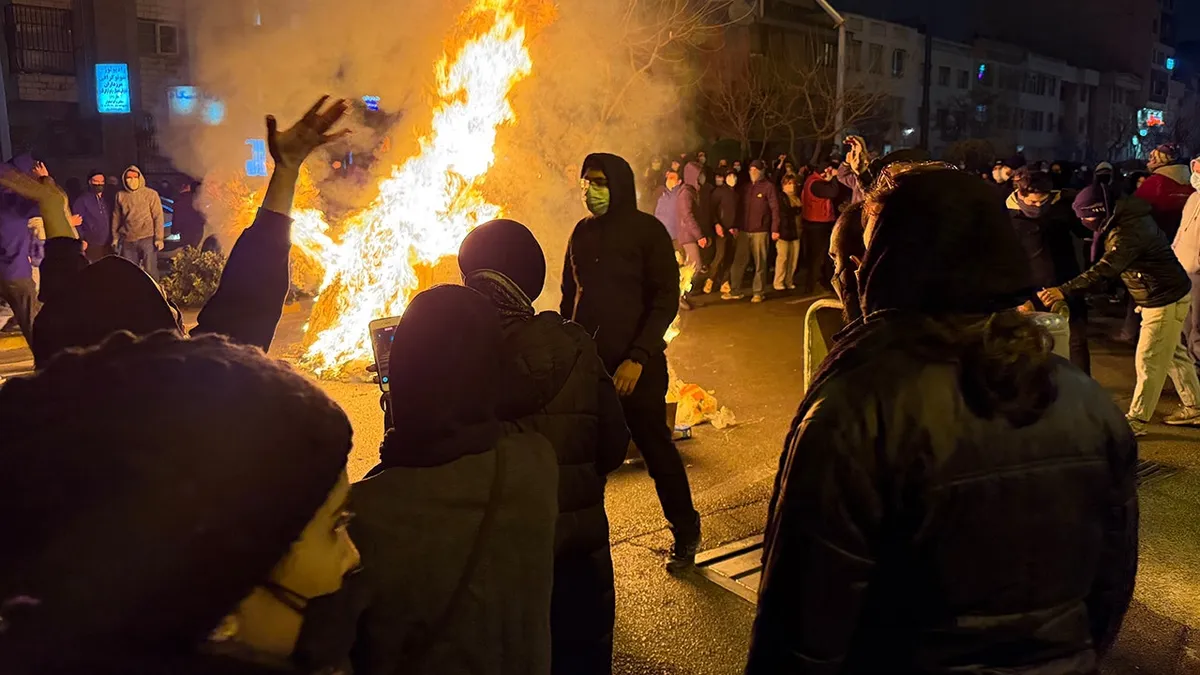
close Video Pompeo says Iran is losing 'significant' funding with aviation sanctions Former Secretary of State Mike Pompeo analyzes Treasury Secretary Scott Bessent launching 'Operation Economic Outcast' against Iran. Pompeo discusses the powerful impact of sanctions and argues that the era of funneling money to Iran is over. The economic offensive aims to achieve complete global isolation by holding Iran's partners accountable under strict U.S. sanctions. NEWYou can now listen to Fox News articles! Hören Sie sich diesen Artikel an 6 Min U.S. Treasury Secretary Scott Bessent’s Monday announcement that America will impose the economic equivalent of the military campaign that defeated Nazi Germany on the Iran" class="entity-link entity-organization" data-entity-id="8614" data-entity-type="organization">Islamic Republic of Iran could set off a series of events leading to the dissolution of the nearly 47-year-old dictatorship in Tehran, according to Iran experts. Bessent’s declaration of economic warfare follows President Donald Trump’s commitment last week to launch an "economic D-Day" against the Tehran regime. The comprehensive U.S. economic pressure point campaign targeting Iran’s already troubled economy could have dramatic effects on the restive population in the country of over 90 million people. "In the Second World War, D-Day marked the historic beginning of a campaign with our allies to target and drive the enemy from its positions, including those in third countries. Today, in that same spirit, we are launching an economic onslaught against Iran's financial connections around the globe," said Bessent. He added, "Our objective is to sever every economic lifeline that sustains this tyrannical regime until Tehran stands alone. Iran's fanatics devote themselves to death to America and seek nuclear weapons to do just that. They have murdered and maimed more of our citizens and service members than any other terrorist regime on Earth." TRUMP THREATENS 'UNPRECEDENTED' ECONOMIC CONSEQUENCES FOR ANY NATION AIDING Iran Treasury Secretary Scott Bessent speaks at a news conference, Monday, Aug. 24, 2026, at the Treasury Department in Washington. (AP Photo/Julia Demaree Nikhinson) Just hours before Bessent spoke, Iran’s currency, the rial, plunged to an all-time low. The rial fell to 2.02 million to the U.S. dollar. Iranians are struggling to afford basic goods. Jonathan Harounoff, an Iran expert and British author of Persian heritage, told Fox News Digital that "Ultimately, this pressure campaign will likely continue to cripple the regime and set the stage for perhaps yet another domestic uprising. The precise timing of such a revolt is impossible to predict." Harounoff, who has written extensively on upheavals in Iran against the clerical leadership, added, "What isn't impossible to predict is that the regime is governing brutishly over a repressed population that has endured sustained economic and social immiseration. It's only a matter of time before more protests break out, and the real question is whether international organizations like the U.N. and Western governments will choose to stand by — or tangibly support the Iranian people and actively sever any cooperation they maintain with the regime." LEAKED Iran REPORT FINDS RECORD PUBLIC ANGER AS REGIME FOCUSES ON HOLDING POWER Iranians gather while blocking a street during a protest in Kermanshah, Iran on Jan. 8, 2026. (Kamran/Middle East Images/AFP via Getty Images) He warned that, "Too often, outsiders speak of regime change as if it were a passive exercise. Certainly, only the people of Iran can bring about organic, homegrown, transformational change — and they have 47 years of turmoil and repression driving them toward it. But there are real ways to support the Iranian people (Starlink, supporting think tanks and foundations, raising awareness of the plight of Iranians, etc.) and help them achieve what has, until now, been a quixotic dream." Jason Brodsky, policy director at United Against Nuclear Iran (UANI), told Fox News Digital, "The question is often asked: what makes this iteration of the maximum pressure campaign different from all other iterations? The answer is this iteration is taking place against a backdrop where there is a synchronization of economic and military pressure against the Iranian regime — a combination which has never been deployed by a U.S. administration until now. The U.S. naval blockade currently in place against Tehran is unprecedented. The Iranian regime's industrial base — for example, steel plants — has also been damaged following kinetic strikes. The Iranian regime’s military capacity has likewise been degraded." Iran ACCELERATES EXECUTION CAMPAIGN AGAINST ANTI-REGIME ACTIVISTS AMID INTERNET CENSORSHIP Buses that were burned during Iran's protests, in Tehran, Iran, Jan. 21, 2026. (Majid Asgaripour/WANA (West Asia News Agency) via Reuters) He noted, "So Operation Economic Outcast is being launched at a time of true weakness in terms of its national power. The regime's risk tolerance may be increasing, but so is its desperation. The drivers pushing the Iranian people into the streets to protest have only gotten worse since January — with political, economic and social forces all deteriorating. The regime is seeking to use the tussle over the Strait of Hormuz as a distraction from all of this." Alireza Nader, an independent Iran expert, however, expressed skepticism that the tightening of the economic screws could provoke a mass revolt. "I don’t think starving the civilian population in Iran will lead to an American victory. The regime has demonstrated an extreme brutality toward the population, having massacred thousands of unarmed protestors this past January. And Iranians are less likely to rise up when the promised help to them from Trump and Netanyahu never materialized." Nader said, "The Woman, Life, Freedom movement against the regime prior to the war had the best chance of overthrowing the regime. This war has disrupted the Iranian people’s struggle for freedom." Iranians block a street while gathering during a protest in Tehran, Iran, on Jan. 9. (MAHSA / Middle East Images/AFP via Getty Images) Beni Sabti, an Iran expert at the Institute for National Security Studies (INSS) in Israel, told Fox News Digital that "there are some protests inside Iran for pensioners and those who did not get their salaries." He said the January protests began with "economic problems." President Trump has said that the Iranian regime murdered 52,000 Iranian demonstrators during the Jan. 8 and 9 mass protests against the regime. Sabti, who was born in Tehran and has deep sourcing in Iran, said Trump’s economic offensive campaign against Iran could "bring out the people again." He said there were some "rumors" that lower-rank army soldiers did not receive their salaries. The U.S. Treasury Secretary Bessent seized on the point that the regime will have payroll problems today. He said, "To the ordinary soldiers supporting this regime, as more and more of your paychecks stop or are supposedly just delayed, ask whether your commanders are leading your country to triumph or to ruin, and recall that the Berlin Wall fell when ordinary soldiers decided not to shoot at their own people." Benjamin Weinthal reports on Israel, Iran, Syria, Turkey and Europe. You can follow Benjamin on Twitter @BenWeinthal, and email him at benjamin.weinthal@fox.com
SRCFox News - World
LANGEN
LEANCenter-Right
WORDS1 147
ENT12
TUE · 2026-08-25 · 12:09 GMTBRIEF NSR-2026-0825-105764
NSR-2026-0825-105764News Report·EN·Political Strategy
Could Iran’s regime collapse? Experts assess Bessent’s bid to sever financial lifelines
U.S. Treasury Secretary Scott Bessent announced a comprehensive economic pressure campaign against Iran, dubbed "Operation Economic Outcast," aiming to sever the regime's financial lifelines.
Fox News - WorldFiled 2026-08-25 · 12:09 GMTLean · Center-RightRead · 5 min
Fox News - WorldFIG 01
Reading time
5min
Word count
1 147words
Sources cited
2cited
Entities identified
12entities
Quality score
100%
§ 01
Briefing Summary
AI-generatedNEWSAR · AI
U.S. Treasury Secretary Scott Bessent announced a comprehensive economic pressure campaign against Iran, dubbed "Operation Economic Outcast," aiming to sever the regime's financial lifelines. This initiative follows President Trump's commitment to an "economic D-Day" against Tehran. Experts believe this intensified economic warfare, coupled with existing military pressure, could destabilize the Iranian regime and potentially lead to domestic uprisings, especially as Iran's currency has hit an all-time low and citizens struggle with basic goods. While some experts see this as a critical moment of weakness for Iran, others express skepticism that economic hardship alone will provoke a mass revolt, noting the regime's history of brutal suppression. The U.S. intends to hold any nation aiding Iran accountable through strict sanctions.
Confidence 0.90Sources 2Claims 5Entities 12
§ 02
Article analysis
Model · rule-basedFraming
Political Strategy
Economic Impact
Tone
Sensational
AI-assessed
CalmNeutralAlarmist
Factuality
0.40 / 1.00
Mixed
LowHigh
Sources cited
2
Limited
FewMany
§ 03
Key claims
5 extracted01
Iran's currency, the rial, plunged to an all-time low of 2.02 million to the U.S. dollar.
statistic
Confidence
1.00
02
The U.S. economic pressure campaign aims to achieve complete global isolation of Iran by holding its partners accountable under strict U.S. sanctions.
quoteScott Bessent
Confidence
1.00
03
U.S. Treasury Secretary Scott Bessent announced a campaign to impose the economic equivalent of the military campaign that defeated Nazi Germany on Iran.
quoteScott Bessent
Confidence
1.00
04
The pressure campaign will likely continue to cripple the regime and set the stage for perhaps yet another domestic uprising.
predictionJonathan Harounoff
Confidence
0.70
05
It's only a matter of time before more protests break out in Iran.
predictionJonathan Harounoff
Confidence
0.60
§ 04
Full report
5 min read · 1 147 words§ 05
Entities
12 identifiedKey playerOppositionContextPositiveNeutralNegative
People4
Locations3
§ 06
Keywords & salience
10 termseconomic sanctions
1.00
iran regime collapse
1.00
financial lifelines
0.90
economic warfare
0.90
global isolation
0.80
scott bessent
0.70
treasury department
0.60
iran currency
0.50
operation economic outcast
0.50
nuclear weapons
0.40
§ 07
Topic connections
Interactive graph Network visualization showing 51 related topics
View Full Graph Person Organization Location Event|Click node to navigate|Edge numbers = shared articles