At least 47 people were killed and more than 50 others kidnapped when armed men attacked a once peaceful community near Haiti’s capital at the weekend, the UN has said.A gang leader has threatened to kill the hostages if authorities kill any gang members as they try to secure the community of Kenscoff, nestled in the hills above Port-au-Prince.Sunday’s attack pierced the belief that security in the Caribbean country was improving. Romain Le Cour, the head of Haiti observatory at the Global Initiative Against Transnational Organized Crime, said: “This is a major political and security test – for the government, for the police and for the international mission alike.”In a video posted on social media, the gang leader warned the director of Haiti’s national police, Vladimir Paraison, not to use drones to repel gangs in the area. “Paraison, if any of our soldiers are hurt, I will kill all of them,” he said, referring to the hostages.He identified himself as Izo-2" class="entity-link entity-person" data-entity-id="193155" data-entity-type="person">Izo 2, a reference to Izo, or Johnson André, one of Haiti’s most powerful gang members. Le Cour said Izo-2" class="entity-link entity-person" data-entity-id="193155" data-entity-type="person">Izo 2 was also known as Didi and led the armed group in Kenscoff on behalf of and in coordination with Izo and other gang leaders. “He’s running a kind of franchise cell for other gangs,” he said.Le Cour said the aim of the attack could be to force Haiti’s police and the UN-backed gang suppression force to disperse even more of their limited resources. “They don’t have enough personnel,” he said. “If you force them to deploy more troops, it would inevitably be at the expense of other areas.”The attack may also be a show of force and a message to Haiti’s government and police as the country prepares to hold general elections on 13 December, the first in more than a decade.Le Cour said: “This is a message to the government and the police that their claims of protection do not match reality. The gangs are saying: when we choose to attack, we can, and we will succeed.”Women mourn at the site of the attack in Kenscoff. Photograph: Patrice Noel/ReutersThe first major attack on Kenscoff occurred in January 2025 and since then there have been sporadic attacks in the mountains surrounding the city centre. Sunday’s attack was the largest yet.At least five of the 47 people killed were children, according to the UN integrated office in Haiti, known as BINUH.Kenscoff’s mayor, Jean Massillon, said two government employees were among those killed, including his cousin who served as his security detail.He said members of Viv Ansanm, a powerful gang coalition that the US has designated as a foreign terrorist organisation, also set fire to 25 homes.Massillon said gangs were still roaming Kenscoff’s periphery. “The atrocity of this crime reminds us that we have to continue working stronger every day to bring peace to the community,” he said. “I’m optimistic that the state will continue working to eradicate the gangs in Kenscoff.”Some survivors accused the government of not providing enough protection before the attack. The police rejected the accusations.Le Cour said that if police and armoured vehicles were indeed stationed in Kenscoff before the attack, it was concerning. “You let the gangs come in even if you had everything in place?” he said.Armed men control an estimated 70% of Port-au-Prince and swaths of land in Haiti’s central region and beyond, and gang violence has displaced a record 1.5 million people across Haiti. More than 3,050 people were reported killed from January to June and another 1,400 injured, according to UN statistics released on Tuesday.
SRCThe Guardian - World News
LANGEN
LEANCenter-Left
WORDS593
ENT12
TUE · 2026-08-25 · 17:35 GMTBRIEF NSR-2026-0825-105815
NSR-2026-0825-105815News Report·EN·Conflict
At least 47 killed and dozens kidnapped in gang attack near Haiti capital
Armed men attacked the community of Kenscoff, near Haiti's capital, over the weekend, resulting in at least 47 deaths and over 50 kidnappings, according to the UN. A gang leader, identified as Izo 2, has threatened to kill the hostages if authorities harm any gang members during security operations.
Associated Press in Port-au-PrinceThe Guardian - World NewsFiled 2026-08-25 · 17:35 GMTLean · Center-LeftRead · 3 min
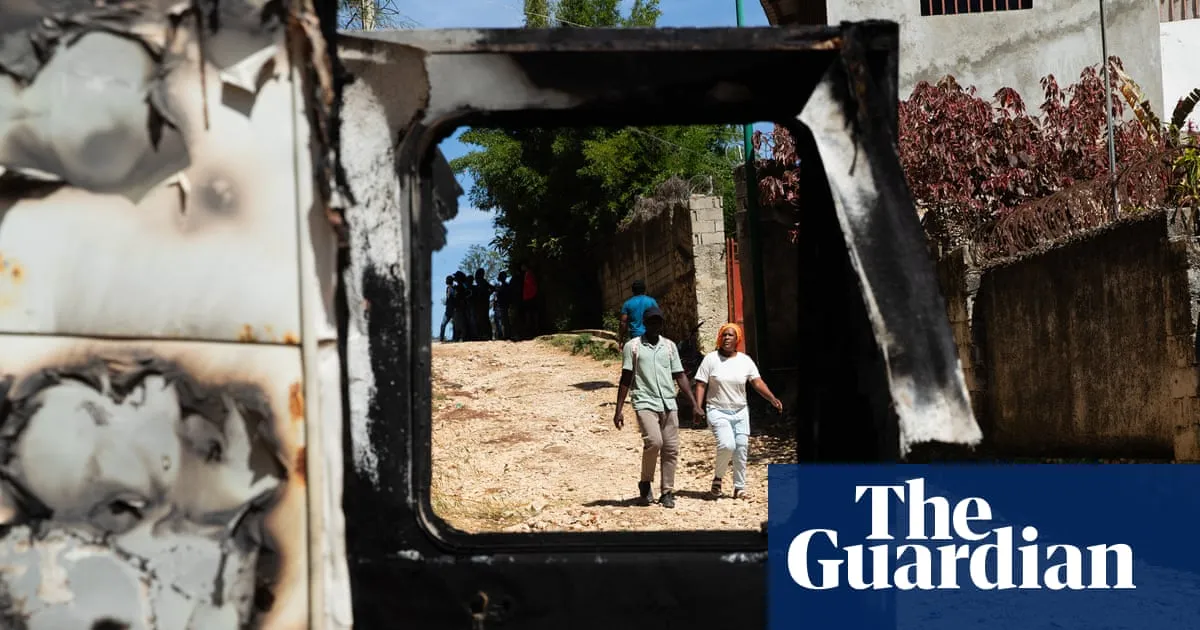
The Guardian - World NewsFIG 01
Reading time
3min
Word count
593words
Sources cited
3cited
Entities identified
12entities
Quality score
100%
§ 01
Briefing Summary
AI-generatedNEWSAR · AI
Armed men attacked the community of Kenscoff, near Haiti's capital, over the weekend, resulting in at least 47 deaths and over 50 kidnappings, according to the UN. A gang leader, identified as Izo 2, has threatened to kill the hostages if authorities harm any gang members during security operations. The attack, which also involved the burning of 25 homes, is seen as a significant security challenge for the government and international missions, potentially aimed at diverting limited police resources and demonstrating the gangs' power ahead of upcoming elections. The UN integrated office in Haiti reported that at least five children were among the deceased. Gangs control a significant portion of Port-au-Prince and surrounding areas, contributing to widespread displacement and violence across the country.
Confidence 0.90Sources 3Claims 5Entities 12
§ 02
Article analysis
Model · rule-basedFraming
Conflict
National Security
Tone
Mixed Tone
AI-assessed
CalmNeutralAlarmist
Factuality
0.70 / 1.00
Factual
LowHigh
Sources cited
3
Well sourced
FewMany
§ 03
Key claims
5 extracted01
A gang leader threatened to kill hostages if authorities kill any gang members.
quoteGang leader (Izo 2)
Confidence
0.95
02
At least five of the 47 people killed were children.
statisticUN integrated office in Haiti (BINUH)
Confidence
0.90
03
At least 47 people were killed and over 50 kidnapped in a gang attack near Haiti's capital.
statisticUN
Confidence
0.90
04
The attack is seen as a major political and security test for the government, police, and international mission.
factualRomain Le Cour
Confidence
0.85
05
The attack may be intended to force the dispersal of limited police and UN resources.
factualRomain Le Cour
Confidence
0.80
§ 04
Full report
3 min read · 593 words§ 05
Entities
12 identifiedKey playerOppositionContextPositiveNeutralNegative
People6
Organizations3
§ 06
Keywords & salience
10 termsgang attack
1.00
kidnapping
0.90
haiti capital
0.80
security test
0.70
gang leader
0.70
hostages
0.60
un mission
0.50
organized crime
0.50
police
0.40
general elections
0.40
§ 07
Topic connections
Interactive graph Network visualization showing 23 related topics
View Full Graph Person Organization Location Event|Click node to navigate|Edge numbers = shared articles