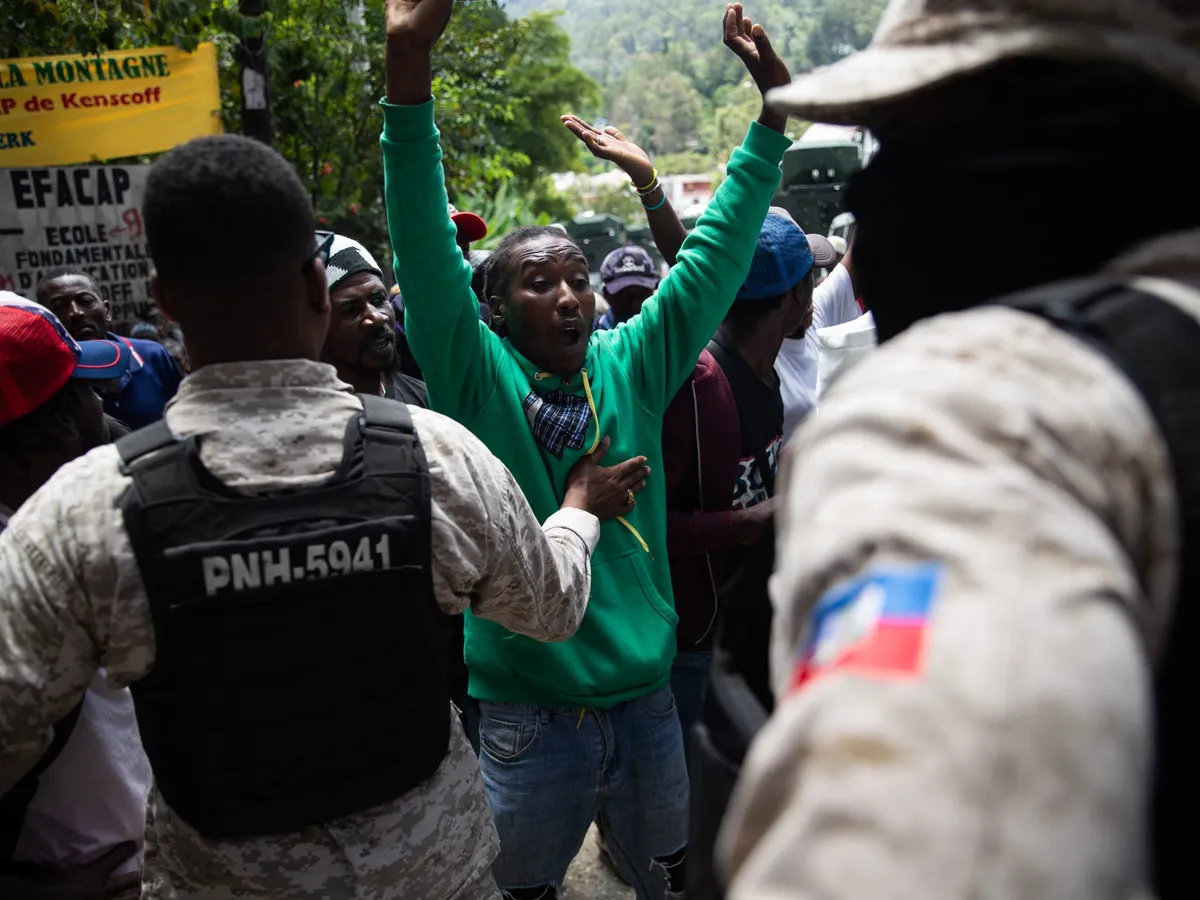
The attack in Kenscoff, a hillside community where crime had been declining, has raised questions about Haiti’s ongoing security struggles.Law enforcement enters Kenscoff, a neighbourhood near Port-au-Prince, Haiti, on August 24 after a night of violence [Clarens Siffroy/AFP]Published On 27 Aug 2026Haiti’s national police has faced growing scrutiny over its failure to stem violent attacks by armed criminal groups, which killed 47 people and kidnapped more than 50 last weekend.Police spokesperson Garry Desrosiers held a news conference on Thursday, taking questions from a handful of reporters.Recommended Stories list of 3 itemslist 1 of 3Haiti gang raid death toll rises to 47 as more than 50 kidnapped, says UNlist 2 of 3Haiti’s PM casts doubt on presidential vote by August as gang clashes growlist 3 of 3Four convicted in US related to killing of Haitian President Jovenel Moiseend of listHe offered few details about how the police plan to respond to the August 23 mass kidnapping, considered one of the largest such incidents in the country’s recent history.“We cannot talk about any plans,” Desrosiers said.The attack on the community of Kenscoff, located in the hills outside of the capital city of Port-au-Prince, has underscored the continued influence of powerful gangs in the country.Hundreds of people fled the attack. Desrosiers said that police are working to return them home.One gang leader has threatened to execute all the hostages if any gang members are killed as police work to gain control over Kenscoff.Asked whether police had gathered any intelligence before the attack, Desrosiers offered sparse comments, saying authorities have been working to find information.He added that the police believe one gang leader has threatened an assault on Tabarre, a neighbourhood in the capital that is home to the United States embassy.“I’m not in a position to give you detailed information,” Desrosiers said.The attack on Kenscoff comes as authorities in Haiti seek to reclaim control of the capital city. The United Nations estimates that the community has suffered about a dozen gang attacks since last year.But violence had been dropping in the area. Between January and August, the nonprofit conflict monitor Armed Conflict Location and Event Data found that the crackdown had lowered violence in Kenscoff by 66 percent compared with a year ago.Still, the UN has warned that gang-related violence is “spreading geographically even as the authorities’ anti-gang campaign intensifies in Port-au-Prince”.The international body has estimated that more than 3,050 people have been killed across the country between January and June alone.“These figures show that the population continues to bear an unacceptable toll from violence,” the UN’s top representative in Haiti, Carlos Ruiz Massieu, said in a statement on Tuesday.Armed groups have acquired growing influence in Haiti since the assassination of former President Jovenel Moise in 2021, which left a power vacuum in the country’s government.No national elections have been held in the years since, and the last elected senators saw their terms expire in 2023.Haitian officials have repeatedly attempted to schedule a new vote, only to postpone the elections due to security concerns and other factors. Currently, a general election is scheduled for December.Armed groups in the country have pointed to the political and economic instability as justification for the violence.Currently, an estimated 70 percent of Port-au-Prince is under gang control. Clashes have displaced more than 1.5 million people across the country.In April, the first members of a UN-backed Gang Suppression Force arrived in Haiti with the aim of dismantling organised violence in the country.It was also designed to relieve a smaller multinational security mission led by Kenya that struggled with a lack of funding and support.UN Secretary-General Antonio Guterres has expressed optimism about the arrival of the force’s members.“Their deployment offers a real opportunity to curb violence and restore the authority of the state,” he said after visiting their base in June.But critics have argued that international efforts have had little success so far. Such missions have also drawn uncomfortable comparisons to previous foreign interventions in Haiti, many of which have faced accusations of rights abuses.Haitian police have also struggled with allegations of corruption, incompetence and, in some cases, collaboration with armed groups.Vladimir Paraison, head of Haiti’s national police, did not attend Thursday’s news conference but has defended the police from criticism since the Kenscoff attack.He has indicated that an investigation is underway to probe whether the violence was enabled by “complicity or negligence”.
SRCAl Jazeera
LANGEN
LEANCenter
WORDS723
ENT12
THU · 2026-08-27 · 22:51 GMTBRIEF NSR-2026-0828-106649
NSR-2026-0828-106649News Report·EN·Conflict
Haiti police confront public frustration after deadly gang attack kills 47
Haitian police are facing public frustration after a recent gang attack in Kenscoff killed 47 people and kidnapped over 50, raising concerns about the country's security. The attack, which occurred in a community where crime had reportedly been declining, highlights the ongoing influence of powerful gangs.
Brian OsgoodAl JazeeraFiled 2026-08-27 · 22:51 GMTLean · CenterRead · 3 min
Al JazeeraFIG 01
Reading time
3min
Word count
723words
Sources cited
3cited
Entities identified
12entities
Quality score
100%
§ 01
Briefing Summary
AI-generatedNEWSAR · AI
Haitian police are facing public frustration after a recent gang attack in Kenscoff killed 47 people and kidnapped over 50, raising concerns about the country's security. The attack, which occurred in a community where crime had reportedly been declining, highlights the ongoing influence of powerful gangs. Police spokesperson Garry Desrosiers offered few details on response plans, stating authorities are working to gather information and return displaced residents. The violence underscores the broader challenge of reclaiming control in the capital, with the UN estimating over 3,050 deaths from gang violence between January and June. The situation is exacerbated by political instability and a lack of elected officials since the 2021 presidential assassination.
Confidence 0.90Sources 3Claims 5Entities 12
§ 02
Article analysis
Model · rule-basedFraming
Conflict
National Security
Tone
Mixed Tone
AI-assessed
CalmNeutralAlarmist
Factuality
0.80 / 1.00
Factual
LowHigh
Sources cited
3
Well sourced
FewMany
§ 03
Key claims
5 extracted01
More than 3,050 people have been killed across Haiti between January and June.
statisticUN
Confidence
1.00
02
Violence in Kenscoff had decreased by 66 percent between January and August compared to the previous year.
statisticArmed Conflict Location and Event Data
Confidence
1.00
03
A gang attack in Kenscoff killed 47 people and kidnapped over 50.
statisticUN
Confidence
1.00
04
Gang-related violence is spreading geographically in Haiti.
factualUN
Confidence
0.90
05
Haiti's national police faces scrutiny for failing to stem violent attacks by armed groups.
factual
Confidence
0.90
§ 04
Full report
3 min read · 723 words§ 05
Entities
12 identifiedKey playerOppositionContextPositiveNeutralNegative
People1
Organizations3
Locations5
§ 06
Keywords & salience
10 termsgang attack
1.00
security struggles
0.90
public frustration
0.80
haiti
0.70
criminal groups
0.70
mass kidnapping
0.60
law enforcement
0.50
port-au-prince
0.50
united nations
0.40
gang leader
0.40
§ 07
Topic connections
Interactive graph Network visualization showing 23 related topics
View Full Graph Person Organization Location Event|Click node to navigate|Edge numbers = shared articles