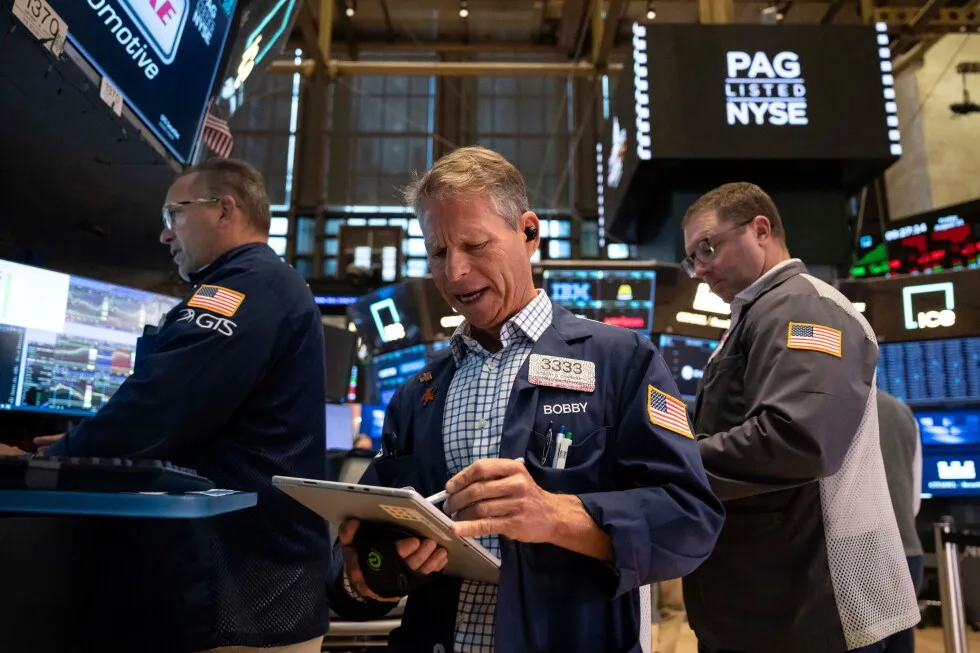
Asian shares mostly rise as oil prices fall and hope grows for AI 1 of 4 | Trader Robert Charmak works on the floor of the New York Stock Exchange in New York, Friday, Aug. 21, 2026. (AP Photo/Yuki Iwamura) 2 of 4 | Currency traders watch monitors at the foreign exchange dealing room of the Hana Bank headquarters in Seoul, South Korea, Wednesday, Aug. 26, 2026. (AP Photo/Ahn Young-joon) 3 of 4 | Currency traders watch monitors near a screen showing the Korea Composite Stock Price Index (KOSPI) and the foreign exchange rate between U.S. dollar and South Korean won at the foreign exchange dealing room of the Hana Bank headquarters in Seoul, South Korea, Wednesday, Aug. 26, 2026. (AP Photo/Ahn Young-joon) 4 of 4 | Options traders work on the floor of the New York Stock Exchange in New York, Friday, Aug. 21, 2026. (AP Photo/Yuki Iwamura) By YURI KAGEYAMA Updated 5:59 AM MESZ, August 26, 2026 Add AP News on Google Add AP News as your preferred source to see more of our stories on Google. Share Share Facebook Copy Link copied Print Email X LinkedIn Bluesky Flipboard Pinterest Reddit TOKYO (AP) — Asian shares mostly rose in early Wednesday trading, as investors kept an eye on the ongoing talks over reopening the Strait of Hormuz, which remains largely shut down because of the war in Iran. The global interest in Artificial Intelligence continued to boost some regional issues, while declining oil prices helped gear up optimism in oil-importing nations like Japan. Resource-poor Japan imports virtually all its oil. Japan’s benchmark Nikkei 225 rose 0.6% in morning trading to 66,227.55. Australia’s S&P/ASX 200 dipped 0.2% to 9,142.60. South Korea’s Kospi jumped 1.6% to 6,849.92. Hong Kong’s Hang Seng gained 0.8% to 25,712.29, while the Shanghai Composite edged up 0.7% to 3,917.04. Oil prices continued to fall. Benchmark U.S. crude dropped $2.06 to $80.30 a barrel. Brent crude, the international standard, lost $2.31 to $86.27 a barrel. Tensions between the United States and Iran seemed to ratchet higher after the Trump administration announced new sanctions to further hurt Iran’s economy. Brent’s price zigzagged between $72 and $102 last month as hopes rose and fell that the United States and Iran could reach a deal. The top diplomats of Iran and Oman met on Tuesday to discuss a phased approach to managing ship traffic through the Strait of Hormuz. The talks came after an oil tanker was disabled in an attack off the coast of Oman, underscoring the ongoing dangers for shipping companies attempting to use the waterway while it’s under Iranian control. Falling oil prices help calm the stock and bond markets 3 MIN READ 16 US stocks edge lower as oil prices rise and more earnings reports roll in 2 MIN READ Japan reports record exports and imports for July as energy costs climb 2 MIN READ A delegation from Pakistan also held talks with Iran’s president on reviving negotiations to end the Iran-U.S. conflict, the Pakistani military said. Pakistan Interior Minister Mohsin Naqvi said a meeting with Iranian President Masoud Pezeshkian had been “very positive and productive.” The yield on the 10-year Treasury fell to 4.63% from 4.70% late Monday and from 4.74% at the end of last week. That’s a significant move for the bond market, though the 10-year yield remains firmly above its 3.97% level from before the war with Iran sent oil prices and worries about inflation much higher. On Wall Street, Nvidia, which is set to report its latest earnings results Wednesday, and other winners of the boom in AI technology helped lead the way. Nvidia rose 2.2%, a day after its drop of 2.9% was the heaviest weight on the S&P 500. Eric Schiffer, who heads the Los Angeles-based Patriarch Organization, expects demand to keep growing in the AI sector, despite some adjustments in the future, as companies and governments can’t afford not to invest in AI to stay competitive. “There’s a lot of fear about AI. Those fears are based on the financing side, meaning that there is so much money that needs to be raised. What it’s underrating, in my opinion, is the fact that this technology is so incredible,” he said. AI stocks have veered up and down through the summer on worries that their prices shot too high and that the AI boom may not be sustainable. All told, the S&P 500 rose 24.42 points to 7,677.28. The Dow Jones Industrial Average added 160.24 to 53,577.40, and the Nasdaq composite climbed 171.11 to 26,151.30. In currency trading, the U.S. dollar slipped to 159.02 Japanese yen from 159.20 yen. The euro cost $1.1669, down from $1.1675. AP Business Writer Stan Choe contributed to this report. Yuri Kageyama is on Threads: https://www.threads.com/@yurikageyama YURI KAGEYAMA Kageyama covers Japan news for The Associated Press. Her topics include social issues, the environment, businesses, entertainment and technology. twitter instagram facebook mailto
SRCAssociated Press (AP)
LANGEN
LEANCenter
WORDS818
ENT12
WED · 2026-08-26 · 04:23 GMTBRIEF NSR-2026-0826-105997
NSR-2026-0826-105997News Report·EN·Economic Impact
Asian shares mostly rise as oil prices fall and hope grows for AI
Asian shares mostly rose on Wednesday as declining oil prices boosted optimism, particularly in oil-importing nations like Japan. Investors were also watching ongoing talks regarding the Strait of Hormuz, which remains largely shut due to the war in Iran.
Associated Press (AP)Filed 2026-08-26 · 04:23 GMTLean · CenterRead · 4 min
Associated Press (AP)FIG 01
Reading time
4min
Word count
818words
Sources cited
0cited
Entities identified
12entities
Quality score
100%
§ 01
Briefing Summary
AI-generatedNEWSAR · AI
Asian shares mostly rose on Wednesday as declining oil prices boosted optimism, particularly in oil-importing nations like Japan. Investors were also watching ongoing talks regarding the Strait of Hormuz, which remains largely shut due to the war in Iran. The global interest in artificial intelligence continued to support regional stocks. Major Asian markets, including Japan's Nikkei 225, South Korea's Kospi, and Hong Kong's Hang Seng, saw gains. On Wall Street, AI-related stocks, such as Nvidia, helped lead the market higher. Meanwhile, the yield on the 10-year Treasury fell. Diplomatic efforts were underway, with Iran and Oman discussing ship traffic management through the Strait of Hormuz, and Pakistan engaging in talks with Iran's president to end the Iran-U.S. conflict.
Confidence 0.90Claims 5Entities 12
§ 02
Article analysis
Model · rule-basedFraming
Economic Impact
Conflict
Tone
Measured
AI-assessed
CalmNeutralAlarmist
Factuality
0.80 / 1.00
Factual
LowHigh
Sources cited
0
No named sources
FewMany
§ 03
Key claims
5 extracted01
Benchmark U.S. crude dropped $2.06 to $80.30 a barrel.
statistic
Confidence
1.00
02
Japan’s benchmark Nikkei 225 rose 0.6% in morning trading to 66,227.55.
statistic
Confidence
1.00
03
The top diplomats of Iran and Oman met on Tuesday to discuss a phased approach to managing ship traffic through the Strait of Hormuz.
factual
Confidence
0.90
04
Asian shares mostly rose in early Wednesday trading.
factual
Confidence
0.90
05
Declining oil prices helped gear up optimism in oil-importing nations like Japan.
factual
Confidence
0.80
§ 04
Full report
4 min read · 818 words§ 05
Entities
12 identifiedKey playerOppositionContextPositiveNeutralNegative
Organizations5
Locations6
§ 06
Keywords & salience
8 termsoil prices
1.00
asian shares
1.00
artificial intelligence
0.90
strait of hormuz
0.80
iran
0.70
japan
0.60
stock markets
0.50
geopolitics
0.40
§ 07
Topic connections
Interactive graph Network visualization showing 51 related topics
View Full Graph Person Organization Location Event|Click node to navigate|Edge numbers = shared articles