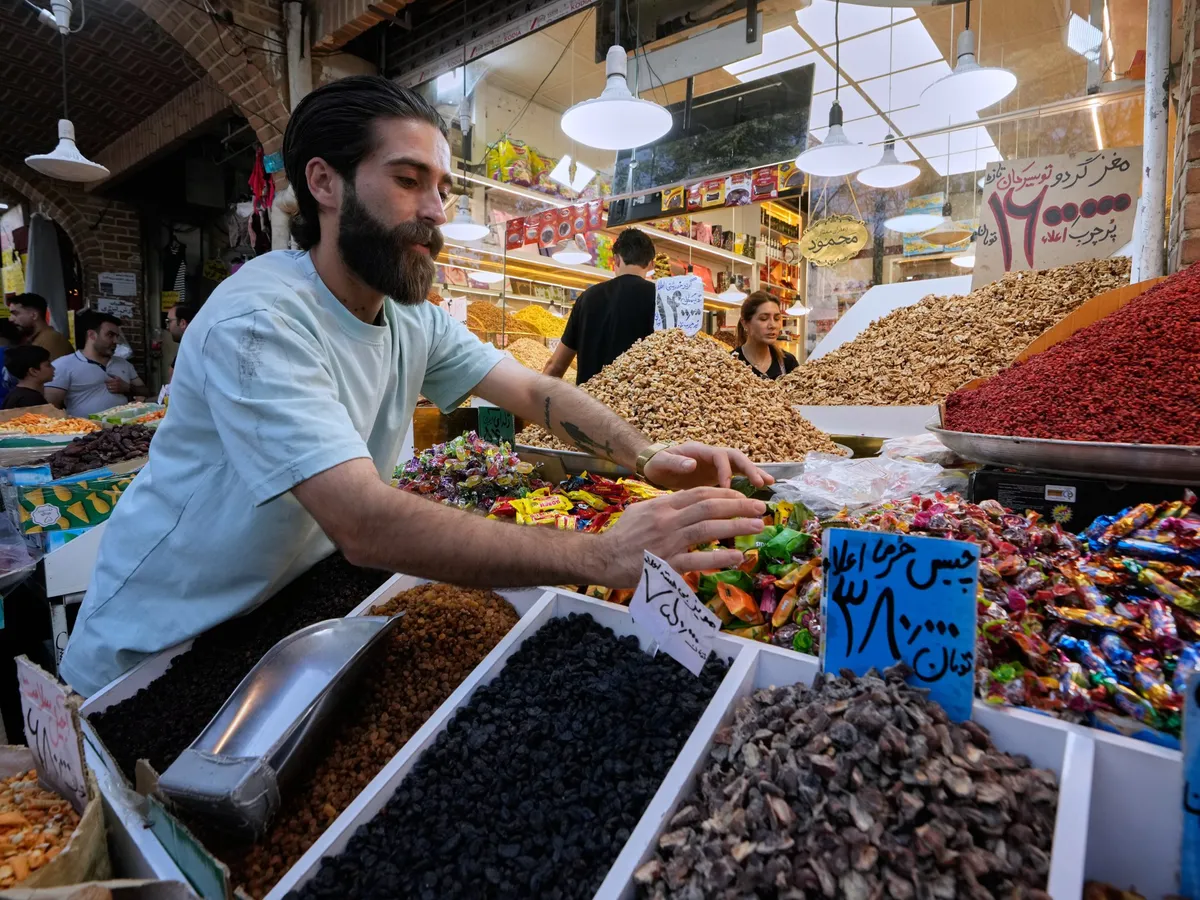
Iranian authorities believe they can withstand US sanctions, but warn of a tough year ahead.A shopkeeper sorts goods at Tehran's Grand Bazaar in Iran, Tuesday, August 25, 2026 [Vahid Salemi/AP]Published On 26 Aug 2026Tehran, Iran – Iranian authorities are adamant that their country’s domestic capacities will be able to keep the country’s economy afloat, despite new economic sanctions targeting Iran unveiled by the United States this week.The US aims to use the sanctions to force Iran into submission in the six month-long war between the two countries. But Iran’s government says it is prepared, with Economy Minister Ali Madanizadeh referring to a two-year plan on state television on Monday night.Recommended Stories list of 3 itemslist 1 of 3Trump tells Al Jazeera ‘not in a hurry’ for Iran to return to talkslist 2 of 3Iran, Oman agree on temporary Hormuz route: What we knowlist 3 of 3Why India is sharing missile secrets with its private sectorend of list“We have our own tools and we also know the game,” Madanizadeh said, in reference to Iran’s years of experience in trying to circumvent sanctions. He added that Tehran could potentially “go on the offensive” in a world where the US was no longer the only dominant force, and was confidant that many countries would effectively reject US President Donald Trump’s threats to cut off all links with Iran.Stockpiling essential goods, foreign currencies and gold has become a main tactic for Tehran. The government has also been forced to resort to rationing energy in one of the most resource-rich countries in the world.Central Bank Governor Abdolnasser Hemmati told senior business representatives during a meeting earlier this week that Oil Exports, Iran’s main foreign currency income source, have almost totally stopped. But Hemmati reassured the business leaders there was no shortage of foreign currency for essential goods as the central bank had cash stockpiles “in places [the US] cannot access”.Hemmati acknowledged “serious issues” like runaway inflation and constantly declining purchasing power for the people, but said, “enduring hardship is very different from collapse and what the US is after”.Iranians must not expect conditions to get any better over the next year, government spokesman Fatemeh Mohajerani told state-linked media on Tuesday. She also said Iran’s Supreme National Security Council would have to grant authorisation for the government to reveal data on poverty levels in the country.Iran’s national currency fell to a new all-time low of 2.05 million rials against the US dollar on the open market on Tuesday, before slightly recovering on Wednesday.Make it at homeDespite the turmoil, Iran’s newly-appointed security chief Mohsen Rezaei urged younger Iranians during a state TV interview earlier this week to “enter the economy” and begin manufacturing goods needed by their households and communities at home.That mentality has permeated the Islamic Republic’s strategic thinking for decades, with national development plans repeatedly emphasising “self-sufficiency” and setting targets to achieve it at great cost.To reduce its reliance on food imports for a population of around 90 million, the government claims that Iran can produce 85 percent of its agricultural products domestically, even as concerns remain over what the increase in domestic agricultural production means for Iran’s dire water scarcity problems.Agriculture Minister Gholam-Reza Nouri said on state television on Tuesday that Tehran aimed to increase domestic food self-sufficiency to 90 percent in the short-term, ahead of ultimately producing all of the country’s essential food domestically.Nouri said that Iran imports about $16bn and exports $8bn in agricultural products – although exports of some products were suspended in March shortly after the start of the war.Iran relies on imports for essential foods and feed commodities, including wheat, maize, rice and vegetable oils. The United Arab Emirates and Saudi Arabia are among Iran’s top suppliers of refined sugar and wheat flour through re-export hubs. Russia and Central Asia can also provide some grain through the Caspian Sea into northern Iran.The United Nations Food and Agriculture Organization said in March that rising import costs, logistics disruptions and policy responses aimed at protecting domestic supply are accelerating food inflation and reducing household purchasing power in Iran. It also warned that overland trade routes do not have the capacity to replace the much larger volumes of goods normally transported by sea.Food prices in Iran were more than 128 percent higher in July than they were a year earlier, according to the latest report by the Statistical Center of Iran. The same amount of money now buys far less food in Tehran and across the country than it did six months ago.Iran’s government also says the country produces some 97 percent of its medicine, although imported medicines account for a much larger share of total pharmaceutical spending.Salman Eshaghi, spokesman of the parliament’s health committee, said in May that Iran faced some levels of shortages for nearly 1,000 medicines. Medicine prices have also surged over recent months, including this week, after the government confirmed that it was gradually cutting off cheap currency allocation to some imports.Hard war-time choicesIran’s authorities have said they are working quickly to repair some of the damage dealt to Iran’s infrastructure during the war, including to oil, gas and utility facilities extensively bombed by the US and Israel.The was has compounded Iran’s existing energy shortages and infrastructure problems.Daily power blackouts continue to plague households and industrial units in Tehran and cities across the country, while natural gas shortages are expected to hit within a few months when the weather gets colder and demand rises.On Tuesday and Wednesday, a considerable number of petrol stations in Tehran, Mashhad, Karaj and several other cities also ran out of fuel allocated to them by the government, leading to lengthy queues.Government spokesperson Mohajerani on Wednesday promised that existing fuel prices and quota levels would remain unchanged through the end of the current Iranian calendar month on September 22. But the government has already cut fuel quotas for private vehicles.The National Iranian Oil Refining and Distribution Company promised on Wednesday that the inauguration of two new refineries in southern Iran by the end of the current year in late March would add about 12 million litres per day to Iran’s production capacity, helping offset some of the shortage.Iran’s government has no choice but to engage in “painful reforms” by increasing fuel prices in order to avoid another “bloodshed” during social unrest, Iranian economist Sadegh Alhosseini warned in a speech on Tuesday.“If Iran heads toward large-scale chaos – kilometres-long petrol queues and becoming like Venezuela – something much worse will happen that will be much more difficult to handle,” he said.But another fuel cost hike will further increase inflation by ramping up transport costs, and many people are already struggling to get by. Iran may continue to withstand historic levels of pressure, but it is becoming increasingly vulnerable to a cycle in which its resources and capacity are steadily depleted.
SRCAl Jazeera
LANGEN
OutletState media · Qatar
WORDS1,135
ENT12
WED · 2026-08-26 · 16:53 GMTBRIEF NSR-2026-0826-106187
NSR-2026-0826-106187News Report·EN·Political Strategy
Iran emphasises self-sufficiency in battle against US economic war
Iranian authorities assert their economy can withstand new US sanctions, imposed as part of a six-month war, by relying on domestic capacities and past experience circumventing sanctions. While acknowledging a tough year ahead with serious issues like inflation and declining purchasing power, officials state Iran has stockpiled essential goods, foreign currency, and gold, and the central bank holds accessible cash reserves.
Maziar MotamediAl JazeeraFiled 2026-08-26 · 16:53 GMTOutlet · State media · QatarRead · 5 min
Al JazeeraFIG 01
Reading time
5min
Word count
1,135words
Sources cited
3cited
Entities identified
12entities
NEWSAR · AI
Iranian authorities assert their economy can withstand new US sanctions, imposed as part of a six-month war, by relying on domestic capacities and past experience circumventing sanctions. While acknowledging a tough year ahead with serious issues like inflation and declining purchasing power, officials state Iran has stockpiled essential goods, foreign currency, and gold, and the central bank holds accessible cash reserves. Oil exports have nearly ceased, but the government aims to increase domestic food self-sufficiency to 90% and claims to produce 97% of its medicine. The national currency recently hit a new low against the US dollar.
Confidence 0.90Sources 3Claims 5Entities 12
Framing
Political Strategy
Economic Impact
Tone
Measured
AI-assessed
CalmNeutralAlarmist
Factuality
0.60 / 1.00
Mixed
LowHigh
Sources cited
3
Well sourced
FewMany
01
Iran's national currency fell to a new all-time low of 2.05 million rials against the US dollar.
statisticArticle reporting market data
Confidence
0.95
02
Iran's oil exports have almost totally stopped.
statisticAbdolnasser Hemmati
Confidence
0.90
03
Iranians must not expect conditions to get any better over the next year.
predictionFatemeh Mohajerani
Confidence
0.85
04
The US aims to use sanctions to force Iran into submission in the six month-long war.
factualArticle's interpretation of US aims
Confidence
0.80
05
Iranian authorities believe they can withstand US sanctions due to domestic capacities.
predictionIranian authorities
Confidence
0.70
§ 04
Full report
5 min read · 1,135 wordsKey playerOppositionContextPositiveNeutralNegative
People4
Organizations1
Locations4
us economic war
1.00
self-sufficiency
0.90
us sanctions
0.90
domestic capacities
0.80
economic sanctions
0.80
circumvent sanctions
0.70
foreign currency
0.60
stockpiling
0.60
inflation
0.50
oil exports
0.40
§ 07
Connections
Who appears together in the newsIn this articleWider coverageLine weight = articles in common
Laying out network…
Strongest ties articles in common
- 15,001
- 12,267
- 7,768
- 2,643
- 2,172
- 1,483
Recurring context not named in this article
- LIsraellinks 9
- PScott Bessentlinks 8
- LStrait of Hormuzlinks 8
- LChinalinks 7
- PAyatollah Ali Khameneilinks 7
- OAl Jazeeralinks 7
- LPakistanlinks 7
- LWashingtonlinks 6