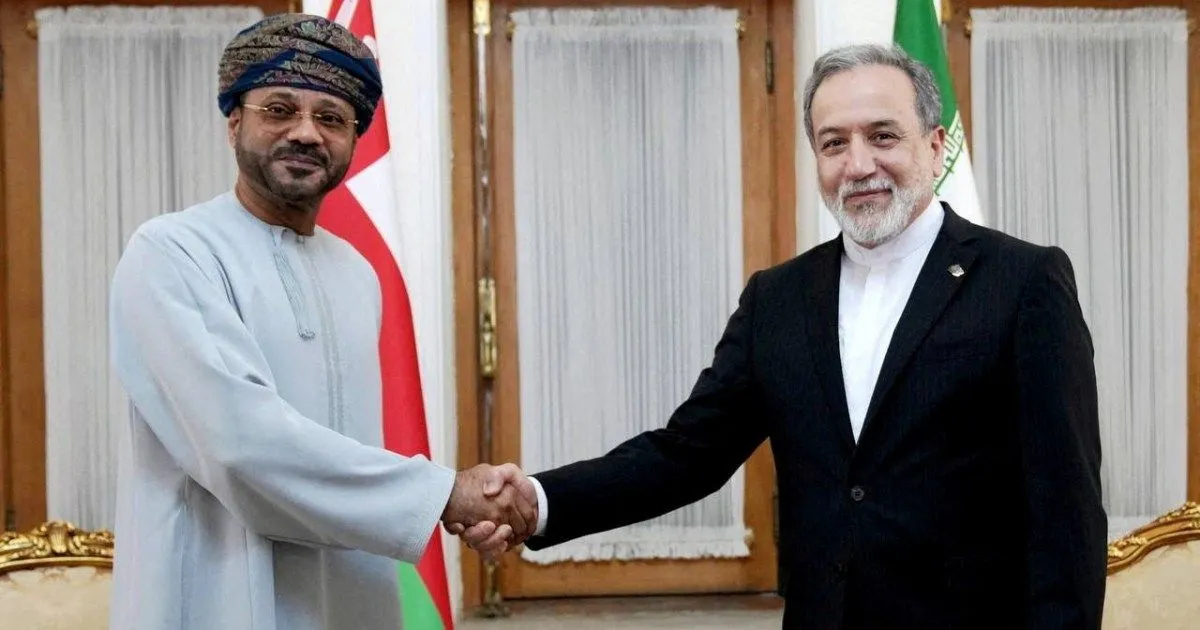
EXPLAINERThere are signs both sides could be ready to de-escalate, at least militarily, analysts say.Iran's Foreign Minister Abbas Araghchi, right, meets with Oman's Foreign Minister Badr Albusaidi in Tehran, Iran, on August 25, 2026 [Handout/Iranian Presidency via Anadolu]Published On 27 Aug 2026Qatari Prime Minister Sheikh Mohammed bin Abdulrahman bin Jassim Al Thani is visiting Tehran on Thursday for talks about de-escalating tensions and reviving failed negotiations between Iran and the United States.His visit comes amid a flurry of high-level delegations travelling to Tehran in recent days, with mediators rallying to persuade the warring sides back to the negotiating table despite continued hardline posturing on both sides.Recommended Stories list of 4 itemslist 1 of 4Qatar’s prime minister to visit Tehran, seeking to revive US-Iran talkslist 2 of 4Trump tells Al Jazeera ‘not in a hurry’ for Iran to return to talkslist 3 of 4Iran, Oman agree on temporary Hormuz route: What we knowlist 4 of 4Iran emphasises self-sufficiency in battle against US economic warend of listSheikh Mohammed, who is also Qatar’s foreign minister, will meet with “a number of Iranian officials” in Tehran to discuss ending hostilities and to “create the conditions conducive to dialogue”, a spokesperson said.He will also address the issue of the critical Strait of Hormuz in the Gulf, and “the need for it to return to the status quo before February 28”. The narrow waterway has been mostly closed to shipping since early March, when Iran closed it, and shipping traffic, which carried more than one-fifth of global oil and gas supplies before the war, has collapsed, sending global energy markets into crisis.Qatar is a key behind-the-scenes negotiator between Washington and Tehran and was pivotal in securing a memorandum of understanding (MoU) in June that briefly paused hostilities, but the deal has since expired.Here’s what else we know about the renewed push for talks:This handout picture provided by Iran’s parliament speaker’s office shows Speaker Mohammad Bagher Ghalibaf, right, receiving Pakistan’s army chief Field Marshall Asim Munir in Tehran on August 24, 2026 [AFP]Who else is visiting Tehran?On Monday, Pakistan’s army chief Asim Munir met with several high-ranking officials in Tehran, including Iranian President Masoud Pezeshkian and Parliament Speaker Mohammad Bagher Ghalibaf, Iran’s chief negotiator.He also met with General Mohsen Rezaei, the recently appointed secretary of Iran’s Supreme National Security Council.On Tuesday, Oman’s Foreign Minister Badr Albusaidi met his Iranian counterpart Abbas Araghchi in Tehran to discuss the Strait of Hormuz, which has become the biggest flashpoint in the conflict. The two countries have been negotiating how to jointly govern the shared passageway for weeks.Iranian Deputy Foreign Minister Kazem Gharibabadi on the same day announced the two sides had agreed to a new temporary shipping route in the strait that would see vessels enter through Iranian waters, and give Tehran partial control over exit routes. However, Iran emphasised that the strait will not reopen until the US lifts sanctions and unfreezes Iran’s assets.What stage is the war at now?Officially, the US and Iran are still at war and have each declared the other side as defeated, despite both suffering economically and politically from it.Amid US news reports that the US may be running low on vital interceptor missiles and equipment in the Middle East, the Trump administration has shifted to a strategy of economic pressure on Iran, announcing new sanctions this week and threatening other countries which continue to do business with it with secondary sanctions.A major obstacle is the closed Strait of Hormuz. Iran wants to continue controlling the waterway, which flows through the territorial waters of Iran and Oman, as it has done in the course of the conflict, but Washington opposes this stance and wants to return to the pre-war arrangement under which all shipping passed freely through the strait.While Trump declared this week that all seamines had been removed from the strait, experts warn that some may have been missed, meaning this remains an additional risk to ships.The US, meanwhile, is also continuing its naval blockade on Iranian ports in and around the strait, hampering Iranian oil exports.Are there signs diplomacy is working?Possibly. The breakthrough in talks between Iran and Oman over the Strait of Hormuz has been viewed by some experts as a sign that Tehran is open to negotiations.The US will also begin returning diplomatic staff who were earlier evacuated from their Middle East stations as early as next week, according to the Reuters news agency on Thursday.US staff and their family members were withdrawn after the US and Israel launched strikes on Iran in late February.Staff were evacuated from Jordan, Bahrain, Kuwait, Saudi Arabia, Lebanon and Iraq, after the US and Israel launched strikes on Iran, and as Tehran retaliated on neighbouring countries.US embassies in Saudi Arabia and Kuwait were temporarily shut down after coming under fire.Now, posts in Jordan, Israel and Oman will be fully restored, US media reported.In the United Arab Emirates, Saudi Arabia, Qatar and Lebanon, missions will be capped at 85 percent, while posts in Iraq, Kuwait and Bahrain will be limited to 75 percent.It has not been confirmed whether the US decision to return embassy staff is connected with the ongoing diplomatic push. However, analysts say it demonstrates Washington’s confidence that the war will not escalate militarily, despite the breakdown of face-to-face talks.A woman buys fruits from a store in Tehran on August 24, 2026 [AFP)What have the US and Iran said about peace talks?Statements from both sides stand in stark contrast to the new push for peace, however.US President Donald Trump told Al Jazeera on Wednesday he is in “no hurry” to resume talks with Iran and said he believes economic and military action against Tehran will both be effective.Washington has notably shifted away from military operations to a strategy of increased economic pressure on Tehran, however. On Monday, a sweeping set of sanctions was unleashed on Iranian firms and Tehran’s trade partners.More than 60 individuals and organisations were targeted across five sectors that Washington accuses of sustaining Iran’s economy: digital assets, technology, gold, aviation and shipping. Oil and financial sectors have been under sanctions for some time.The new sanctions affect entities in China, Hong Kong, the UK, Ukraine, Syria, France, Malaysia, Singapore and several other countries.Iran, meanwhile, has rejected and condemned the new sanctions. In a letter to the United Nations on Wednesday, Iran’s Foreign Minister Araghchi described the US sanctions as an “act of state and economic terrorism”. He urged member states not to implement them.High-ranking military officials recently appointed in a security cabinet shuffle have also continued to issue defiant statements. When Pakistan’s Munir visited, Supreme National Security Council secretary Rezaei reportedly told him that Iran “distrusts America”.However, Iranian President Pezeshkian has sounded a slightly different tune.Last week, he called for Iran to negotiate from a place of strength, not weakness, saying: “It is better that we bring the war to an end now as we are in a position of power and dignity.”The Iranian president’s authority is, however, limited, as he is subordinate to Supreme Leader Mojtaba Khamenei. Hardliners, especially in the military, have accused his government of conceding to the US by agreeing to the June MoU, although the president has pushed back against that criticism, saying the agreement did not represent capitulation.What does the renewed diplomatic activity mean?There’s no confirmation yet that the US is directly involved in the flurry of diplomatic activity seen this past week.However, some analysts speculate that the US’s increased economic pressure on Iran could be a means to force Tehran to agree to negotiations.
SRCAl Jazeera
LANGEN
LEANCenter
WORDS1 250
ENT12
THU · 2026-08-27 · 10:50 GMTBRIEF NSR-2026-0827-106439
NSR-2026-0827-106439News Report·EN·Diplomatic
Is Iran war diplomacy ramping up, as Qatar, Oman, Pakistan officials visit?
High-level diplomatic visits to Tehran, including from Qatar, Oman, and Pakistan, suggest a potential de-escalation in the conflict between Iran and the United States. Qatari Prime Minister Sheikh Mohammed bin Abdulrahman bin Jassim Al Thani is in Tehran to discuss ending hostilities and reviving stalled negotiations, as well as the critical Strait of Hormuz.
Al Jazeera StaffAl JazeeraFiled 2026-08-27 · 10:50 GMTLean · CenterRead · 5 min
Al JazeeraFIG 01
Reading time
5min
Word count
1 250words
Sources cited
5cited
Entities identified
12entities
Quality score
100%
§ 01
Briefing Summary
AI-generatedNEWSAR · AI
High-level diplomatic visits to Tehran, including from Qatar, Oman, and Pakistan, suggest a potential de-escalation in the conflict between Iran and the United States. Qatari Prime Minister Sheikh Mohammed bin Abdulrahman bin Jassim Al Thani is in Tehran to discuss ending hostilities and reviving stalled negotiations, as well as the critical Strait of Hormuz. Oman's Foreign Minister also met with his Iranian counterpart to discuss the strait, with an agreement reached on a temporary shipping route. These visits follow Pakistan's army chief meeting with Iranian officials. The conflict has led to the closure of the Strait of Hormuz, impacting global energy markets, and the US has imposed new sanctions on Iran. Despite hardline posturing, analysts see these diplomatic efforts as signs of readiness for dialogue.
Confidence 0.90Sources 5Claims 5Entities 12
§ 02
Article analysis
Model · rule-basedFraming
Diplomatic
Conflict
Tone
Measured
AI-assessed
CalmNeutralAlarmist
Factuality
0.70 / 1.00
Factual
LowHigh
Sources cited
5
Well sourced
FewMany
§ 03
Key claims
5 extracted01
Oman’s Foreign Minister Badr Albusaidi met his Iranian counterpart Abbas Araghchi in Tehran to discuss the Strait of Hormuz.
factualarticle
Confidence
0.90
02
Pakistan’s army chief Asim Munir met with Iranian President Masoud Pezeshkian and Parliament Speaker Mohammad Bagher Ghalibaf in Tehran on Monday.
factualarticle
Confidence
0.90
03
The Strait of Hormuz has been mostly closed to shipping since early March, when Iran closed it, and shipping traffic has collapsed.
factualarticle
Confidence
0.90
04
Qatari Prime Minister Sheikh Mohammed bin Abdulrahman bin Jassim Al Thani is visiting Tehran for talks about de-escalating tensions and reviving failed negotiations between Iran and the United States.
factualarticle
Confidence
0.90
05
Iran and Oman have agreed to a new temporary shipping route in the Strait of Hormuz.
factualKazem Gharibabadi
Confidence
0.80
§ 04
Full report
5 min read · 1 250 words§ 05
Entities
12 identifiedKey playerOppositionContextPositiveNeutralNegative
People6
§ 06
Keywords & salience
10 termsiran war diplomacy
1.00
de-escalation
0.90
strait of hormuz
0.80
us-iran talks
0.70
negotiations
0.70
hostilities
0.70
energy markets
0.60
qatar
0.60
pakistan
0.50
oman
0.50
§ 07
Topic connections
Interactive graph Network visualization showing 51 related topics
View Full Graph Person Organization Location Event|Click node to navigate|Edge numbers = shared articles