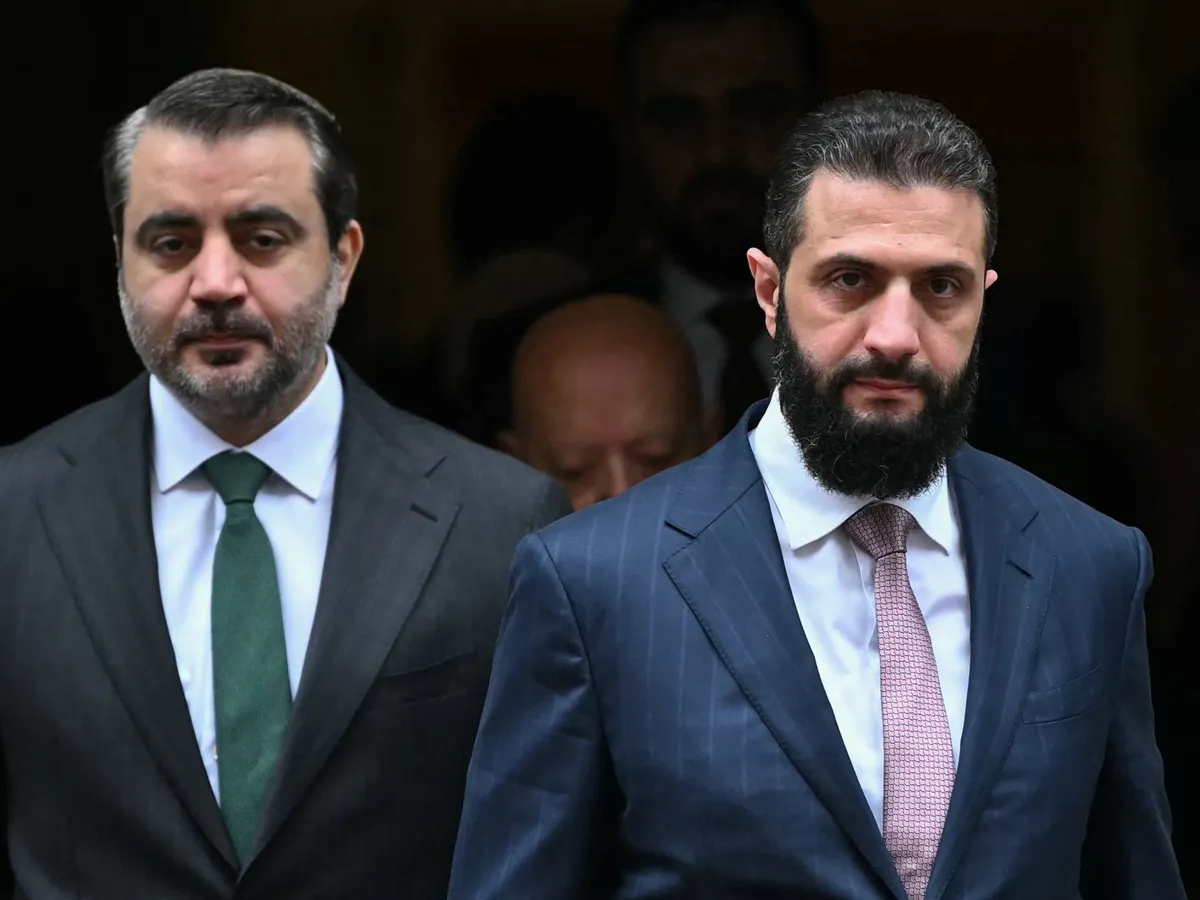
Israel has attacked Syria, occupied its south since the al-Assad regime’s ouster, testing Syria’s diplomatic outreach. But analysts say Damascus has few other options for now.Syria's President Ahmed al-Sharaa and Foreign Minister Asaad al-Shaibani [File: Justin Tallis/Pool via Reuters]Published On 31 Aug 2026Ever since the fall of Bashar al-Assad’s government, Syria has chosen diplomatic engagement with Israel over military confrontation.As Syria’s new government attempts to rebuild the country after more than a decade of war, the country’s officials have committed themselves to a policy of avoiding conflicts with their neighbours.Yet Israel continues to disrupt any efforts at a more sustained peace agreement, including through repeated attacks on Syrian soil. But analysts told Al Jazeera that despite these provocations, Damascus sees the diplomatic track as its only choice.“Syria’s government is intensely pragmatic in that it’s willing to basically sit down and talk to and do deals with people as long as it promotes Syria’s national interest,” Rob Geist Pinfold, a lecturer on security studies at King’s College London, told Al Jazeera.Syria’s concernsUnder the al-Assad presidency, Syria was a part of the Iran-driven “axis of resistance” that also included other allies of Tehran. Syrian territory was used to transport weapons and financial aid from Iran to Tehran’s Lebanese allies, Hezbollah.The Syrian military itself, however, has not engaged militarily with Israel since a 1974 disengagement agreement signed under Bashar’s father and predecessor, Hafez al-Assad.When rebels led by current President Ahmed al-Sharaa took Damascus and deposed the al-Assad government in December 2024, Israel instantly responded by attacking Syria’s military infrastructure around the country. Israeli troops also moved further into parts of southern Syria, beyond the occupied Golan Heights. Almost two years later, Israeli troops continue to set up checkpoints and harass and arrest Syrian citizens in these parts of the country.Since then, Syrian officials, including President al-Sharaa, have said they have no intent to attack Israel and that they seek peace with all their neighbours. Still, Israel has threatened the Syrian government on numerous occasions, warning them not to deploy military troops in southern Syria and even bombing the Syrian Ministry of Defence in Damascus in July 2025.“The government has to walk a tightrope as ever,” Geist Pinfold said. “There seems to be a feeling in Syria that Syrians are tired of war, they’re tired of conflict, they want stability, they want to be able to grow, they want to practise nation building.”Damascus has responded to the numerous aggressions by seeking regional and international help. Syria’s new government has gained the trust of Donald Trump’s administration in the US and has close ties with Turkiye and numerous Gulf states. Continued Israeli aggressions and violations have not deterred Syria’s efforts at diplomacy either.“The Syrian government is hoping that it can basically leverage its pragmatism to create stability in Syria by basically removing Israel as the key spoiler at the moment in contemporary post-Assad Syria,” Geist Pinfold said. “It hasn’t been able to do that so far simply because under the Netanyahu administration, Israel seems more willing to live by the sword.”While Damascus has said it is committed to peace and diplomacy, it has also made clear it does not yet view Israel as a reliable neighbour. Syria’s Foreign Minister Asaad al-Shaibani told the Reuters news agency: “We do not trust Israel currently.”Syria has also filed multiple complaints with the United Nations regarding Israel.“Damascus does not currently consider Israel a trustworthy political partner, but it views negotiations with it as a security necessity,” Souhayb Jawhar, a Lebanese analyst with Badil, a Beirut-based think tank, told Al Jazeera.Jawhar said Damascus has three immediate demands, which include stopping Israeli strikes on Syrian territory, stopping Israeli incursions into Syrian territory and the arrests of Syrian citizens, and forcing Israel to withdraw its troops from the areas it seized after the fall of al-Assad.“After years of war, Syrians are exhausted and certainly not interested in another war,” Bente Scheller, head of Heinrich-Boll-Stiftung’s Middle East and North Africa Division, told Al Jazeera. “However, Israel acting with impunity in Syria creates hard feelings and undermines support for normalisation or even peace.”Until now, Syria appears to believe that the alternative to diplomacy with Israel, even in the face of Israeli attacks, could be too costly, particularly for a country still rebuilding after several devastating years of war.“[Diplomacy] is the least costly option for Damascus,” Jawhar said. “The Syrian leadership does not want to open a military front with Israel while it is rebuilding its army, state and economy. It is also counting on the United States to impose constraints on Israeli behaviour.”Israel’s concernsAl-Shaibani met with Roman Gofman, the head of Israel’s Mossad intelligence agency, in US-mediated talks in Amman recently. Syria’s state media agency SANA said the talks “focused on establishing practical mechanisms to halt Israeli attacks, arrests and targeting operations” and “reviving negotiations for a lasting security agreement between the two sides”.The talks came on the back of an Israeli attack on a Syrian airbase near Idlib, in northwest Syria, though the two sides had reportedly also met shortly before that attack. Analysts said the attacks were likely a message to Syria about efforts to rebuild their air force and to Turkiye, whose zone of influence extends across northern Syria.But despite Israel’s belligerence, analysts said Syrians generally are supportive of the government’s efforts to avoid conflict and apply pressure on the Israelis via regional and international allies.“There seems to be a popular appetite for Israel to basically go away and stop being a threat and stop being a spoiler,” Geist Pinfold said. “That does not mean that there’s a popular appetite, for example, for Syria to give up its claim to the Golan Heights.”The issue of the Golan Heights has particular relevance in Syria. The area was originally occupied by Israel in 1967 and Israeli troops further advanced in the Golan after the fall of al-Assad in December 2024. Israel has said repeatedly they do not intend to give up the Golan Heights, which also gives Israel a direct flight path to attack Iran, Geist Pinfold pointed out.And with October’s elections approaching in Israel, many analysts said Benjamin Netanyahu’s government may look to raise tensions on Israel’s many fronts, including possibly in Syria, rather than ease them.“There’s this understanding that coming to an agreement [with Syria] could actually be worse for Israel’s national interests,” Geist Pinfold said. “Whereas if it doesn’t agree to anything, it can’t be accused of breaking anything. And also it gives Israel more operational freedoms.”Turkiye as the next bogeymanAfter Israel’s attack on the airbase, US Ambassador to Turkiye Tom Barrack proposed the creation of a deconfliction mechanism that would include Turkiye, Syria and Israel.The mechanism follows other such US-led efforts in Lebanon and between Israel and Syria in Amman. Analysts, however, said such a mechanism was unlikely to be effective without concerted US pressure on Israel.“The recent bombardments of Abu al-Duhur airbase despite intense talks the days before show that the current Israeli government values military means over a political process and does not hesitate to act against Trump’s plans,” Scheller said.Despite declared ceasefires or efforts at de-escalation, Israel continues attacks on people, including civilians, in Gaza, the occupied West Bank, Lebanon and Syria. And analysts believe it has a new enemy in its crosshairs.
SRCAl Jazeera
LANGEN
LEANCenter
WORDS1 207
ENT12
MON · 2026-08-31 · 08:05 GMTBRIEF NSR-2026-0831-107620
NSR-2026-0831-107620Analysis·EN·Diplomatic
Syria is choosing diplomacy with Israel, but can its approach last?
Following the ouster of the al-Assad regime in December 2024, Syria has adopted a diplomatic approach towards Israel, prioritizing rebuilding and avoiding conflict. Despite this, Israel has conducted attacks on Syrian territory and occupied parts of southern Syria, testing Damascus's strategy.
Justin SalhaniAl JazeeraFiled 2026-08-31 · 08:05 GMTLean · CenterRead · 5 min
Al JazeeraFIG 01
Reading time
5min
Word count
1 207words
Sources cited
1cited
Entities identified
12entities
Quality score
100%
§ 01
Briefing Summary
AI-generatedNEWSAR · AI
Following the ouster of the al-Assad regime in December 2024, Syria has adopted a diplomatic approach towards Israel, prioritizing rebuilding and avoiding conflict. Despite this, Israel has conducted attacks on Syrian territory and occupied parts of southern Syria, testing Damascus's strategy. Analysts suggest Syria sees diplomacy as its only viable option due to exhaustion from war and the need for stability. Syria's new government seeks regional and international support, including from the US, Turkey, and Gulf states, to counter Israeli aggressions. Damascus has three immediate demands: an end to Israeli strikes and incursions, the release of detained citizens, and Israeli troop withdrawal from occupied areas. While Syria officially seeks peace, it does not currently trust Israel as a reliable partner.
Confidence 0.90Sources 1Claims 5Entities 12
§ 02
Article analysis
Model · rule-basedFraming
Diplomatic
Conflict
Tone
Measured
AI-assessed
CalmNeutralAlarmist
Factuality
0.60 / 1.00
Mixed
LowHigh
Sources cited
1
Limited
FewMany
§ 03
Key claims
5 extracted01
Syria's government is intensely pragmatic and willing to talk to and do deals as long as it promotes Syria’s national interest.
quoteRob Geist Pinfold
Confidence
1.00
02
Israel attacked Syria's military infrastructure and occupied parts of southern Syria after the al-Assad government was deposed.
factual
Confidence
0.95
03
Syrian officials have stated they have no intent to attack Israel and seek peace with their neighbors.
factual
Confidence
0.90
04
Syria has chosen diplomatic engagement with Israel over military confrontation since the fall of Bashar al-Assad’s government.
factual
Confidence
0.90
05
Despite provocations, Damascus sees the diplomatic track as its only choice.
factualanalysts
Confidence
0.85
§ 04
Full report
5 min read · 1 207 words§ 05
Entities
12 identifiedKey playerOppositionContextPositiveNeutralNegative
People4
Organizations3
§ 06
Keywords & salience
8 termssyria diplomacy israel
1.00
al-assad regime
0.80
syrian national interest
0.70
axis of resistance
0.60
military confrontation
0.50
hezbollah
0.50
occupied south syria
0.40
ahmed al-sharaa
0.40
§ 07
Topic connections
Interactive graph Network visualization showing 51 related topics
View Full Graph Person Organization Location Event|Click node to navigate|Edge numbers = shared articles