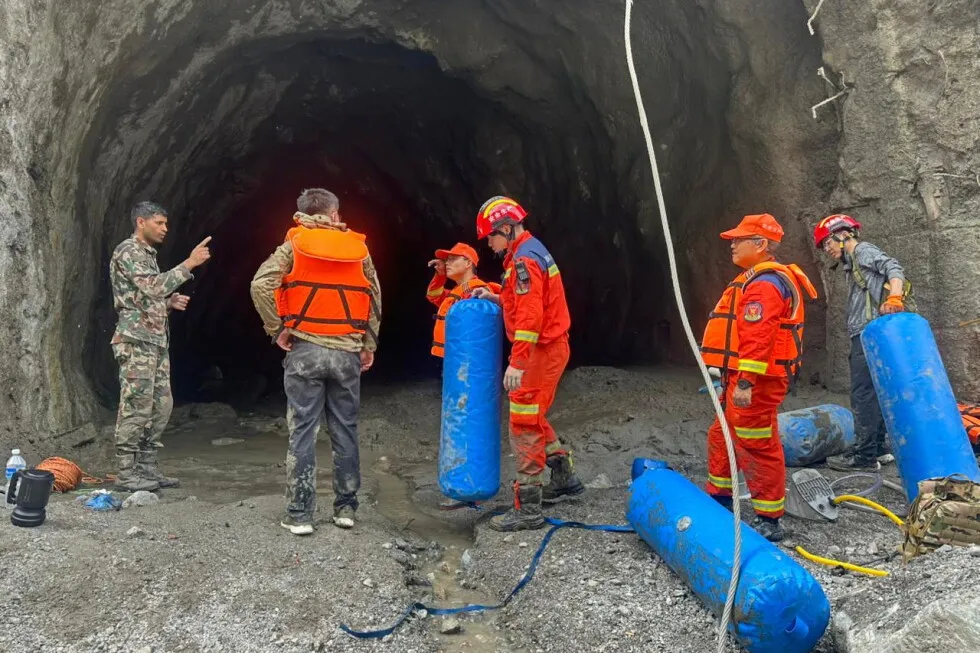
Why finding missing workers from Nepal’s hydropower tunnels is proving to be difficult 1 of 3 | This photo provided by the Nepal-army" class="entity-link entity-organization" data-entity-id="194000" data-entity-type="organization">Nepal Army, shows Nepal-army" class="entity-link entity-organization" data-entity-id="194000" data-entity-type="organization">Nepal Army soldiers undertake rescue operation at the site of a hydropower project in Upper Trishuli, Nepal, Monday, Aug. 31, 2026. (Nepal-army" class="entity-link entity-organization" data-entity-id="194000" data-entity-type="organization">Nepal Army via AP) 2 of 3 | Residents carry their belongings as they walk to safer areas in the aftermath of flash floods in Devighat, in Nepal’s Nuwakot district, Thursday, Aug. 27, 2026. (AP Photo/Niranjan Shrestha) 3 of 3 | In this image provided by Manish Maharjan, filmmaker and drone pilot Manish Maharjan operates a drone at the entrance to a tunnel at the Rashuwaghadi hydropower project in Rasuwa district, Nepal, Monday, Aug. 31, 2026. (Manish Maharjan via AP) By SHEIKH SAALIQ and SHRISTI KAFLE Updated 1:03 PM MESZ, September 1, 2026 Add AP News on Google Add AP News as your preferred source to see more of our stories on Google. Share Share Facebook Copy Link copied Print Email X LinkedIn Bluesky Flipboard Pinterest Reddit NEW DELHI (AP) — Rescue crews in Nepal are racing against time to find hundreds of missing workers who are feared trapped inside hydropower tunnels damaged by flooding that has killed more than 1,000 people across Nepal and China. At least 900 workers are missing from hydropower projects, with about 500 believed to be inside tunnels, according to officials and industry representatives. Access to the tunnels has been hampered by flooding, debris and damaged infrastructure, making it difficult for rescue teams to reach workers. Brig. Gen. Raja Ram Basnet, a Nepal-army" class="entity-link entity-organization" data-entity-id="194000" data-entity-type="organization">Nepal Army spokesperson, said teams assisted by foreign experts were working at several hydropower projects. Army footage showed rescuers entering dark, debris-filled tunnels, wading through mud and climbing over rocks as they searched for the missing. Mohan Kumar Dangi, president of the Nepal" class="entity-link entity-organization" data-entity-id="197936" data-entity-type="organization">Independent Power Producers Association of Nepal, said floods damaged at least 12 hydropower projects in Rasuwa and Nuwakot districts, with a combined capacity of 670 MW. Four were under construction, seven operational and one in testing phase, he said. hydropower projects undergo risk assessments and other studies before construction, but called the Aug. 26 flooding “something unimaginable,” Dangi said. The biggest challenge for rescuers is reaching them. Many of Nepal’s hydropower projects are in remote, mountainous areas where steep terrain and narrow roads can make access difficult. flooding has worsened conditions, damaging roads and limiting routes to some sites. Rescuers also are facing tunnels that are blocked or damaged. The floods swept mud, huge rocks and debris into underground passages, collapsing sections and trapping workers. Even where tunnel entrances are accessible, crews must clear large amounts of debris before reaching deeper sections. Rescuers comb through mud and debris as Nepal-China floods leave more than 1,000 dead 2 MIN READ Hundreds feared stuck in hydropower tunnels as flood deaths surpass 950 in Nepal and Tibet 1 MIN READ ‘No hollow or empty space': A drone operator reveals difficulties in Nepal’s tunnel rescue efforts 1 MIN READ Debris is obscuring the locations of workers Finding the missing workers also has proved difficult. Filmmaker and drone pilot Manish Maharjan, who has been volunteering with the Nepalese army, said some tunnels were “filled with mud like toothpaste in a tube.” At one hydropower project, he used a drone to search to the end of a tunnel but found no sign of life. Some workers called for help during early hours after floods, while others who escaped said colleagues remained underground. It was not clear whether rescuers had since made contact with those workers or whether they were still alive. Experts say the first 72 hours after a disaster can be critical. People trapped underground may survive without food for some time, but limited drinking water and breathable air can quickly become life-threatening. Anil Pokhrel, a disaster risk reduction expert and former head of Nepal’s disaster authority, said the flooding exposed weaknesses in Nepal’s rescue capacity. He said rescuers lost valuable time locating the tunnel’s exact entry point and coordinates and lacked heavy equipment and adequately trained personnel. “Harsh and remote locations with inclement weather worsened the situation. Also, we didn’t have adequately trained human resources to undertake such operations,” he said. Nepal has more than a century of experience building tunnels but remains poorly prepared for complex tunnel rescues, Pokhrel said. “We are focused on tunnel design and construction but are not adequately prepared for rescue operations,” he said. SHEIKH SAALIQ Saaliq is the South Asia correspondent for The Associated Press, based in New Delhi. He reports on India and the wider South Asia region, with a focus on politics, democracy, conflict and religion. twitter mailto
SRCAssociated Press (AP)
LANGEN
LEANCenter
WORDS777
ENT12
TUE · 2026-09-01 · 11:23 GMTBRIEF NSR-2026-0901-108063
NSR-2026-0901-108063News Report·EN·Human Interest
Why finding missing workers from Nepal’s hydropower tunnels is proving to be difficult
Rescue efforts are underway in Nepal to find hundreds of workers feared trapped in hydropower tunnels following severe flooding. Approximately 500 workers are believed to be inside tunnels at damaged hydropower projects, with access severely hindered by debris, mud, and collapsed infrastructure.
Associated Press (AP)Filed 2026-09-01 · 11:23 GMTLean · CenterRead · 4 min
Associated Press (AP)FIG 01
Reading time
4min
Word count
777words
Sources cited
3cited
Entities identified
12entities
Quality score
100%
§ 01
Briefing Summary
AI-generatedNEWSAR · AI
Rescue efforts are underway in Nepal to find hundreds of workers feared trapped in hydropower tunnels following severe flooding. Approximately 500 workers are believed to be inside tunnels at damaged hydropower projects, with access severely hindered by debris, mud, and collapsed infrastructure. Remote locations, difficult terrain, and damaged roads further complicate rescue operations. Rescuers are facing tunnels filled with mud and rocks, making it challenging to locate and reach any survivors. Experts highlight that Nepal's rescue capacity is being tested, with a lack of heavy equipment and adequately trained personnel for such complex tunnel rescues. The flooding has already caused over 1,000 deaths across Nepal and China.
Confidence 0.90Sources 3Claims 5Entities 12
§ 02
Article analysis
Model · rule-basedFraming
Human Interest
Economic Impact
Tone
Mixed Tone
AI-assessed
CalmNeutralAlarmist
Factuality
0.80 / 1.00
Factual
LowHigh
Sources cited
3
Well sourced
FewMany
§ 03
Key claims
5 extracted01
Access to the tunnels has been hampered by flooding, debris, and damaged infrastructure.
factual
Confidence
0.95
02
The floods swept mud, huge rocks, and debris into underground passages, collapsing sections and trapping workers.
factual
Confidence
0.90
03
Floods damaged at least 12 hydropower projects in Rasuwa and Nuwakot districts.
statisticMohan Kumar Dangi, president of the Independent Power Producers Association of Nepal
Confidence
0.90
04
Hundreds of workers are feared trapped inside hydropower tunnels damaged by flooding.
factual
Confidence
0.90
05
At least 900 workers are missing from hydropower projects, with about 500 believed to be inside tunnels.
statisticofficials and industry representatives
Confidence
0.85
§ 04
Full report
4 min read · 777 words§ 05
Entities
12 identifiedKey playerOppositionContextPositiveNeutralNegative
Organizations3
Locations5
§ 06
Keywords & salience
9 termshydropower tunnels
1.00
rescue operation
0.90
missing workers
0.90
flooding
0.80
nepal
0.70
damaged infrastructure
0.60
remote areas
0.50
mountainous areas
0.50
risk assessments
0.40
§ 07
Topic connections
Interactive graph Network visualization showing 51 related topics
View Full Graph Person Organization Location Event|Click node to navigate|Edge numbers = shared articles