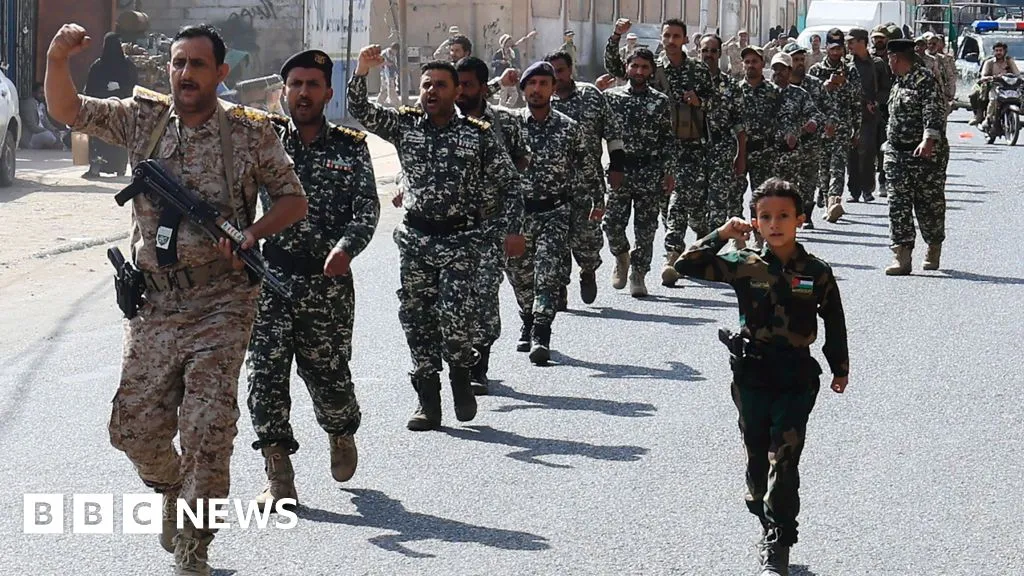
ReutersSaudi-backed Yemeni forces have been struggling to contain Houthi advancesThe Houthis' lightning advance across the southern reaches of the Tihamah – Yemen's arid coastal plain – appears to have taken most observers by surprise.Until recently, the anti-Houthi coalition known as the National Resistance held significant territory along Yemen's Red Sea coast. In a matter of days, much of this has fallen to the Houthis.According to some estimates, the Iranian-backed rebels have captured as much as 130km (81 miles) of the country's strategically important coastline.It's the group's most impressive military coup for several years, proving that despite a civil war that has lasted 12 years, devastating Saudi air raids and attacks by American, Israeli and British forces, the Houthis remain a force to be reckoned with.With their opponents stunned and demoralised, it's unlikely the Houthis will be dislodged any time soon."Now that they are there, they're going to be entrenched," Hisham al-Omeisi, senior analyst at the Brussels-based European Institute of Peace, told the BBC. "And it's going to be a lot more costly to push them out."Of course, the Houthis are not alone. They enjoy the backing of Iran, support that has become even more important for Tehran in the wake of the setbacks and defeats experienced by other parts of its so-called "Axis of Resistance" – Lebanese Hezbollah, Hamas in Gaza and the Assad regime in Syria."So they redirected their support to the Houthis," al-Omeisi said. "And of course they need that support."Even though most analysts agree that it's a mistake simply to describe the Houthis as Iranian puppets, events of the past few days raise an uncomfortable new reality.Seven months after the US and Israel launched their huge, combined assault on Iran, the regime in Tehran now exerts authority over not just one, but two of the world's most important maritime passages: the Strait of Hormuz, at the mouth of the Persian Gulf, and the Bab al-Mandab, gateway to the Red Sea (and the Suez Canal)."Now Iran, directly and through proxies, controls two of the most strategic choke points in the Middle East and the world," says Farea al-Muslimi, a research fellow at London's Chatham House think tank, "controlling more than 35% of the fuel and oil trade globally.""This is as much leverage as a nuclear bomb," he says.If the Houthis have also taken control of several key islands in the Red Sea, including Perim - which sits in the middle of the narrowest point of the Bab al-Mandab - then the group's ability to interfere with international shipping will be greatly enhanced.As the group's actions in the wake of Israel's war on Gaza proved, shipping in the Red Sea is highly vulnerable to Houthi missiles, drones and small attack boats."They were able to control what was going in and out of the Bab al-Mandab and up towards Suez without having these territorial gains," Yemen expert Iona Craig told BBC Radio 4's Today programme on Friday."But of course now they're controlling the area immediately overlooking the Bab al-Mandab, and this gives them far more leverage."Shipping companies are likely to be sceptical about the sincerity of a statement released on Friday afternoon, in which the Houthi military said that maritime navigation was "safe for all companies except for Saudi vessels, which have already been subject to a blockade".In their earlier attacks, the Houthis said they were only targeting vessels linked to Israel, but in fact hit ships with no such connection, including a Norwegian-flagged tanker.Craig said the Houthis may nevertheless refrain from indiscriminate attacks, fearing a repeat of Operation Rough Rider - six weeks of major US air and naval strikes in the spring of 2025."They've already felt the wrath of the US," she said.But would the US want to get involved anyway?President Donald Trump's war with Iran is already unpopular. With oil prices creeping back up, it's doubtful that a new front would do much to enhance his approval ratings or his Republican party's chances in November's midterm US elections.EPAThe Houthis control large parts of Yemen, including the main city SanaaAccording to the Axios website, appeals for US intervention from the Saudi Crown Prince Mohammed bin Salman have so far gone unanswered.Axios writes that the US "is increasingly concerned about the escalating conflict in Yemen and is working to intensify its support for the kingdom while simultaneously seeking to avoid direct military involvement".But it's not just the potential threat to the Bab al-Mandab that's causing fear in Saudi Arabia.Satellite images of an apparent Houthi missile-and-drone attack on Saudi Arabia's East-West pipeline – a vital alternative route for oil exports following the closure of the Strait of Hormuz earlier this year – point to an effort by Iran's Yemeni allies to add to the economic pressures generated by the US-Israeli war with Iran.Even if Iran did not directly order the attack, it clearly stands to benefit.Baraa Shaiban, a researcher and analyst at the London-based Royal United Services Institute, says the origins of the latest upsurge in fighting – the worst since a United Nations-brokered truce in 2022 - can be traced back to July, when a Houthi delegation returned from the state funeral of Iran's Supreme Leader, Ayatollah Ali Khamenei."Immediately after, the escalation started," he says, "and it looked very clearly that [Iran was] determined to now have a bigger foothold on the Red Sea".With Yemen teetering on the edge of a return to all-out war, Saudi Arabia anxious about preserving its economic lifeline to the Red Sea and Donald Trump apparently reluctant to get involved, America's conflict with Iran just took on a new and potentially dangerous dimension.For the people of Yemen, displaced, bombed, starved and impoverished by a dozen years of civil war, recent developments can only make their lives worse.
SRCBBC News - World
LANGEN
LEANCenter
WORDS953
ENT12
FRI · 2026-09-11 · 19:44 GMTBRIEF NSR-2026-0911-110622
NSR-2026-0911-110622Analysis·EN·Conflict
Lightning Houthi advance in Yemen may bring dangerous new dimension to Iran war
Houthi rebels have captured approximately 130km of Yemen's strategic Red Sea coastline, marking their most significant military achievement in years. This advance, surprising observers, has seen them seize territory previously held by Saudi-backed forces.
15 minutes agoShareSaveAdd as preferred on GooglePaul AdamsDiplomatic correspondentBBC News - WorldFiled 2026-09-11 · 19:44 GMTLean · CenterRead · 4 min
BBC News - WorldFIG 01
Reading time
4min
Word count
953words
Sources cited
3cited
Entities identified
12entities
Quality score
100%
§ 01
Briefing Summary
AI-generatedNEWSAR · AI
Houthi rebels have captured approximately 130km of Yemen's strategic Red Sea coastline, marking their most significant military achievement in years. This advance, surprising observers, has seen them seize territory previously held by Saudi-backed forces. The Houthis, supported by Iran, now control the Bab al-Mandab strait, a critical maritime passage, alongside Iran's existing influence over the Strait of Hormuz. This dual control significantly enhances Iran's leverage over global oil trade. The rebels' ability to disrupt shipping, as demonstrated previously, is now amplified by their territorial gains. While the US is concerned and increasing support for Saudi Arabia, it is reportedly seeking to avoid direct military involvement in Yemen, potentially due to the unpopularity of President Trump's war with Iran.
Confidence 0.90Sources 3Claims 5Entities 12
§ 02
Article analysis
Model · rule-basedFraming
Conflict
Political Strategy
Tone
Mixed Tone
AI-assessed
CalmNeutralAlarmist
Factuality
0.60 / 1.00
Mixed
LowHigh
Sources cited
3
Well sourced
FewMany
§ 03
Key claims
5 extracted01
Iran, through its proxies, now controls two critical global maritime passages: the Strait of Hormuz and the Bab al-Mandab.
quoteFarea al-Muslimi
Confidence
0.90
02
Houthi forces have made rapid advances across Yemen's southern Tihamah coastal plain, capturing significant territory.
factual
Confidence
0.90
03
Control of the Bab al-Mandab and key islands like Perim significantly enhances the Houthis' ability to disrupt international shipping.
factual
Confidence
0.85
04
Iran's backing of the Houthis is increasingly important for Tehran due to setbacks in its other regional proxies.
quoteHisham al-Omeisi
Confidence
0.85
05
The Houthis' recent military gains are their most impressive in years, demonstrating their continued strength.
factual
Confidence
0.80
§ 04
Full report
4 min read · 953 words§ 05
Entities
12 identifiedKey playerOppositionContextPositiveNeutralNegative
Organizations5
Locations6
§ 06
Keywords & salience
9 termshouthi advances
1.00
iran war
0.90
yemen
0.80
strategic coastline
0.70
bab al-mandab
0.60
axis of resistance
0.60
strait of hormuz
0.50
maritime passages
0.50
oil trade
0.40
§ 07
Topic connections
Interactive graph Network visualization showing 51 related topics
View Full Graph Person Organization Location Event|Click node to navigate|Edge numbers = shared articles