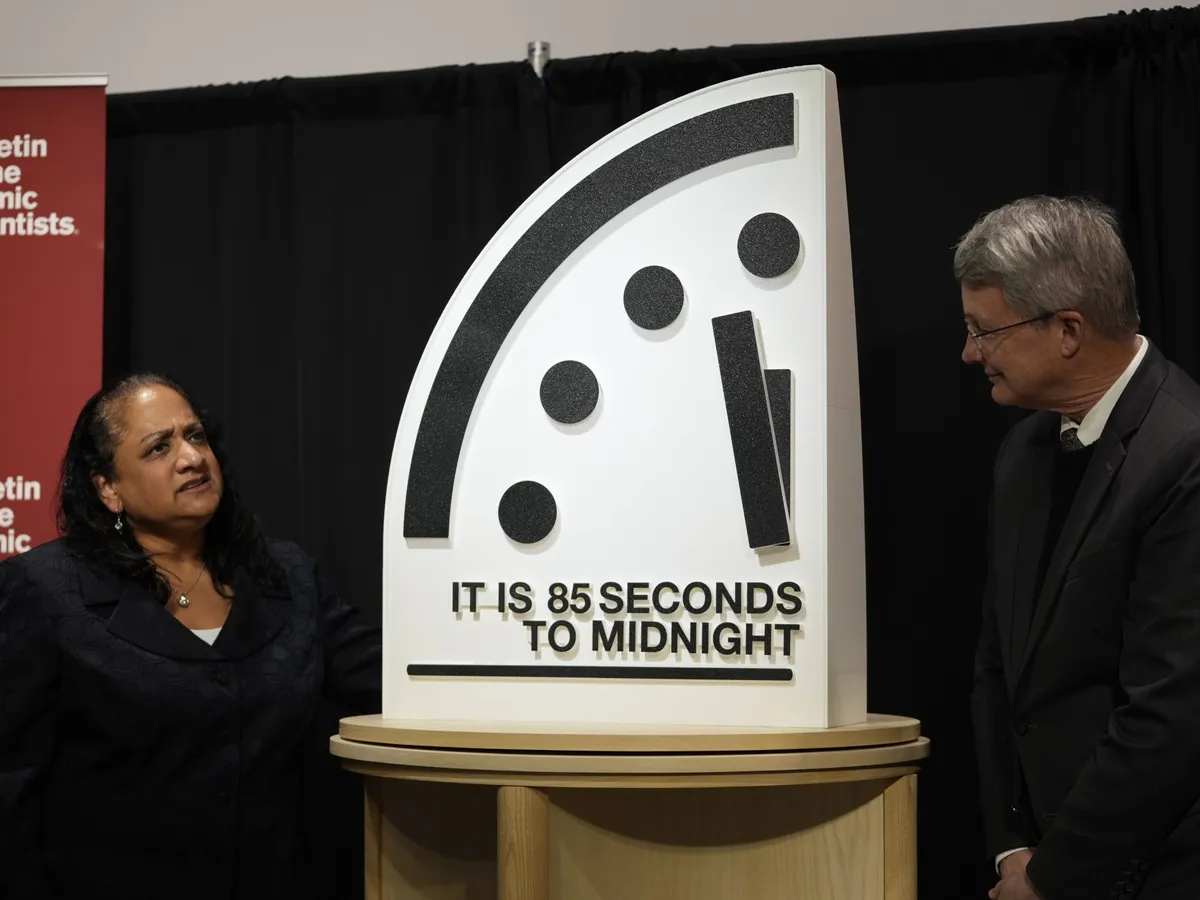
Atomic scientists say the public must demand swift action from leaders to reverse course on nuclear weapons and climate threats.Published On 28 Jan 2026The world is closer than ever to destruction, scientists have said, as the Doomsday Clock was set at 85 seconds to midnight for 2026, the gloomiest assessment of humanity’s prospects since the beginning of the tradition in 1947.The Bulletin of the Atomic Scientists, a not-for-profit organisation founded by Albert Einstein and other scientists, warned in its annual assessment on Tuesday that international cooperation is going backwards on nuclear weapons, climate change and biotechnology, while artificial intelligence poses new threats.(Al Jazeera)“The Doomsday Clock’s message cannot be clearer. Catastrophic risks are on the rise, cooperation is on the decline, and we are running out of time,” said Alexandra Bell, the president and CEO of the Bulletin of the Atomic Scientists.Recommended Stories list of 4 itemslist 1 of 4Renewables muscle fossil fuels out of EU electricity market, says researchlist 2 of 4‘Change is inevitable’: What is next for Iran?list 3 of 4Pentagon downplays China threat: What it means for US allieslist 4 of 4The ‘discombobulator’: Did US use ‘secret weapon’ in Maduro abduction?end of list“Change is both necessary and possible, but the global community must demand swift action from their leaders,” Bell said.In a more detailed statement explaining the reasoning for moving the clock closer to midnight, the bulletin expressed concerns that countries including Russia, China, and the United States were becoming “increasingly aggressive, adversarial, and nationalistic”.It said that “hard-won global understandings are collapsing”, while a “winner-takes-all great power competition” is emerging in its place.The assessment cited conflicts in 2025, including Russia’s war on Ukraine, clashes between India and Pakistan that erupted in May, and the US and Israel’s attacks on Iran in June.On the climate emergency, the bulletin said that national and international responses have ranged from “wholly insufficient to profoundly destructive”.“None of the three most recent UN climate summits emphasised phasing out fossil fuels or monitoring carbon dioxide emissions,” it said, adding that US President Donald Trump has “essentially declared war on renewable energy and sensible climate policies, relentlessly gutting national efforts to combat climate change”.
SRCAl Jazeera
LANGEN
LEANCenter
WORDS358
ENT12
WED · 2026-01-28 · 05:03 GMTBRIEF NSR-2026-0128-11185
NSR-2026-0128-11185News Report·EN·National Security
Symbolic Doomsday Clock moves closer to midnight amid ‘catastrophic risks’
In January 2026, the Bulletin of the Atomic Scientists moved the symbolic Doomsday Clock to 85 seconds to midnight, the closest it has been since 1947. The Bulletin, founded by Albert Einstein, cited increasing dangers from nuclear weapons, climate change, biotechnology, and artificial intelligence.
Lyndal RowlandsAl JazeeraFiled 2026-01-28 · 05:03 GMTLean · CenterRead · 2 min
Al JazeeraFIG 01
Reading time
2min
Word count
358words
Sources cited
2cited
Entities identified
12entities
Quality score
100%
§ 01
Briefing Summary
AI-generatedNEWSAR · AI
In January 2026, the Bulletin of the Atomic Scientists moved the symbolic Doomsday Clock to 85 seconds to midnight, the closest it has been since 1947. The Bulletin, founded by Albert Einstein, cited increasing dangers from nuclear weapons, climate change, biotechnology, and artificial intelligence. They warned that international cooperation is declining as countries become more nationalistic and aggressive. Conflicts in Ukraine, between India and Pakistan, and attacks on Iran were specifically mentioned. The Bulletin also criticized insufficient global responses to the climate emergency, including a lack of emphasis on phasing out fossil fuels. The organization urged the global community to demand swift action from leaders to reverse these trends.
Confidence 0.90Sources 2Claims 5Entities 12
§ 02
Article analysis
Model · rule-basedFraming
National Security
Environmental
Tone
Mixed Tone
AI-assessed
CalmNeutralAlarmist
Factuality
0.70 / 1.00
Factual
LowHigh
Sources cited
2
Limited
FewMany
§ 03
Key claims
5 extracted01
Catastrophic risks are on the rise, cooperation is on the decline, and we are running out of time.
quoteAlexandra Bell, president and CEO of the Bulletin of the Atomic Scientists
Confidence
1.00
02
The Doomsday Clock was set at 85 seconds to midnight for 2026.
factualBulletin of the Atomic Scientists
Confidence
1.00
03
Conflicts in 2025 included Russia’s war on Ukraine, clashes between India and Pakistan, and the US and Israel’s attacks on Iran.
factualBulletin of the Atomic Scientists
Confidence
0.90
04
Countries including Russia, China, and the United States were becoming increasingly aggressive, adversarial, and nationalistic.
factualBulletin of the Atomic Scientists
Confidence
0.90
05
US President Donald Trump has essentially declared war on renewable energy and sensible climate policies.
factualBulletin of the Atomic Scientists
Confidence
0.80
§ 04
Full report
2 min read · 358 words§ 05
Entities
12 identifiedKey playerOppositionContextPositiveNeutralNegative
People3
Organizations1
§ 06
Keywords & salience
9 termsdoomsday clock
1.00
nuclear weapons
0.80
climate change
0.80
catastrophic risks
0.70
international cooperation
0.60
fossil fuels
0.50
artificial intelligence
0.50
global security
0.40
climate policy
0.40
§ 07
Topic connections
Interactive graph No topic relationship data available yet. This graph will appear once topic relationships have been computed.