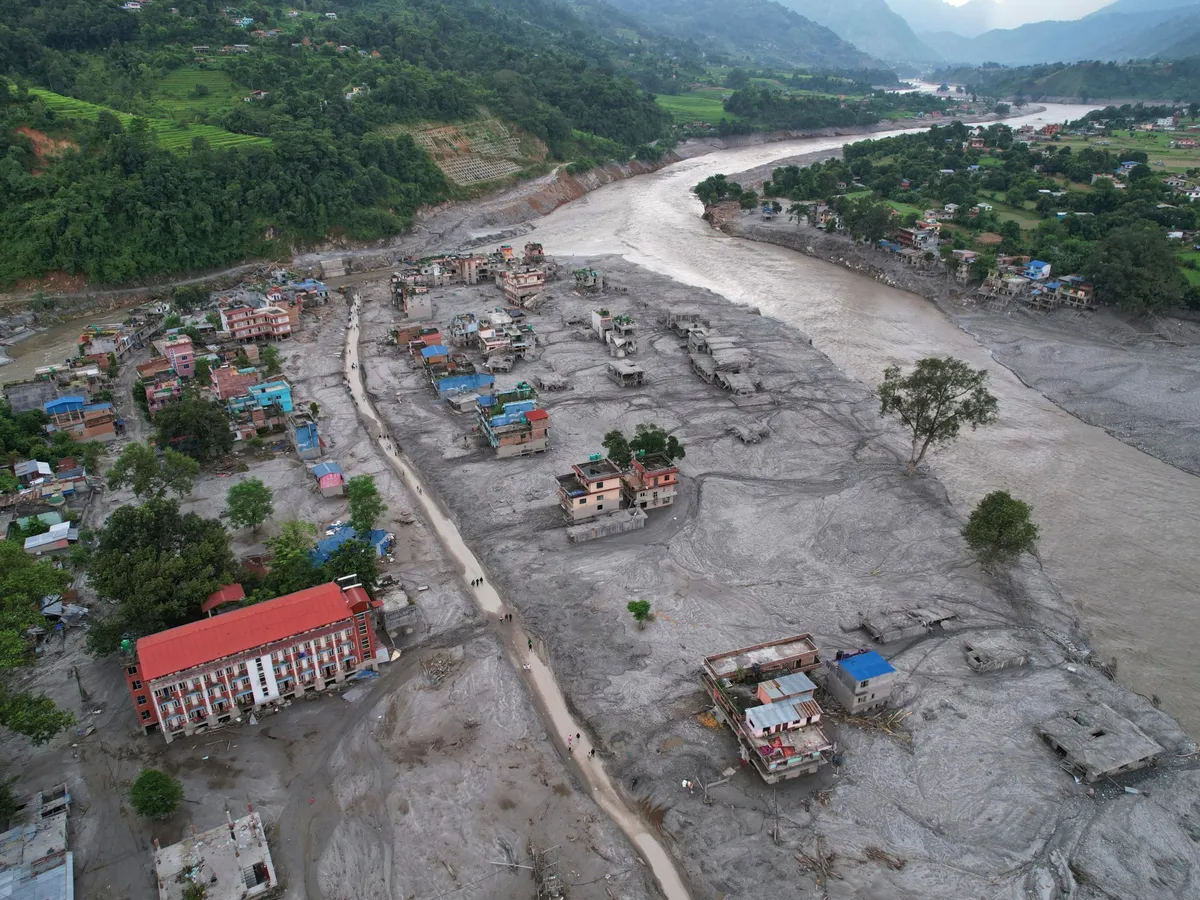
The combined toll from the deadly incident now stands at 1,446 people dead and at least 6,669 missing.Scientists say Climate Change was a core contributing factor in last month’s deadly Glacial Mountain Collapse that flooded parts of Nepal and Tibet, killing more than 1,400 people and leaving thousands still missing.Researchers from the World Weather Attribution (WWA) group said in a report released on Thursday that the disaster was not caused by a single extreme weather event, but rather a “compound crisis” shaped by long-term warming, glacier retreat, Permafrost Thaw and geological instability.Recommended Stories list of 3 itemslist 1 of 3Nepal holds day of mourning for more than 1,300 killed in floodslist 2 of 3Photos: UN urges global aid after China, Nepal Floods kill over 1,300list 3 of 3Relatives hold cremations without bodies for Nepal’s missing flood victimsend of listWWA uses peer-reviewed methods to assess the role played by Global Warming in extreme weather events, according to its website.A huge section of rock and glacier broke away from Langtang Lirung mountain on August 26, triggering a flood of water, ice and debris that swept downstream, destroying communities and infrastructure.“Relentless warming has lifted the altitude of the freezing threshold on the high Himalaya, exposing ice and permafrost deep in the bedrock to higher and longer thaw temperatures, weakening mountain slopes,” according to the report, Rapid Warming in the Himalaya Exacerbates Geohazard Cascades Beyond Adaptation Limits.Report co-author Walter Immerzeel, a mountain hydrologist at Utrecht University, said the region was undergoing “fundamental, irreversible shifts”, with glacier retreat and permafrost degradation undermining mountain stability.Nepal, a largely rural nation of 30 million people, contributes a fraction of global Greenhouse Gas Emissions compared with industrialised nations.
SRCAl Jazeera
LANGEN
LEANCenter
WORDS279
ENT12
THU · 2026-09-17 · 11:19 GMTBRIEF NSR-2026-0917-111986
NSR-2026-0917-111986News Report·EN·Environmental
Climate change had major role in triggering Nepal floods, scientists say
Scientists from the World Weather Attribution group have concluded that climate change played a significant role in a recent glacial mountain collapse in Nepal and Tibet. This event, which occurred on August 26th, triggered floods that resulted in 1,446 deaths and left at least 6,669 people missing.
By AFP and ReutersAl JazeeraFiled 2026-09-17 · 11:19 GMTLean · CenterRead · 2 min
Al JazeeraFIG 01
Reading time
2min
Word count
279words
Sources cited
2cited
Entities identified
12entities
Quality score
100%
§ 01
Briefing Summary
AI-generatedNEWSAR · AI
Scientists from the World Weather Attribution group have concluded that climate change played a significant role in a recent glacial mountain collapse in Nepal and Tibet. This event, which occurred on August 26th, triggered floods that resulted in 1,446 deaths and left at least 6,669 people missing. Researchers described the disaster as a "compound crisis" driven by long-term warming, glacier retreat, permafrost thaw, and geological instability, rather than a single extreme weather event. The report indicates that relentless warming has weakened mountain slopes by exposing ice and permafrost to higher thaw temperatures. This degradation is causing fundamental and irreversible shifts in the region, undermining mountain stability.
Confidence 0.90Sources 2Claims 5Entities 12
§ 02
Article analysis
Model · rule-basedFraming
Environmental
Human Interest
Tone
Measured
AI-assessed
CalmNeutralAlarmist
Factuality
0.80 / 1.00
Factual
LowHigh
Sources cited
2
Limited
FewMany
§ 03
Key claims
5 extracted01
1,446 people are dead and at least 6,669 are missing from the floods.
statistic
Confidence
1.00
02
The region is undergoing 'fundamental, irreversible shifts' with glacier retreat and permafrost degradation undermining mountain stability.
quoteWalter Immerzeel, mountain hydrologist at Utrecht University
Confidence
0.95
03
The disaster was a 'compound crisis' shaped by long-term warming, glacier retreat, permafrost thaw, and geological instability.
factualResearchers from the World Weather Attribution (WWA) group
Confidence
0.90
04
Climate change was a core contributing factor in the recent glacial mountain collapse that flooded parts of Nepal and Tibet.
factualScientists from the World Weather Attribution (WWA) group
Confidence
0.90
05
Relentless warming has lifted the freezing threshold in the Himalayas, exposing ice and permafrost to higher thaw temperatures.
factualReport: Rapid Warming in the Himalaya Exacerbates Geohazard Cascades Beyond Adaptation Limits
Confidence
0.85
§ 04
Full report
2 min read · 279 words§ 05
Entities
12 identifiedKey playerOppositionContextPositiveNeutralNegative
§ 06
Keywords & salience
10 termsclimate change
1.00
nepal floods
0.90
glacial mountain collapse
0.80
global warming
0.70
glacier retreat
0.70
permafrost thaw
0.60
compound crisis
0.50
geological instability
0.50
world weather attribution
0.40
himalaya
0.40
§ 07
Topic connections
Interactive graph Network visualization showing 51 related topics
View Full Graph Person Organization Location Event|Click node to navigate|Edge numbers = shared articles