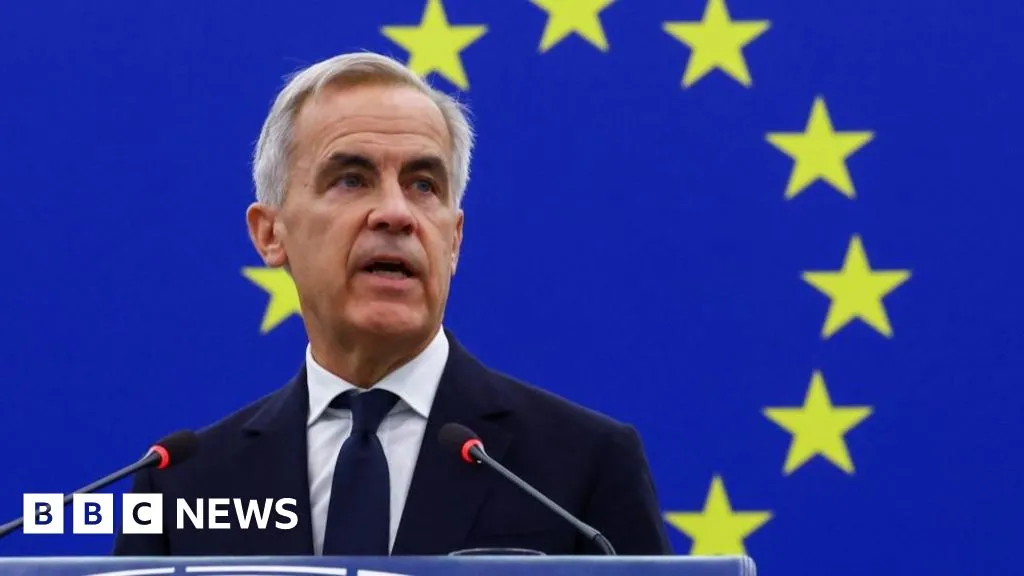
Is Canada about to join the EU? Headlines across Europe indicate a lot of confusion right now.The EU constitution rules that possibility out as Canada is geographically outside Europe.But in a speech on Thursday to the European Parliament, Canada's Prime Minister Mark Carney said: "Canada and Europe should secure our strategic autonomy through deep cooperation in the full range of strategic capabilities."Mark Carney was responding – extremely warmly – to an invitation by European Commission President Ursula von der Leyen for Canada to become the EU's first associate member.The EU and Canada already have a far-reaching trade deal (Ceta) in place but Carney insisted additional cooperation on energy and economic security, on critical and raw materials, education, tech and AI innovation, and defence would help safeguard all countries involved.Canada and the EU feel increasingly squeezed by the superpowers USA on the one side and China on the other – and by tech giants, too, that seem to operate supranationally.The idea of associate EU membership, Carney emphasised, would not be to form a third superpower or to create a bloc against anyone else."We do not pursue zero sum deals," he said. Instead he suggested like-minded nations should club together to create a new form of multilateral global governance in an increasingly turbulent world where – in the minds of some others - might is right.
SRCBBC News - World
LANGEN
LEANCenter
WORDS224
ENT8
THU · 2026-09-17 · 16:59 GMTBRIEF NSR-2026-0917-112075
NSR-2026-0917-112075News Report·EN·Political Strategy
Warm words on Canada's EU 'associate membership' but no guarantees
Canadian Prime Minister Mark Carney responded warmly to an invitation from European Commission President Ursula von der Leyen for Canada to become the EU's first associate member. Carney proposed deep cooperation across strategic capabilities, including energy, economic security, critical materials, education, tech, AI, and defense.
1 hour agoShareSaveAdd as preferred on GoogleKatya AdlerEurope editorBBC News - WorldFiled 2026-09-17 · 16:59 GMTLean · CenterRead · 1 min
BBC News - WorldFIG 01
Reading time
1min
Word count
224words
Sources cited
2cited
Entities identified
8entities
Quality score
100%
§ 01
Briefing Summary
AI-generatedNEWSAR · AI
Canadian Prime Minister Mark Carney responded warmly to an invitation from European Commission President Ursula von der Leyen for Canada to become the EU's first associate member. Carney proposed deep cooperation across strategic capabilities, including energy, economic security, critical materials, education, tech, AI, and defense. This initiative stems from a shared concern between Canada and the EU about being influenced by superpowers like the US and China, as well as supranational tech giants. Carney emphasized that this associate membership is not intended to create a third superpower or a bloc against others, but rather to foster multilateral global governance among like-minded nations in a turbulent world. However, the article notes there is no certainty this idea will materialize.
Confidence 0.90Sources 2Claims 5Entities 8
§ 02
Article analysis
Model · rule-basedFraming
Political Strategy
Diplomatic
Tone
Measured
AI-assessed
CalmNeutralAlarmist
Factuality
0.60 / 1.00
Mixed
LowHigh
Sources cited
2
Limited
FewMany
§ 03
Key claims
5 extracted01
Mark Carney emphasized that associate EU membership is not intended to form a third superpower or a bloc against others.
quoteMark Carney
Confidence
1.00
02
European Commission President Ursula von der Leyen invited Canada to become the EU's first associate member.
factualUrsula von der Leyen
Confidence
1.00
03
Canada's Prime Minister Mark Carney stated Canada and Europe should secure strategic autonomy through deep cooperation.
quoteMark Carney
Confidence
1.00
04
The EU constitution rules out Canada joining the EU as Canada is geographically outside Europe.
factual
Confidence
1.00
05
Canada and the EU feel increasingly squeezed by the USA, China, and tech giants.
factual
Confidence
0.90
§ 04
Full report
1 min read · 224 words§ 05
Entities
8 identifiedKey playerOppositionContextPositiveNeutralNegative
Organizations1
§ 06
Keywords & salience
8 termsassociate membership
1.00
canada eu cooperation
0.90
strategic autonomy
0.80
global governance
0.70
economic security
0.60
tech and ai innovation
0.50
superpowers
0.40
multilateral
0.40
§ 07
Topic connections
Interactive graph Network visualization showing 51 related topics
View Full Graph Person Organization Location Event|Click node to navigate|Edge numbers = shared articles