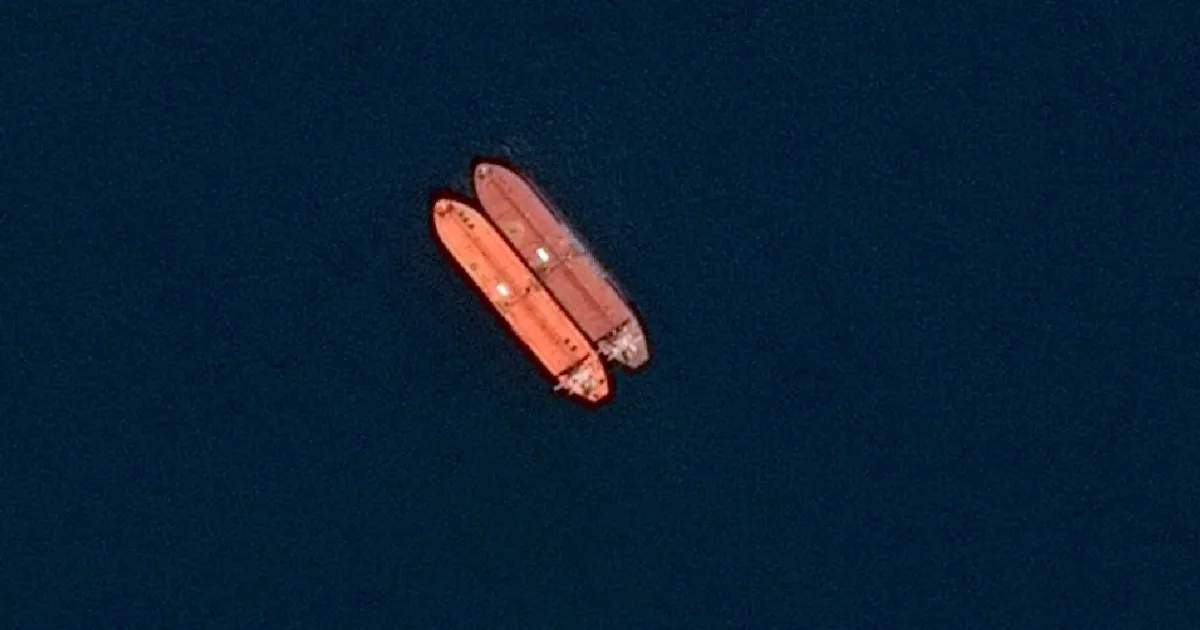
EXPLAINEROman’s Sohar port is becoming a popular spot for ship-to-ship oil transfers amid continued Hormuz blockade.A satellite image of side-by-side ships at sea, off the coast of Sohar, Oman, on June 9, 2026 [Reuters]Published On 18 Sep 2026Saudi Arabia’s oil exports have been disrupted after Iran-aligned Houthis damaged its key East-West pipeline, which helped circumvent the blockade of the Strait of Hormuz – a global oil chokepoint.With the strait in effect closed and Bab al-Mandeb falling under Houthi control, Riyadh has been forced to find ways to export its oil. It is now increasingly offering crude to buyers through ship-to-ship transfers off Oman.As commercial ships are increasingly refusing to pass through the strait due to the conflict, Saudi Arabia is transporting the crude to Oman’s Sohar port, located just outside the strait, where the oil is transferred from Saudi tankers to others.Iran closed the strait, through which nearly a fifth of pre-war global energy passed, in response to the United States-Israeli war, and has used the waterway as leverage in the talks.Media reports suggest that the Hormuz closure and rising oil prices have pushed the US and its allies in the region to adopt shadow tactics, much like what Iran has been doing for years to export its own crude.So, what are ship-to-ship transfers, and are they safe?A US Navy guided-missile destroyer moves along the Suez Canal, en route to support the Operation Epic Fury attack on Iran, off Egypt, on March 5, 2026 [Reuters]Where are these ports?Two ports that have become central to bypassing the Strait of Hormuz are Sohar and another off the coast of Fujairah in the United Arab Emirates.Sohar is a major deepwater industrial hub that handles substantial bulk cargo, petrochemicals and container traffic. Its strategic position has allowed international shipping lines to bypass the narrow Gulf bottleneck while maintaining direct overland connectivity to Arabian Peninsula markets.The UAE’s Port of Fujairah is situated on the country’s eastern coast and serves as one of the world’s largest bunkering and crude oil storage hubs. Its open-ocean anchorage provides a crucial offshore staging area for ship-to-ship transfers and energy exports outside the Strait of Hormuz.These ports are close to the boundaries drawn by the Persian Gulf Strait Authority, the new Iranian body established to manage the Strait of Hormuz.The Iranian authorities have attacked ships that they say use unauthorised routes – the southern route of the strait, closer to Omani waters – to transit the waterway.The US military has reportedly been assisting scores of these secretive ship-to-ship oil transfers to keep Gulf energy exports flowing, starting from early May this year.[Al Jazeera]What are ship-to-ship transfers and how do they happen?Ship-to-ship (STS) transfers are maritime exchanges where cargo — read crude oil or liquefied natural gas (LNG) here — is transferred directly between two vessels at sea.STS transfers serve as a critical logistical bridge when direct port access is blocked or restricted.The companies need to undertake meticulous coordination amid favourable sea conditions to prevent spills and collisions.One vessel, often the larger ship, maintains a steady course or anchors. The manoeuvring ship approaches slowly, followed by hulls brought parallel, protected by pneumatic rubber fenders deployed along the ship sides to absorb impacts.Their trackers are turned off to maintain secrecy and avoid detection. After some mandatory safety checks, the discharging ship’s pumps move the oil through the connected hoses while monitoring pressure and weather.Who is engaging in ship-to-ship transfers and why?Riyadh relied on the East-West 1,200km (746-mile) pipeline, which connects the kingdom’s main oil-producing fields in the east of the country with Yanbu port on the Red Sea coast in the west, to export oil.With its closure after recent drone attacks, Riyadh’s first option becomes “shipping more crude from its Gulf terminals through the Strait of Hormuz, including ship-to-ship transfers outside the strait, such as Sohar in Oman,” said Rishi Rajanala, research specialist in Oil Americas at LSEG Data & Analytics.“Gulf producers have already been moving part of their exports this way, but volumes depend on tanker availability, insurance and freight costs, and remain well below pre-war levels,” he added.Starting this month, Hormuz-route exports have “edged higher, over 2 mb/d [million barrels per day] in the first two weeks, roughly 1 mb/d above August,” said Rahul Choudhary, VP Upstream Research, Rystad Energy.He added that the uptick is expected to rise further this month as “already evident in Aramco offering additional loadings to Asian refiners out of Sohar”.“Saudi Arabia can lean further on dark tanker activity in the coming days to offset Yanbu losses,” he added, referring to Saudi Arabia losing access to the Red Sea for shipping.But it isn’t only Saudi Arabia. Reports from independent trackers and the media have also identified Kuwait and Qatar as relying on similar tactics at times to transit cargoes past the Strait of Hormuz.Are ship-to-ship transfers safe?ship-to-ship transfers are relatively dangerous, especially when being taken up in shadows — and also inefficient compared with standard shipping by vessels.Experts note that unregulated STS transfers often rely on ageing vessels with poor hull maintenance, uninspected hoses, and turned-off AIS tracking without insurance coverage.TankerTrackers, a platform that monitors global oil shipments, said last week that ship-to-ship transfers are rising. “Over the past 14 days, there were 7.15 million barrels per day being exchanged,” the monitor said, quoting AIS numbers and satellite imagery.The monitor added that it represents an increase of 56 percent compared with the previous month.Despite the risks, ship-to-ship transfers also carry an upside in a volatile landscape like the Middle East today.Ships and tankers belonging to major transport companies are unwilling to enter the Strait of Hormuz because of the threat of attacks from either Iran or the US. At the same time, countries in the Gulf need to get as much oil and gas out through the Strait of Hormuz as possible.So these countries, in effect, bear the risk, sending their tankers and ships, often with trackers switched off, just across the Strait of Hormuz, where traditional oil and gas carriers wait in safer waters. These carriers then ferry the oil and gas to markets in China, India, South Korea, Japan and elsewhere.Who provides insurance for such ship-to-ship transfers?For traditional insurers, ship-to-ship transfers can be “particularly complicated”, said Oscar Seikaly, CEO of the NSI Insurance Group.Any loss could involve the physical vessels and their cargo, but also “pollution and collision liabilities, cargo insurance, war-risk cover,” and other factors, he said. “Underwriters may also impose navigational warranties, security conditions, additional war premiums or restrictions,” he told Al Jazeera.However, he pointed out, “most of the oil that is being moved belongs to the national oil companies of the respective country”. Therefore, Seikaly said, many rely on sovereign-backed self-insurance arrangements and private insurance markets.“During wartime or other high-risk disruptions, insurers are unlikely to provide broad cover to include ship-to-ship transfers,” he said. “As a result, a significant share of the risk may ultimately remain with the producing country rather than being transferred fully to commercial insurers.”
SRCAl Jazeera
LANGEN
LEANCenter
WORDS1 157
ENT12
FRI · 2026-09-18 · 06:02 GMTBRIEF NSR-2026-0918-112202
NSR-2026-0918-112202Analysis·EN·Conflict
Oman oil escape route: How ship-to-ship transfers work — despite big risks
Amid the ongoing blockade of the Strait of Hormuz, Oman's Sohar port is increasingly facilitating ship-to-ship (STS) oil transfers. This method allows Saudi Arabia to export crude oil after its key East-West pipeline was damaged, forcing it to find alternatives to the Hormuz chokepoint.
By Al Jazeera staffAl JazeeraFiled 2026-09-18 · 06:02 GMTLean · CenterRead · 5 min
Al JazeeraFIG 01
Reading time
5min
Word count
1 157words
Sources cited
3cited
Entities identified
12entities
Quality score
100%
§ 01
Briefing Summary
AI-generatedNEWSAR · AI
Amid the ongoing blockade of the Strait of Hormuz, Oman's Sohar port is increasingly facilitating ship-to-ship (STS) oil transfers. This method allows Saudi Arabia to export crude oil after its key East-West pipeline was damaged, forcing it to find alternatives to the Hormuz chokepoint. STS transfers involve moving oil directly between two vessels at sea, requiring meticulous coordination and favorable conditions to prevent incidents. Ports like Sohar and Fujairah in the UAE are strategically positioned outside the strait to enable these operations. The US military has reportedly been assisting in these transfers to maintain Gulf energy exports.
Confidence 0.90Sources 3Claims 5Entities 12
§ 02
Article analysis
Model · rule-basedFraming
Conflict
Economic Impact
Tone
Measured
AI-assessed
CalmNeutralAlarmist
Factuality
0.70 / 1.00
Factual
LowHigh
Sources cited
3
Well sourced
FewMany
§ 03
Key claims
5 extracted01
The UAE's Port of Fujairah serves as one of the world's largest bunkering and crude oil storage hubs and provides offshore staging for ship-to-ship transfers.
factual
Confidence
0.90
02
Saudi Arabia is increasingly offering crude to buyers through ship-to-ship transfers off Oman due to disruptions in its East-West pipeline and the closure of the Strait of Hormuz.
factual
Confidence
0.90
03
Oman's Sohar port is becoming a popular spot for ship-to-ship oil transfers due to the continued Hormuz blockade.
factual
Confidence
0.90
04
Iran closed the Strait of Hormuz in response to the United States-Israeli war and uses it as leverage in talks.
factual
Confidence
0.80
05
The US military has reportedly been assisting ship-to-ship oil transfers to keep Gulf energy exports flowing.
factualMedia reports
Confidence
0.70
§ 04
Full report
5 min read · 1 157 words§ 05
Entities
12 identifiedKey playerOppositionContextPositiveNeutralNegative
Locations9
§ 06
Keywords & salience
8 termsstrait of hormuz
1.00
ship-to-ship transfers
1.00
oil exports
0.90
sohar port
0.80
houthi control
0.70
blockade
0.60
crude oil
0.50
port of fujairah
0.40
§ 07
Topic connections
Interactive graph Network visualization showing 51 related topics
View Full Graph Person Organization Location Event|Click node to navigate|Edge numbers = shared articles