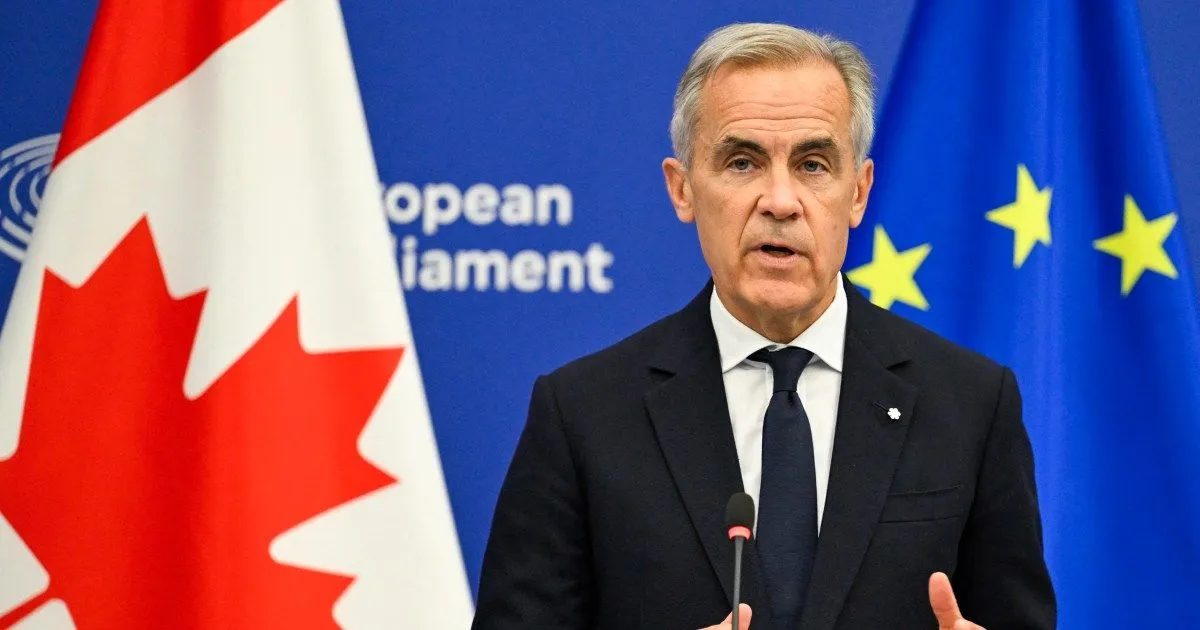
EXPLAINERThis is the latest step in Canada’s bid to move closer to Europe amid bitter trade war with the US.Canadian Prime Minister Mark Carney delivers a speech in the chamber of the European Parliament in Strasbourg, eastern France, during which he welcomed a proposal by the European Commission President Ursula von der Leyen for Canada to become the EU's first associate member, on September 17, 2026 [Jean-Christophe Verhaegen/AFP]Published On 18 Sep 2026Canada has applied to join the Joint Expeditionary Force (JEF), a European military coalition, as it seeks to diversify its diplomatic and security ties following a sharp downturn in relations with the United States.Prime Minister Mark Carney made the request on Wednesday during an official trip to the United Kingdom, which he visited after meeting with European Commission chief Ursula von der Leyen in Brussels. She invited Canada to become the first-ever “associate member” of the bloc.Recommended Stories list of 4 itemslist 1 of 4Canada’s Carney welcomes EU’s associated membership proposallist 2 of 4Trump says Canada becoming EU ‘associate member’ could be ‘hostile act’list 3 of 4Can ‘middle powers’ come together to build a new economic alliance?list 4 of 4UK’s Burnham, Canada’s Carney discuss AI risks, defence cooperationend of listIn a statement, Carney called the UK-led JEF an “important initiative”.Canada and the US have recently hit each other with tit-for-tat tariffs after trade talks failed. Ottawa has subsequently launched a transatlantic charm offensive to reduce its heavy reliance on the US on everything from trade to defence.Here’s what we know about the military force and what Canadian membership might mean:What is the JEF?Formed in 2014, the coalition is made up of 10 European states and aims to be capable of rapid military deployments to deter threats from Russia in areas around the North Sea, the wider North Atlantic-Arctic region and the Baltic.It is led by the UK and has its headquarters in Northwood, just north of London. Denmark, Estonia, Finland, Iceland, Latvia, Lithuania, the Netherlands, Norway and Sweden are its other members.JEF states, among its conditions for membership: A common strategic interest in the security of Northern Europe, the High North, the North Atlantic, and the Baltic Sea region; shared values, including a belief in democracy, human rights and the rules-based international order; and NATO alignment.The JEF acts independently of the NATO alliance, although it can support NATO or United Nations missions if needed.Participation in exercises is voluntary, but members of the JEF should have “political will and trust” as it operates as a “coalition of the willing” rather than with a treaty, the organisation says.The UK military envisaged it to function as a faster, more adaptable force with less bureaucratic drag. It is designed to take action “below the traditional threshold of war”, according to the UK parliament, meaning it can bypass issues NATO might hesitate to address because of its “an attack on one is an attack on all” policy, which carries a high risk of escalation.Combined, the JEF’s rapid response forces number about 10,000 soldiers. The alliance has not been deployed yet on any high-stakes missions, so it remains untested.There are, however, questions about how effective UK leadership might be, as London itself is viewed by MPs as not spending enough on defence at the moment.A highly critical report by the parliamentary defence committee last year found that the UK is “nowhere near” where it needs to be to defend itself and allies. The report added that the UK is failing to meet its NATO obligations, and falling “far short of its claimed leadership position”.The UK currently spends about 2.6 percent of its gross domestic product on defence, short of the NATO goal of 3.5 percent by 2035.UK-based policy think tank, the Royal United Services Institute (RUSI), called for Canada’s inclusion in the JEF last year, and recently urged London to ramp up investment and start deploying the force.“It has been under-exploited because of the UK’s lack of capacity, so it’s in a position of far less strength than it could be … but changes to the membership structure might see new shifts,” defence analyst Keir Giles, of the Chatham House think tank, told Al Jazeera.Why does Canada want to join the JEF?Canada is seeking opportunities that will give the country more options beyond reliance on its traditional ally, the US, amid their ongoing trade war.Like most other JEF countries, Giles said, Canada has in past decades run down its military forces because of reliance on external forces like the US and NATO, but is now rapidly rebuilding. Although the country’s military capabilities in the NATO alliance are often overlooked because of the US, Giles said Canada has always been a crucial part of NATO’s patrols in the North Atlantic and Baltic waters.The JEF initially invited Canada to join in 2015, but Ottawa declined, citing the lack of an immediate threat. There are no reports of the US being invited. JEF invitations have so far only been extended to northern Europe and Baltic NATO countries.But the coalition is concerned with securing areas in the North Atlantic where Canada is a neighbour, meaning there is now some geographical logic to the decision.Security is only one aspect of the kind of integration Canada is seeking. Canada will likely agree to join the EU as an “associate member”, for example. Besides this, the UK and Canada share Commonwealth ties.“Canada joining is a logical step because of the JEF’s purpose, because of the cultural affinity it shares with other members and because of a common understanding of how to deal with the threats in that shared area,” Giles noted, adding that the country “now fully understands the dangers of co-dependence with the US”.Why is Canada having issues with the US?Canada is locked in a trade war with the US. Back-and-forth retaliatory measures have resulted in both sides slapping new tariffs on each other. That’s especially painful for Canada, which exports 70 percent of all its goods to the US.In August, trade talks between the two countries broke down, and US President Donald Trump imposed a 50 percent levy on $20bn of Canadian goods, or 5.5 percent of its exports, disrupting the long history of stable relations between the two North American neighbours.Canada responded with tariffs on US steel, dairy, appliances, farm equipment, pulp and paper, and electronics.Trump has also previously suggested making Canada a 51st state, raising sovereignty concerns. He appeared to revisit this idea following news that trade talks had broken down when he wrote on his Truth Social platform: “Canada wants the benefits of being a State, without being one!!!” Trump recently renamed Lake Ontario to Lake America in a fit of pique over Ottawa’s refusal to bow down to his demands.Canada, which has long remained in the shadow of the US in terms of defence, has since launched a strategy to bolster its domestic defence capabilities by ramping up military spending and reducing its reliance on US military suppliers.Carney’s defence plan, launched earlier this year, will see defence spending increase from about 40 billion Canadian dollars ($28.6bn) to more than 60 billion Canadian dollars ($42.8bn) in the next five years.This comes as Europe’s relations with Washington have frayed because of tensions over NATO funding. Trump has long claimed that the US shoulders an unfair share of this burden. His insistence on seizing control of Greenland also triggered a standoff.More recently, European countries’ refusal to be dragged into the US and Israel’s war on Iran has irked the Trump administration.
SRCAl Jazeera
LANGEN
LEANCenter
WORDS1 242
ENT12
FRI · 2026-09-18 · 12:51 GMTBRIEF NSR-2026-0918-112295
NSR-2026-0918-112295Analysis·EN·Diplomatic
Why does Canada want to join the Europe-led JEF military partnership?
Canada has applied to join the UK-led Joint Expeditionary Force (JEF), a European military coalition, as it seeks to diversify its diplomatic and security ties. Prime Minister Mark Carney made the request during a trip to the United Kingdom, following an invitation from European Commission chief Ursula von der Leyen for Canada to become an "associate member" of the EU.
Shola LawalAl JazeeraFiled 2026-09-18 · 12:51 GMTLean · CenterRead · 5 min
Al JazeeraFIG 01
Reading time
5min
Word count
1 242words
Sources cited
3cited
Entities identified
12entities
Quality score
100%
§ 01
Briefing Summary
AI-generatedNEWSAR · AI
Canada has applied to join the UK-led Joint Expeditionary Force (JEF), a European military coalition, as it seeks to diversify its diplomatic and security ties. Prime Minister Mark Carney made the request during a trip to the United Kingdom, following an invitation from European Commission chief Ursula von der Leyen for Canada to become an "associate member" of the EU. This move comes amid a trade war with the United States, prompting Canada to reduce its reliance on its traditional ally. The JEF, formed in 2014, comprises ten European states and aims for rapid military deployments to deter threats in Northern Europe, the Arctic, and the Baltic region. Canada's membership would align with the JEF's conditions of shared strategic interests, values, and NATO alignment.
Confidence 0.90Sources 3Claims 5Entities 12
§ 02
Article analysis
Model · rule-basedFraming
Diplomatic
Political Strategy
Tone
Measured
AI-assessed
CalmNeutralAlarmist
Factuality
0.70 / 1.00
Factual
LowHigh
Sources cited
3
Well sourced
FewMany
§ 03
Key claims
5 extracted01
European Commission President Ursula von der Leyen invited Canada to become the first-ever “associate member” of the bloc.
quoteUrsula von der Leyen
Confidence
1.00
02
Prime Minister Mark Carney made the request on Wednesday during an official trip to the United Kingdom.
factual
Confidence
1.00
03
Canada is seeking to diversify its diplomatic and security ties following a sharp downturn in relations with the United States.
factual
Confidence
1.00
04
The JEF aims to be capable of rapid military deployments to deter threats from Russia in areas around the North Sea, the wider North Atlantic-Arctic region and the Baltic.
factual
Confidence
1.00
05
Canada has applied to join the Joint Expeditionary Force (JEF), a European military coalition.
factual
Confidence
1.00
§ 04
Full report
5 min read · 1 242 words§ 05
Entities
12 identifiedKey playerOppositionContextPositiveNeutralNegative
Organizations3
§ 06
Keywords & salience
9 termscanada
1.00
joint expeditionary force (jef)
1.00
europe
0.90
military partnership
0.90
security ties
0.80
united states
0.70
trade war
0.60
russia
0.50
nato alignment
0.40
§ 07
Topic connections
Interactive graph Network visualization showing 51 related topics
View Full Graph Person Organization Location Event|Click node to navigate|Edge numbers = shared articles