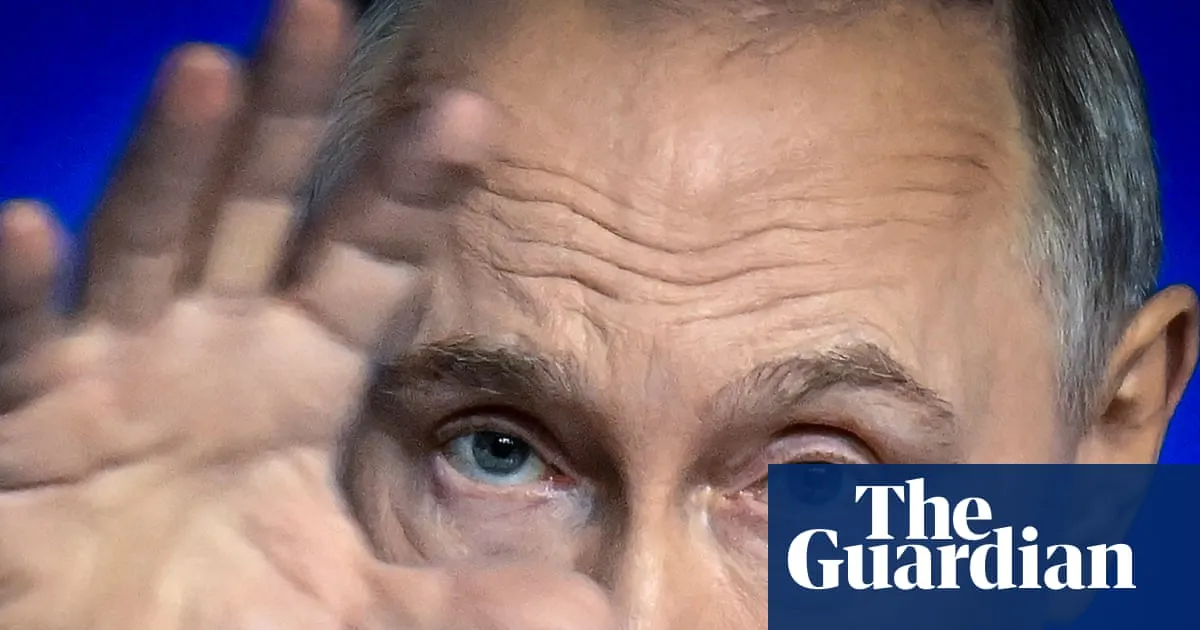
At 6am on 29 June 2021, the Russian journalist Roman Badanin was woken by a knock on the door of his family’s Moscow apartment. “Come quickly, someone has scratched your car in the courtyard,” a voice shouted from outside. As he opened the door, masked men pushed their way in.Across the city, a similar raid was happening at the home of Badanin’s colleague Mikhail Rubin. The masked men were officers of the FSB, the Russian intelligence service, instruments of the “climate of fear and violence” that the journalists say Vladimir Putin has imposed on Russia in their forensically detailed biography of the Russian president.The Tsar in Person is almost 800 pages and has won the Grand Prix Strasbourg, a French literary award, whose jury said it read like a “spy novel” and praised the “courage and commitment” of the authors during decades of investigating reporting.For Badanin and Rubin, the dawn raids were a warning. As founders of the independent media project Proekt, specialising in investigative journalism, both men had been threatened, interrogated, labelled traitors and foreign agents, banned from news events and had offices searched. Other colleagues had not been so lucky: several had died suddenly or in unexplained accidents or seemingly random attacks.Rubin told the Guardian: “The first time we were threatened was in 2019 when we published an investigation into the chief of Putin’s propaganda operation. A Kremlin official warned me the consequences might be scary. Security agents visited my parents and asked them why I, their son, was selling out his country, betraying Russia.”After the FSB agents’ dawn raid, Rubin discovered his passport placed carefully on a table. “It was a message. If they’d taken it, I wouldn’t be allowed to leave the country, but they wanted me to leave so they put it where I would see it,” he said. “At the time I didn’t plan on leaving. I didn’t want to overthink the danger because I thought they were just trying to stop me working.”Less than three weeks later, the Kremlin declared Proekt an “undesirable” media outlet. “I left Moscow the next morning,” Rubin said.Badanin, who was on holiday with his family in Morocco, decided it was too dangerous for him to return. “The choice was prison or exile and I didn’t want to go to prison.”Roman Badanin (left) and Mikhail Rubin. Composite: Wikipedia and ProektTheir book, so far published only in Russian and French, charts the rise of Putin from an unremarkable clerk and undercover KGB agent at St Petersburg city hall to the Kremlin, where he has clung to power since 2000.It is not the first biography to portray the president and his circle of cronies as cruel and corrupt, but the devil is in the encyclopaedic detail. Badanin and Rubin, both former Kremlin-accredited “pool” journalists, have 40 years of investigative journalism between them and have conducted hundreds of interviews to produce a grim portrait of Putin.They depict him as a modern-day tsar, without ideology or convictions, a dictator capable of “limitless cruelty” who sees himself as above morality and laws. Rivals and opponent, or simply those who have become inconvenient, meet unexpected ends in accidents, crashes and falls, or are poisoned with toxins and radioactive particles causing agonising deaths.“These pages are the result of war and repression, of exile and the death of some of those close to us, the suffering of friends thrown in prison,” the pair write. “We hope it will contribute to destroying the circumstances that have made all this misfortune possible and defeat the person who did this with his own hands.”It is also the story of Russia from the end of the Soviet Union to today. Badanin says the book is aimed at young Russians who have no idea what their country was like before Putin took power. Unsurprisingly, it is banned by the Kremlin.Badanin told Le Monde: “We’re also targeting audiences abroad, where many myths about Putin are circulating. There’s no need to invent myths about Putin. Let the facts reveal the truth about him and his system.“The Kremlin leader has no ideology. The war in Ukraine has made this clear: this war is not an extension of his ideas, it is merely a means of staying in power.”Today, even thousands of miles from Moscow, neither journalist feels entirely safe from what they call “Putin’s death squads” dispatched to murder dissident Russians abroad to demonstrate the Kremlin’s long arms.Last year, FBI agents turned up at Badanin’s California home to warn him they had information that he was at risk of an attack “by foreign special services”.“I feel a little bit safer here than in Europe, but not completely safe,” Badanin said.
SRCThe Guardian - World News
LANGEN
LEANCenter-Left
WORDS775
ENT12
TUE · 2026-09-22 · 10:58 GMTBRIEF NSR-2026-0922-113183
NSR-2026-0922-113183News Report·EN·Human Rights
‘The choice was prison or exile’: journalists who fled Russia publish grim portrait of Putin
Russian journalists Roman Badanin and Mikhail Rubin, who fled Russia in 2021, have published a biography of Vladimir Putin titled "The Tsar in Person." The book details Putin's rise to power and portrays him as a dictator capable of "limitless cruelty." The journalists were forced into exile after their independent media project, Proekt, was declared an "undesirable" organization and they faced raids and threats from the FSB. They describe a "climate of fear and violence" imposed by Putin, with rivals and critics meeting untimely ends.
Kim WillsherThe Guardian - World NewsFiled 2026-09-22 · 10:58 GMTLean · Center-LeftRead · 4 min
The Guardian - World NewsFIG 01
Reading time
4min
Word count
775words
Sources cited
3cited
Entities identified
12entities
Quality score
100%
§ 01
Briefing Summary
AI-generatedNEWSAR · AI
Russian journalists Roman Badanin and Mikhail Rubin, who fled Russia in 2021, have published a biography of Vladimir Putin titled "The Tsar in Person." The book details Putin's rise to power and portrays him as a dictator capable of "limitless cruelty." The journalists were forced into exile after their independent media project, Proekt, was declared an "undesirable" organization and they faced raids and threats from the FSB. They describe a "climate of fear and violence" imposed by Putin, with rivals and critics meeting untimely ends. The book, which has won a French literary award, aims to reveal the truth about Putin and his system to young Russians and international audiences. Both journalists continue to feel unsafe abroad, with Badanin having been warned of a potential attack by foreign special services.
Confidence 0.90Sources 3Claims 5Entities 12
§ 02
Article analysis
Model · rule-basedFraming
Human Rights
Political Strategy
Tone
Mixed Tone
AI-assessed
CalmNeutralAlarmist
Factuality
0.70 / 1.00
Factual
LowHigh
Sources cited
3
Well sourced
FewMany
§ 03
Key claims
5 extracted01
Mikhail Rubin was warned in 2019 about consequences after publishing an investigation into Putin's propaganda chief.
quoteMikhail Rubin
Confidence
1.00
02
Proekt, an independent media project founded by Badanin and Rubin, was declared an 'undesirable' media outlet by the Kremlin.
factualArticle
Confidence
1.00
03
The book 'The Tsar in Person' by Badanin and Rubin details Putin's rise and presents a grim portrait of his rule.
factualArticle
Confidence
1.00
04
The FSB conducted dawn raids on the homes of Roman Badanin and Mikhail Rubin in Moscow.
factualRoman Badanin and Mikhail Rubin
Confidence
1.00
05
Journalists Roman Badanin and Mikhail Rubin fled Russia due to a 'climate of fear and violence' imposed by Vladimir Putin.
quoteRoman Badanin and Mikhail Rubin
Confidence
1.00
§ 04
Full report
4 min read · 775 words§ 05
Entities
12 identifiedKey playerOppositionContextPositiveNeutralNegative
People3
Organizations4
§ 06
Keywords & salience
10 termsjournalists
1.00
putin
1.00
russia
0.90
investigative journalism
0.80
exile
0.80
proekt
0.70
fsb
0.70
climate of fear
0.60
foreign agents
0.50
kgb
0.40
§ 07
Topic connections
Interactive graph No topic relationship data available yet. This graph will appear once topic relationships have been computed.