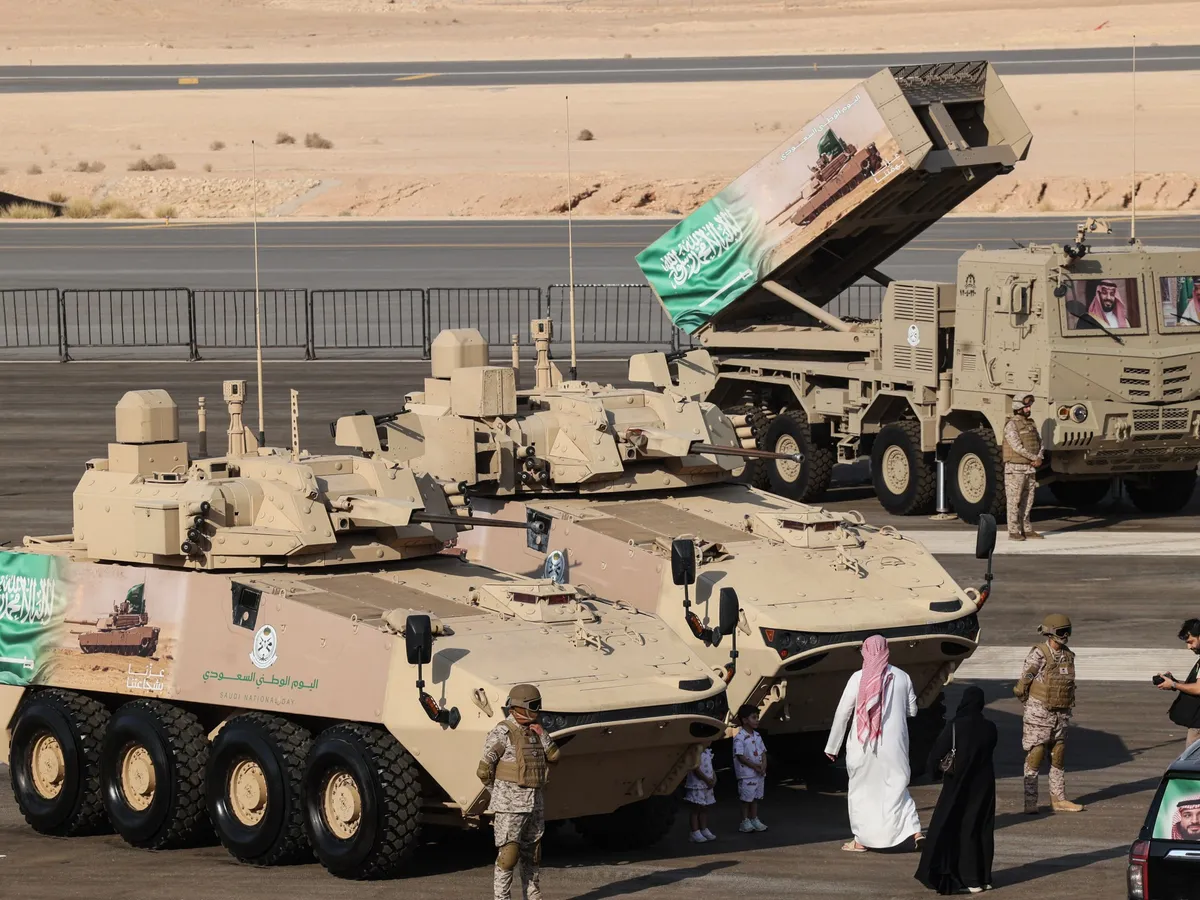
EXPLAINERUK to refuel Saudi fighter jets and France to secure energy infrastructure amid fighting with Yemen’s Houthi group.Saudis pose in front of LAV-FSV light armoured vehicles on display during a military parade marking the 96th Saudi National Day in Riyadh on September 22, 2026 [Fayez Nureldine/AFP]Published On 23 Sep 2026The United Kingdom will provide Saudi Arabia with military support in its escalating war against Yemen’s Iran-backed Houthi group, the British government said this week.The UK agreed to provide air-to-air refuelling of Saudi fighter jets that are conducting missions after the kingdom requested air-defence support, UK Prime Minister Andy Burnham said on Monday.Recommended Stories list of 3 itemslist 1 of 3A simple guide to the Yemen conflictlist 2 of 3UK to refuel Saudi jets to help counter Houthi attackslist 3 of 3Houthis battle for strategic heights in Yemen as thousands more flee homesend of listHowever, it will not directly join Riyadh’s renewed conflict with the Houthis, which began in 2014 after the Houthis seized Yemen’s capital Sanaa along with large areas of northwest Yemen, driving the internationally recognised government to Aden. The two sides had reached a United Nations-mediated ceasefire in 2022, before fighting broke out again this year amid the US-Israel war on Iran.Particularly heavy fighting erupted again two weeks ago as the Houthis advanced against Yemeni forces to the Red Sea coast, taking the strategic port city of Mocha and Mayyun Island in the middle of the Bab al-Mandeb, the entry point for shipping entering the Red Sea from the south.Since then, the group has targeted Riyadh as well as Saudi oil infrastructure, including taking out a section of the vital East-West Pipeline that had allowed Saudi to make oil exports despite disruption in the Strait of Hormuz triggered by the Iran war.Before the latest bout of fighting broke out, the Houthis had also declared a blockade on Saudi shipping in the Bab al-Mandeb Strait and Red Sea, through which about 12 percent of global trade passes.Here is what you need to know about what support the UK will provide:What has the UK announced?British PM Burnham said London had accepted a Saudi request for what he called “defensive air-to-air refuelling”. Britain will deploy one Royal Air Force Voyager tanker aircraft to assist with this in the coming days.“We have received a request from the kingdom of Saudi Arabia for military support,” Burnham told reporters on his way to the UN General Assembly in New York this week, adding that he had agreed to the request on the advice of his defence and foreign secretaries.Burnham said the arrangement would be “time-limited” and would be kept under review. However, the UK’s Ministry of Defence (MoD) has not specified a timetable.Burnham said the UK was “acting to secure the interests of Britain and the wider region”, linking the need to keep oil export routes open.In a statement, the MoD told Al Jazeera that the decision to provide support “builds on the UK’s existing military contribution to Saudi Arabia’s air defence”, including the deployment of “air defence equipment and UK personnel helping to protect against missile and drone attacks”.“Saudi Arabia and Yemen are long-standing partners of the United Kingdom, and play a vital role in regional stability. It is in the UK’s interest to protect regional stability, protecting vital trade and energy supplies and encouraging a diplomatic resolution to the conflict in Yemen,” the MoD said.What is air-to-air refuelling?Air-to-air refuelling is the transfer of aviation fuel from one aircraft to another in mid-air.Refuelling in mid-air will allow Saudi fighter jets to remain airborne past their fuel limits, in order to spend more time patrolling Saudi airspace or responding to incoming threats.Saudi Arabia faces potential threats to cities, military installations and energy infrastructure spread across a very large area.While the Houthis have largely targeted Saudi cities in the south of the country, close to the Yemeni border, they have hit targets in the capital city, Riyadh, in the country’s centre.During Israel’s war on Gaza, the Houthis also launched missiles towards Israel.What’s the UK-Saudi Arabia military relationship?Britain has particularly deep military ties with Saudi Arabia, one of the biggest buyers of British military equipment, stretching back for decades.Under the Conservative Party government of John Major in the 1990s, and the later Labour governments of Tony Blair and Gordon Brown from the late 1990s to 2010, the UK supplied Tornado and Hawk aircraft and other equipment to the kingdom, involving the UK defence company BAE Systems.The relationship was expanded to include Eurofighter Typhoon combat aircraft. In 2006, Saudi Arabia agreed to buy 72 Typhoons in a deal worth $40bn that also included technology transfer and training.London has also provided defensive assistance during the ongoing regional conflict. Earlier this year, the UK deployed its Sky Sabre air-defence system to Saudi Arabia to help defend the kingdom from Iranian missile attacks on United States military assets and other infrastructure on Saudi territory.Will this make a difference?The air refuelling assistance from London could improve Saudi Arabia’s ability to defend itself to some degree, but what the UK has announced so far is limited, experts say.The UK’s support carries more political weight than military significance, according to Chris Doyle, director of the Council for Arab-British Understanding.“In military terms this is not a major change-up,” Doyle said, arguing that what matters more for Saudi Arabia right now is having visible international backing as it confronts the Houthis.Riyadh will be keen to avoid appearing “isolated” in the conflict, particularly as other countries remain reluctant to become directly involved, he said. Most significantly, the administration of US President Donald Trump has already indicated it will not involve itself in the Saudi-Houthi fighting or against Houthi blockades on Saudi-linked shipping in the Red Sea.Trump said the Houthis had assured US officials that they had no intention of attacking US shipping in the Red Sea.As for other states, “Many are reluctant to get involved. They see this as being part of the wider US-Iran conflict, and they just are hesitant,” Doyle said.
SRCAl Jazeera
LANGEN
LEANCenter
WORDS997
ENT12
WED · 2026-09-23 · 13:57 GMTBRIEF NSR-2026-0923-113502
NSR-2026-0923-113502News Report·EN·National Security
How much is UK supporting Saudi Arabia in its war with Iran-backed Houthis?
The United Kingdom will provide Saudi Arabia with air-to-air refuelling support for its fighter jets amid renewed fighting with Yemen's Iran-backed Houthi group. British Prime Minister Andy Burnham announced that a Royal Air Force Voyager tanker aircraft will be deployed to assist with this "defensive" measure, which is intended to be time-limited.
Usaid SiddiquiAl JazeeraFiled 2026-09-23 · 13:57 GMTLean · CenterRead · 4 min
Al JazeeraFIG 01
Reading time
4min
Word count
997words
Sources cited
3cited
Entities identified
12entities
Quality score
100%
§ 01
Briefing Summary
AI-generatedNEWSAR · AI
The United Kingdom will provide Saudi Arabia with air-to-air refuelling support for its fighter jets amid renewed fighting with Yemen's Iran-backed Houthi group. British Prime Minister Andy Burnham announced that a Royal Air Force Voyager tanker aircraft will be deployed to assist with this "defensive" measure, which is intended to be time-limited. This support aims to secure British interests and regional stability, particularly by keeping oil export routes open. The UK's decision builds on existing military contributions to Saudi Arabia's air defence. The Houthis have recently targeted Saudi cities and oil infrastructure, including a vital pipeline, and have previously declared blockades on shipping in the Red Sea.
Confidence 0.90Sources 3Claims 5Entities 12
§ 02
Article analysis
Model · rule-basedFraming
National Security
Conflict
Tone
Measured
AI-assessed
CalmNeutralAlarmist
Factuality
0.70 / 1.00
Factual
LowHigh
Sources cited
3
Well sourced
FewMany
§ 03
Key claims
5 extracted01
The Houthis seized Yemen’s capital Sanaa in 2014, leading to the current conflict.
factual
Confidence
1.00
02
The UK's support is a response to a Saudi request for air-defence support.
factualUK Prime Minister Andy Burnham
Confidence
1.00
03
The UK will provide Saudi Arabia with military support, including air-to-air refuelling of Saudi fighter jets.
factualBritish government
Confidence
1.00
04
The Houthis have targeted Riyadh and Saudi oil infrastructure, including a section of the East-West Pipeline.
factual
Confidence
0.90
05
The UK's support arrangement will be 'time-limited' and kept under review.
factualUK Prime Minister Andy Burnham
Confidence
0.90
§ 04
Full report
4 min read · 997 words§ 05
Entities
12 identifiedKey playerOppositionContextPositiveNeutralNegative
People1
§ 06
Keywords & salience
9 termsyemen conflict
1.00
saudi arabia
0.90
houthi group
0.90
uk military support
0.80
iran-backed
0.70
air-to-air refuelling
0.60
red sea
0.50
bab al-mandeb strait
0.50
saudi oil infrastructure
0.40
§ 07
Topic connections
Interactive graph Network visualization showing 51 related topics
View Full Graph Person Organization Location Event|Click node to navigate|Edge numbers = shared articles