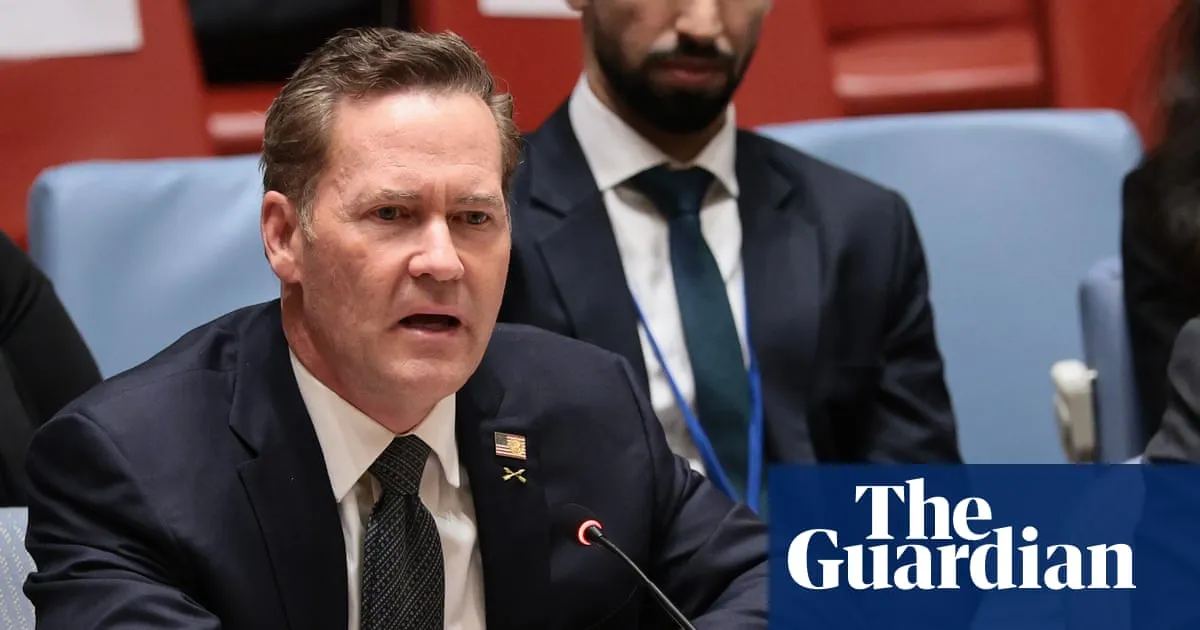
The Trump administration’s ambassador to the United Nations said the US rejected Iran’s proposal to end the ongoing war there because Iranian negotiators “were asking for everything up front”.Echoing comments by Donald Trump on Saturday, the president’s UN ambassador Mike Waltz told CNN’s State of the Union on Sunday that Iran had asked for relief “from billions and billions of sanctions that are going into place” as part of an economic blockade on Iran. The blockade is aimed at putting pressure on Iran to stop its attacks on vessels in the Strait of Hormuz.“They were asking for everything up front with a promise that they would then talk,” Waltz said on State of the Union. “The president is just not confident that the Iranians are coming in good faith and that we will truly negotiate the end of their nuclear program.”Trump said on Saturday that he had rejected Iran’s peace plan, proposed at the recent UN general assembly in New York, arguing that desperation was driving the Iranians’ push for an agreement on the key waterway. “They want to make a deal to open the Hormuz strait immediately because they’re losing so badly,” Trump said.Trump said the US was “winning tremendously” and had “total control of the Hormuz strait”.Waltz pointed to the failed US-Iran memorandum of understanding (MOU) signed in Pakistan in June that laid out a 14-point framework agreement for a negotiated peace.Iran, he said, “immediately violated it by attacking international shipping, in violation of international law, and 146 nations have joined us in condemning Iran for those attacks”.Iran on Sunday insisted that only diplomacy can solve its conflict with the US and Israel.“Our conditions are clear, and any move toward reopening the Strait of Hormuz is contingent on these conditions being met,” the Iranian foreign minister, Abbas Araghchi, posted on social media. “Only a negotiated solution can get them out of this deadlock.”Araghchi also appeared on NBC’s Meet the Press on Sunday, saying his country is prepared to resume fighting with the US but has not yet abandoned diplomacy after Trump rejected Iran’s peace proposal.“We are fully prepared for the war to be resumed,” Araghchi said. “We stand firm in the face of any new aggression, even if it comes to a doomsday war.“At the same time, we stand ready for diplomacy. It is up to President Trump to choose.”The Iranian president, Masoud Pezeshkian, in an interview with the CBS show Face the Nation, said his country was ready for talks on its nuclear program and other issues – but would not accept “bullying or coercion”.“Iran is not seeking war, but will defend itself against pressure, threats and attacks,” Pezeshkian said, adding that it had already agreed that “we’re not supposed to develop nuclear weapons”.On CNN, Waltz also addressed recent reports that China had assisted Iran in missile targeting of shipping in the Strait of Hormuz and on US military bases in the region.Waltz did not confirm the leaked intelligence assessments but said Trump had raised the issue with China premier Xi Jinping during the latter’s recent state visit to the US capital Washington DC. Trump had also done so “multiple times” previously, including during his visit to China in May, according to Waltz.“I think we have seen movement in a positive direction,” Waltz said. “President Trump has made it clear it’s unacceptable.”Waltz pointed to readouts of the high-level meeting that said the US and China had “agreed that Iran can never have a nuclear weapon”.“They cannot and should not be tolling, much less attacking, international shipping in an international waterway,” Waltz said. “So I think that was incredibly important to hear from President Xi coming out of the summit.”Waltz also rejected reporting in the Wall Street Journal that the US would resume bombing Iran after the federal midterm elections in November. He pointed to Trump’s comments that Iran was miscalculating.“The president is looking to make not just this generation – but the next generation – safer by not allowing what is essentially a terrorist organization in [Iran’s Islamic Revolutionary Guard Corps] that is controlling the levers of government and wants to march towards a nuclear weapon,” Waltz said. “We’re not going to let the IRGC have a nuclear weapon, much less hold the world hostage with one.”
SRCThe Guardian - World News
LANGEN
LEANCenter-Left
WORDS710
ENT12
SUN · 2026-09-27 · 16:28 GMTBRIEF NSR-2026-0927-114506
NSR-2026-0927-114506News Report·EN·Diplomatic
UN ambassador Waltz says Iran was not negotiating ‘in good faith’ to end war
US Ambassador to the UN Mike Waltz stated that the Trump administration rejected Iran's proposal to end the war because Iran demanded immediate relief from billions in sanctions. Waltz echoed President Trump's assertion that Iran's proposal, made at the UN General Assembly, was driven by desperation due to losses in the Strait of Hormuz.
Edward HelmoreThe Guardian - World NewsFiled 2026-09-27 · 16:28 GMTLean · Center-LeftRead · 3 min
The Guardian - World NewsFIG 01
Reading time
3min
Word count
710words
Sources cited
4cited
Entities identified
12entities
Quality score
100%
§ 01
Briefing Summary
AI-generatedNEWSAR · AI
US Ambassador to the UN Mike Waltz stated that the Trump administration rejected Iran's proposal to end the war because Iran demanded immediate relief from billions in sanctions. Waltz echoed President Trump's assertion that Iran's proposal, made at the UN General Assembly, was driven by desperation due to losses in the Strait of Hormuz. The US views Iran's approach as not negotiating in good faith, citing a previous memorandum of understanding that Iran allegedly violated by attacking international shipping. Iran's Foreign Minister insisted that diplomacy is the only solution and that reopening the Strait of Hormuz is contingent on meeting their conditions, while also stating readiness for conflict. President Pezeshkian indicated Iran is open to talks on its nuclear program but not under coercion.
Confidence 0.90Sources 4Claims 5Entities 12
§ 02
Article analysis
Model · rule-basedFraming
Diplomatic
Conflict
Tone
Mixed Tone
AI-assessed
CalmNeutralAlarmist
Factuality
0.70 / 1.00
Factual
LowHigh
Sources cited
4
Well sourced
FewMany
§ 03
Key claims
5 extracted01
Iran is prepared for diplomacy but also fully prepared for war to be resumed.
factualAbbas Araghchi
Confidence
1.00
02
Iran insisted that only diplomacy can solve its conflict with the US and Israel, and any move toward reopening the strait of Hormuz is contingent on conditions being met.
factualAbbas Araghchi
Confidence
1.00
03
Iran violated a US-Iran memorandum of understanding by attacking international shipping.
factualMike Waltz
Confidence
1.00
04
Iran asked for relief 'from billions and billions of sanctions that are going into place' as part of an economic blockade.
factualMike Waltz
Confidence
1.00
05
US rejected Iran's proposal to end the war because Iran asked for billions in sanctions relief upfront with a promise to talk later.
factualMike Waltz
Confidence
1.00
§ 04
Full report
3 min read · 710 words§ 05
Entities
12 identifiedKey playerOppositionContextPositiveNeutralNegative
People4
Organizations1
Locations5
§ 06
Keywords & salience
10 termshormuz strait
1.00
iran nuclear program
1.00
sanctions relief
0.90
negotiations
0.90
good faith
0.80
international shipping attacks
0.70
trump administration
0.60
diplomacy
0.50
peace plan
0.50
economic blockade
0.40
§ 07
Topic connections
Interactive graph Network visualization showing 51 related topics
View Full Graph Person Organization Location Event|Click node to navigate|Edge numbers = shared articles