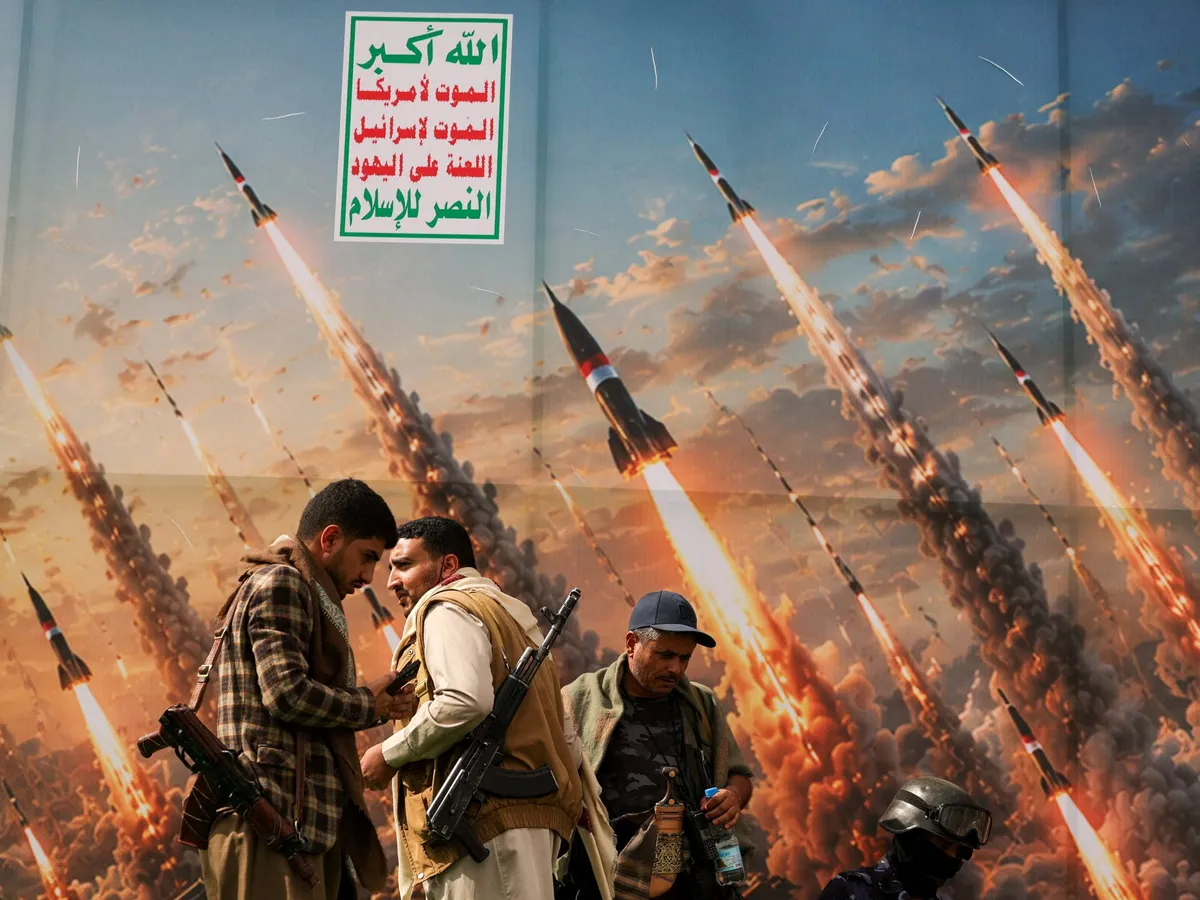
EXPLAINERExperts say use of modified Iranian defence system could alter the balance in the fight for the Red Sea.Houthi activists stand in front of a banner depicting Houthi missiles at an anti-Saudi Arabia rally in Sanaa, Yemen, on July 31, 2026 [Khaled Abdullah/Reuters]Published On 29 Sep 2026Yemen’s internationally recognised, Saudi-backed government has alleged that the Tehran-backed Houthis have modified Iranian air defence weapons into loitering cruise missiles with the assistance of Iran’s Islamic Revolutionary Guard Corps (IRGC).The Yemeni government has warned that the capability of such missiles – which operate on a heat-tracking system, it alleged – in practice threatens civilian air traffic over Yemen and the crucial Red Sea.Meanwhile, the Houthis have ramped up attacks on Saudi Arabia as they fight Yemeni government forces. On Thursday, Riyadh said it intercepted six ballistic missiles aimed at Taif in western Saudi Arabia and the Yanbu port area on the Red Sea.The Houthis also said they attacked “a sensitive target” in the Saudi capital, Riyadh, and Saudi Aramco facilities in Yanbu. Houthi military spokesman Yahya Saree said the group used ballistic and cruise missiles as well as drones in the two operations.The Houthis were in open conflict with Yemen’s government and a Saudi-led coalition of Arab states from 2014 until a United Nations-brokered ceasefire was declared in 2022, but fighting has reignited in recent weeks with the Houthis taking the Red Sea coast of Yemen along with the strategically important city of Mocha and Mayyun Island in the Bab al-Mandeb strait at the southern entrance to the Red Sea.In July, the armed group declared a naval blockade against Saudi Arabia in the Red Sea, essentially opening yet another theatre in the US-Israel war on Iran.Since the closure of the critical Strait of Hormuz during the war, the Red Sea has become a vital alternative export route for the region’s biggest oil player, Saudi Arabia. Its East-West Pipeline, which carries oil from its eastern oilfields to the western port of Yanbu is only just restarting operations after damage inflicted by a drone attack this month.So what do the Houthis’ latest missile capabilities mean for the region?What has the Yemeni government said?Brigadier General Majed al-Nazili, spokesperson for the Yemeni government forces, said the Houthis are using Iranian air defence weapons that pose a danger to all aircraft.Al-Nazili said the weapons have been modified with the assistance of IRGC experts and are being used to strike aircraft and cruise missiles.“These missiles move around for a period of up to 25 minutes per missile and operate using a thermal-tracking system and attack any heat source without the ability to distinguish between military or civilian targets,” he said in a statement.“This constitutes a direct and serious threat to the safety of civil aviation and the lives of passengers,” al-Nazili added.(Al Jazeera)Why does Yemen’s government think regional airspace is under threat?Al-Nazili noted that aircraft belonging to the United Nations or humanitarian organisations travelling via air routes over Yemen and the region could potentially be in danger.“Threatening the airspace over the southern Red Sea and turning it into a danger zone for civilian aircraft and passengers represents an escalation that goes beyond the scope of Yemeni airspace safety alone,” he said.Al-Nazili also said “this dangerous escalation coincides with the threats” by Iranian officials, including Mohsen Rezaei, the secretary of Iran’s Supreme National Security Council, to target aviation services in the region after the US sanctioned Iranian airlines.Rezaei had initially warned that regional airports could lose flights if they joined US restrictions on Iranian aviation. Two days later, his office later clarified that Tehran was not planning military retaliation over the restrictions although it said nonmilitary countermeasures against specific airports remained possible.Using “Iranian weapons from Yemeni territory poses a direct threat to international air navigation routes and cannot be considered a purely domestic Yemeni issue,” al-Nazili said, calling on international authorities to take “urgent and decisive action”.Motorbikes in Tehran drive past Iranian missiles and banners showing portraits of Supreme Leader Mojtaba Khamenei, centre, and military commanders and nuclear scientists killed in Israeli and US strikes [Vahid Salemi/AP]Have the Houthis modified Iranian weapons systems?Eleonora Ardemagni, a senior associate research fellow at the Italian Institute for International Political Studies, told Al Jazeera that while there is no conclusive evidence that the Houthis have modified an Iranian air defence system, “a series of things suggest this can’t be ruled out.”“The Houthis have often demonstrated to be able to innovate despite the warfighting scenario, so the evolution of threat capabilities is a constant for the group,” she said.Ardemagni said years of research have established that “the Houthis don’t receive assembled missiles from Iran but Iranian-origin components to be assembled, so they have significant expertise in assembling weapons.”She referred to an incident in June 2025 when the Yemeni government-aligned National Resistance Forces, led by Tareq Saleh, seized a 750-tonne shipment of weapons and military equipment bound for the Houthis, including hundreds of advanced cruise, antiship and anti-aircraft missiles, according to the US military’s Central Command.In July this year, several media reports, including from the Reuters news agency, said an Iranian Mahan Air flight directed to Yemen’s Houthi-held capital, Sanaa, was carrying IRGC commanders, military advisers and weapons. Al Jazeera could not independently verify this report. “The flight was forced to land in Houthi-controlled Hodeidah at last, the same governorate from which the Yemeni government now states the Houthis would launch cruise missiles,” Ardemagni told Al Jazeera.Brigadier General Mohammed Al-Kumaim, a Yemeni military and strategic analyst, said the Houthis are no longer content with using Iranian ballistic missiles and drones but have begun employing advanced air defence technologies based on “loitering” cruise missiles.Al-Kumaim noted that these missiles can remain in the air for up to 25 minutes, tracking the flight path of targets from their electrothermal emissions.Yemeni military and strategic expert Ali Al-Dhahab told Al Jazeera that the effect of these loitering munition projectiles is to create a “permanent threat” to any moving object in the air, which could temporarily restrict military air movements.AI giant Anthropic has also identified a weapons-development cell in northern Yemen reportedly linked to the Houthis that used its Claude AI to develop guidance, navigation and control software for a guided rocket and several missile programmes.What are the Houthis’ known missile capabilities?The Houthis have a multilayered missile force, ranging from short- and medium-range ballistic missiles to antiship cruise missiles and modified surface-to-air missiles.Research into the armed group’s arsenal suggested it has evolved substantially from the inherited Yemeni military stockpiles it seized when it took Sanaa in 2014, including Soviet- and Chinese-designed missiles, and has incorporated Iranian-designed missiles.Here is what we know the Houthis have in their missile arsenal, based on their recent statements: Palestine-2: a two-stage, solid-fuel missile unveiled by the group that the Houthis claim is hypersonic with a range exceeding 2,000km (1,245 miles) Toufan: one of their long-range systems, said to have an estimated range of 1,350km to 1,950km (840 to 1,210 miles). An International Institute for Strategic Studies (IISS) assessment said the Toufan appeared to be a rebranded Iranian Ghadr. Burkan series: short- to medium-range ballistic missiles based on Iranian designs Quds series: cruise missiles cited by Houthi spokespeople after strikes on oil and economic facilities in the region Older inventory: The Houthis have historically possessed or modified older variants of missiles that include the Scud-B/-C, Tochka and Qaher-1 ballistic missiles as well as C-802 antiship cruise missiles. What does this mean for the Red Sea and the Yemen war?As far as the regional aviation sector is concerned, Saj Ahmad, chief analyst at StrategicAero Research, told Al Jazeera that “critically, air traffic around Yemen is almost nil, and that reduces the propensity of inadvertent threats to passenger airplanes.”However, “these same missiles are being launched northwards into Saudi Arabia, where there is commercial traffic,” Ahmad added.That Houthi threat, therefore, poses “a huge dilemma for the Saudis, who will be very reluctant to close off airspace but equally be mindful of the risks of allowing air traffic through when missiles are inbound”, Ahmad said.He added that the Houthis have “demonstrated that they can hit targets at distance. The attack near Tel Aviv airport last year is but one example.”When the Houthis’ arsenal is analysed in the context of the crucial Bab al-Mandeb strait, “any missiles that the Houthis have in their armoury can easily decimate ships at will on a much narrower waterway,” Ahmad said.[Al Jazeera]Yemeni military strategist Al-Kumaim said the introduction of these supposedly new missiles “adds another capability to the military operations theatre south of the Red Sea” and is part of a broader Iranian strategy to exert pressure on regional airspace and energy supply chains.Analyst Ardemagni noted that Yemen’s government and Saudi Arabia “have an interest in raising the alarm bell for regional security as much as possible given the current ‘loneliness’, in terms of regional and international allies they are experiencing since the Yemen war has reignited”.She added that if new cruise missiles are demonstrated, “it would certainly contribute to redesigning Red Sea balances in favour of nonstate armed actors.”(Al Jazeera)
SRCAl Jazeera
LANGEN
LEANCenter
WORDS1 504
ENT12
TUE · 2026-09-29 · 13:22 GMTBRIEF NSR-2026-0929-114974
NSR-2026-0929-114974News Report·EN·Conflict
Are Houthis using new modified cruise missiles in Yemen’s war?
Yemen's internationally recognized government alleges that Houthi rebels, with Iranian Revolutionary Guard Corps assistance, have modified Iranian air defense systems into heat-seeking cruise missiles. These modified weapons, capable of loitering for up to 25 minutes, are claimed to pose a significant threat to civilian air traffic over Yemen and the Red Sea, as they cannot distinguish between military and civilian targets.
Yashraj SharmaAl JazeeraFiled 2026-09-29 · 13:22 GMTLean · CenterRead · 7 min
Al JazeeraFIG 01
Reading time
7min
Word count
1 504words
Sources cited
2cited
Entities identified
12entities
Quality score
100%
§ 01
Briefing Summary
AI-generatedNEWSAR · AI
Yemen's internationally recognized government alleges that Houthi rebels, with Iranian Revolutionary Guard Corps assistance, have modified Iranian air defense systems into heat-seeking cruise missiles. These modified weapons, capable of loitering for up to 25 minutes, are claimed to pose a significant threat to civilian air traffic over Yemen and the Red Sea, as they cannot distinguish between military and civilian targets. This development comes as Houthi attacks on Saudi Arabia have intensified, including missile and drone strikes on key locations. Experts suggest this potential new capability could alter the balance of power in the Red Sea, a vital shipping route. The Yemeni government has called for urgent international action regarding this perceived threat to international air navigation.
Confidence 0.90Sources 2Claims 5Entities 12
§ 02
Article analysis
Model · rule-basedFraming
Conflict
National Security
Tone
Mixed Tone
AI-assessed
CalmNeutralAlarmist
Factuality
0.70 / 1.00
Factual
LowHigh
Sources cited
2
Limited
FewMany
§ 03
Key claims
5 extracted01
Houthis ramped up attacks on Saudi Arabia, with Riyadh intercepting six ballistic missiles aimed at Taif and Yanbu.
factualRiyadh
Confidence
0.90
02
Houthis claimed to have attacked a 'sensitive target' in Riyadh and Saudi Aramco facilities in Yanbu using ballistic and cruise missiles, and drones.
factualHouthi military spokesman Yahya Saree
Confidence
0.80
03
The modified missiles allegedly use a heat-tracking system and pose a threat to civilian air traffic and the Red Sea.
factualBrigadier General Majed al-Nazili (Yemeni government forces spokesperson)
Confidence
0.80
04
Yemen's government alleges Houthis modified Iranian air defense weapons into loitering cruise missiles with IRGC assistance.
factualYemen's internationally recognised, Saudi-backed government
Confidence
0.80
05
The modified missiles move for up to 25 minutes and attack any heat source without distinguishing between military or civilian targets.
factualBrigadier General Majed al-Nazili
Confidence
0.70
§ 04
Full report
7 min read · 1 504 words§ 05
Entities
12 identifiedKey playerOppositionContextPositiveNeutralNegative
Organizations3
Locations5
§ 06
Keywords & salience
10 termshouthi missiles
1.00
yemen war
0.90
red sea
0.80
cruise missiles
0.70
iranian defence system
0.70
iran
0.60
saudi arabia
0.60
heat-tracking system
0.50
civilian air traffic
0.40
bab al-mandeb strait
0.40
§ 07
Topic connections
Interactive graph Network visualization showing 51 related topics
View Full Graph Person Organization Location Event|Click node to navigate|Edge numbers = shared articles