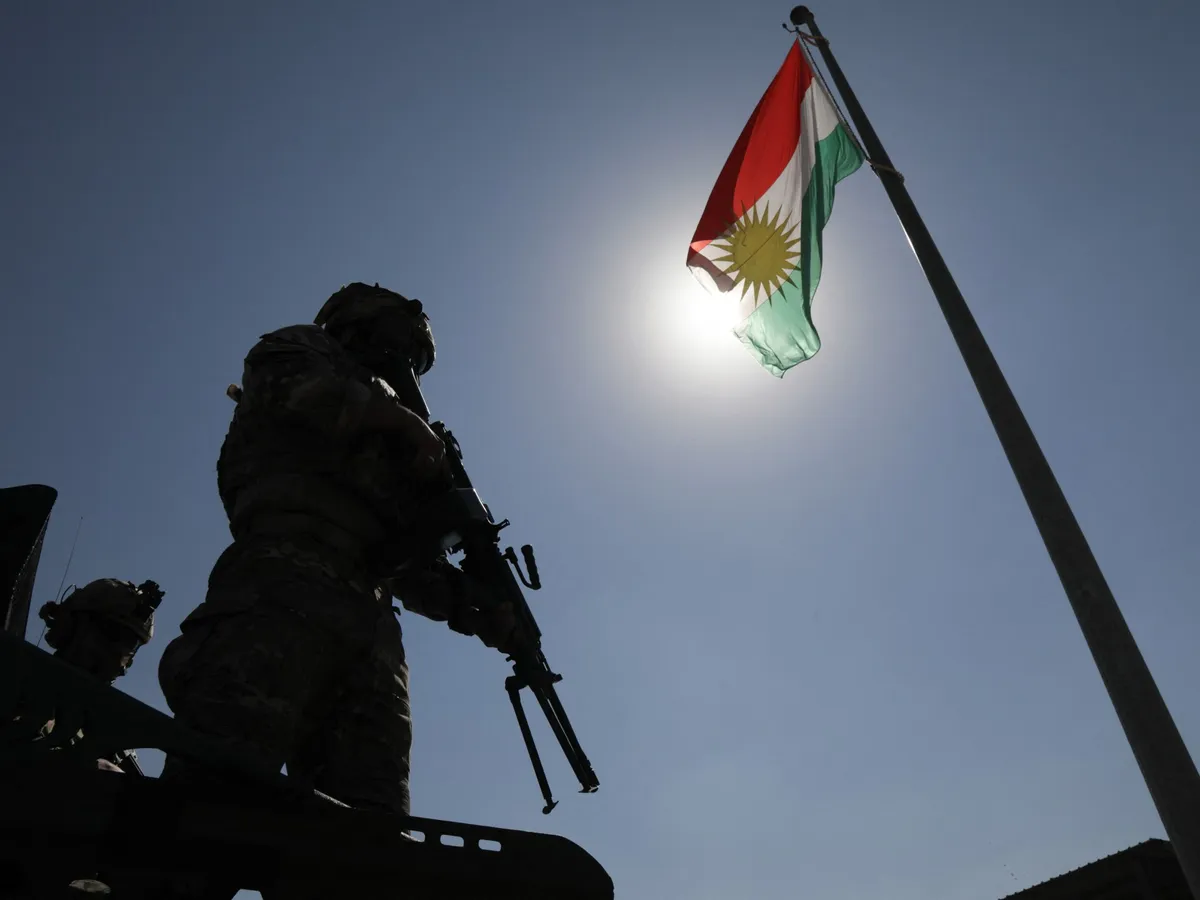
Kurdish authorities say that militias have merged into one force, but challenges to unity remain.Kurdish Peshmerga fighters take position south of Erbil, capital of Iraq's semi-autonomous northern Kurdish region, on September 30, 2026 [Safin Hamid/AFP]Published On 1 Oct 2026Iraq’s Kurdish forces are entering a new era following the withdrawal of US-led international forces that had been in the country to fight ISIL (ISIS).On Wednesday, the United States announced the formal end of Operation Inherent Resolve, its name for the 12-year-long campaign to defeat ISIL, and the completion of the withdrawal of its military forces from Iraq.Recommended Stories list of 3 itemslist 1 of 3Can Iraq handle future security challenges alone?list 2 of 3Pentagon says US troop withdrawal from Iraq is completelist 3 of 3Iraq celebrates Sovereignty Day as US troops complete withdrawalend of listOther partners in the war against the armed group also withdrew from Iraq, in accordance with a September 30 deadline set by Washington and Baghdad two years prior.For years, Iraq’s Kurdish forces – known as the Peshmerga – have relied on close military support from coalition forces, and the US in particular, to safeguard their autonomy and defend against ISIL.Their withdrawal has posed new political and security challenges for Iraq. Where does the Peshmerga stand today?The challenge of unificationDays before the coalition’s withdrawal, on September 21, the Erbil-based Kurdish Regional Government (KRG) – which presides over Iraq’s semi-autonomous Kurdistan region – announced that it had finally merged Kurdish armed factions into a unified fighting force.In his speech at the ceremony marking the event, KRG President Nechirvan Barzani characterised it as a major national step towards consolidating the region’s institutions.“Kurdistan needs one force, one ministry, and one command,” he said. “The Peshmerga must be a national force, free from party interference and disputes. Today, we take a major step towards achieving this goal.”Barzani announced that the militias affiliated with his Kurdish Democratic Party (KDP) and its historic rival Kurdistan" class="entity-link entity-organization" data-entity-id="212139" data-entity-type="organization">Patriotic Union of Kurdistan (PUK) were now under one structure. The KDP and PUK represent the two dominant Kurdish Iraqi factions.Zeidon Alkinani, a Middle East political analyst and founding director of the Doha-based Arab Perspectives Institute, told Al Jazeera that the unification would help stabilise Iraq.“Iraq’s most damaging rivalries have been within communities, intra-Shia and intra-Kurdish, not between them,” he said.He says reducing the role of the Erbil-based KDP and the Sulaymaniyah-based PUK party structures within the Peshmerga “strengthens Iraq’s stability and gives Erbil firmer legal footing with Baghdad”.However, the work is far from finished. Barzani, in his speech, warned that the unification marked the start of a phase that “may be even more difficult” than past Kurdish struggles, requiring the Peshmerga to stand above party loyalties.“The test is whether [unification] survives, given the persistence of two geographically distinct commands”, Alkinani says.Retired Lieutenant General Jabbar al-Yawar, former secretary general of the Ministry of Peshmerga in the KRG, told Al Jazeera that these parties were embroiled in a number of political disputes, including governance of Kurdistan and relations with Baghdad.These disputes, he says, could extend to military institutions if the forces remain tied to political parties.Iraq’s semi-autonomous Kurdistan region President Nechirvan Barzani [File:Azad Lashkari/Reuters]ReadinessOn the ground, the Ministry of Peshmerga insists that its forces are ready for the new era.Spokesperson Major General Othman Mohammed told Al Jazeera that the Peshmerga “has always been on full alert,” touting its role in repelling the ISIL in 2014 despite having limited means.He pointed to the relationship between the Peshmerga and Iraq’s other security forces, noting that commanders from both sides enjoyed very good cooperation and coordination.This coordination has become more important now that the international coalition has ended its mission, with Iraqis now relying on their own capabilities to detect and stop ISIL activity.Kurdish Peshmerga fighters take position on the Qarachogh mountain in the Makhmur district, about 60 kilometres (37 miles) south of Erbil, on September 30, 2026 [Safin Hamid/AFP]Despite this readiness, Mohammed Salih, a non-resident senior fellow at the US-based Foreign Policy Research Institute and an expert on Iraqi and regional affairs, says there is “considerable uncertainty and concern among Kurds surrounding the US withdrawal”.Many are asking whether the departure of US troops means the end of Washington’s commitment to Kurdish security, he told Al Jazeera, given that the US has been “a key security guarantor for the Kurdistan region for the past three decades”.Importantly, the US took with it key air defence systems when it withdrew, creating serious concern for Erbil, which has come under several drone and missile attacks since the start of the US war on Iran.Balanced relationsErbil has signalled its intention to continue cooperating with Baghdad as before, under Iraq’s federalist framework.The day after coalition forces withdrew, KDP leader and former KRG President Masoud Barzani touted “very strong coordination with the Iraqi federal government to confront any kind of threat or danger, whether it comes under the name of ISIS or any other name”.In Baghdad, he backed the federal government’s efforts to fight corruption, disarm Iran-aligned militias and settle outstanding disputes with Erbil under the constitution.Iraqi federalism and unity “depend on communication, coordination and respect for the rule of law among political parties, not on foreign troops”, Alkinani of the Arab Perspectives Institute said, in relation to the coalition withdrawal.Baghdad faced a dilemma when Washington demanded it disarm Iran-aligned Iraqi armed groups. The armed groups refused, pointing to the US presence in Iraq even as it waged war on Iran.The withdrawal may help the cause of federalism by removing this justification, he said, “but only if Iraqis replace it with dialogue and law rather than force”.Supporters of Iran-aligned armed factions gather for a rally celebrating the withdrawal of forces of the US-led coalition against ISIL from Iraq, in Baghdad on September 30, 2026 [Ahmad Al-Rubaye/AFP]
SRCAl Jazeera
LANGEN
LEANCenter
WORDS956
ENT12
THU · 2026-10-01 · 10:14 GMTBRIEF NSR-2026-1001-115531
NSR-2026-1001-115531News Report·EN·National Security
Iraq’s Kurdish forces look to a new era after US withdrawal
Iraq's Kurdish forces, the Peshmerga, are entering a new era following the withdrawal of US-led international forces after the defeat of ISIL. On September 21, 2026, the Erbil-based Kurdish Regional Government announced the merger of Kurdish armed factions into a unified fighting force, aiming to create a national force free from party interference.
Rached El-MoctarAl JazeeraFiled 2026-10-01 · 10:14 GMTLean · CenterRead · 4 min
Al JazeeraFIG 01
Reading time
4min
Word count
956words
Sources cited
2cited
Entities identified
12entities
Quality score
100%
§ 01
Briefing Summary
AI-generatedNEWSAR · AI
Iraq's Kurdish forces, the Peshmerga, are entering a new era following the withdrawal of US-led international forces after the defeat of ISIL. On September 21, 2026, the Erbil-based Kurdish Regional Government announced the merger of Kurdish armed factions into a unified fighting force, aiming to create a national force free from party interference. This unification, involving militias from the dominant KDP and PUK factions, is seen as a step towards stabilizing Iraq by reducing internal rivalries. However, challenges remain, including persistent party disputes and distinct geographical commands, which could impact the long-term success of the unified force. Despite these challenges, the Ministry of Peshmerga insists its forces are ready to handle security responsibilities independently, though uncertainty exists among Kurds regarding the end of US security guarantees.
Confidence 0.90Sources 2Claims 5Entities 12
§ 02
Article analysis
Model · rule-basedFraming
National Security
Political Strategy
Tone
Measured
AI-assessed
CalmNeutralAlarmist
Factuality
0.70 / 1.00
Factual
LowHigh
Sources cited
2
Limited
FewMany
§ 03
Key claims
5 extracted01
The unification of Kurdish armed factions is a major national step towards consolidating the region’s institutions.
quoteKRG President Nechirvan Barzani
Confidence
1.00
02
The US announced the formal end of Operation Inherent Resolve and the completion of its military forces' withdrawal from Iraq.
factualUnited States
Confidence
1.00
03
The unification phase may be even more difficult than past Kurdish struggles.
quoteKRG President Nechirvan Barzani
Confidence
0.90
04
Reducing the role of party structures within the Peshmerga strengthens Iraq’s stability and gives Erbil firmer legal footing with Baghdad.
quoteZeidon Alkinani
Confidence
0.90
05
Kurdish forces have merged into one unified fighting force following the withdrawal of US-led international forces.
factualKurdish authorities
Confidence
0.90
§ 04
Full report
4 min read · 956 words§ 05
Entities
12 identifiedKey playerOppositionContextPositiveNeutralNegative
Organizations6
Locations4
§ 06
Keywords & salience
10 termsus withdrawal
1.00
kurdish forces
1.00
peshmerga
0.90
isil
0.80
security challenges
0.70
unification
0.70
krg
0.60
kdp
0.50
puk
0.50
iraq
0.40
§ 07
Topic connections
Interactive graph Network visualization showing 51 related topics
View Full Graph Person Organization Location Event|Click node to navigate|Edge numbers = shared articles