Government forces fend off waves of Houthi attacks as civilians in the populous province are imperiled.Damaged buildings in Taiz City, capital of the Taiz governorate in southwestern Yemen, on September 25, 2026 [AFP]Published On 4 Oct 2026Yemen’s internationally recognised government and the Iran-backed Houthis are engaged in a fierce struggle for the Taiz governorate, a key strategic area in the southwest of the country.Rashad al-Alimi, chief of the Saudi Arabia-backed Presidential Leadership Council (PLC), announced on Sunday the start of a major offensive against the Houthis to regain lost territory. It is expected that this will result in more battles around Taiz, already the site of some of the most recent fighting.Recommended Stories list of 4 itemslist 1 of 4A Yemeni family spends a week on the road fleeing another Houthi offensivelist 2 of 4Yemen’s war disrupts roads and ports, deepening humanitarian crisislist 3 of 4Yemen’s army says targets Houthis in hundreds of strikes, killing 700list 4 of 4Saudi-led coalition dismisses ‘misleading’ Houthi claim of Riyadh attackend of listObservers and analysts say that the Houthis are trying to consolidate their gains after seizing much of Yemen’s Red Sea coast last month. For the government, the battle for Taiz represents a strategic and existential struggle for control of the country.Here’s what we know.Why is Taiz important?Taiz governorate is Yemen’s most populous region, with nearly 4.5 million people. The flat western coastal region sits on the Red Sea and includes the port city of Mocha and the strategically important Bab al-Mandeb strait.These coastal regions were captured by the Houthis in a surprise and lightning campaign in early September, raising fears the group could choke off international shipping through the strait. They were also key supply routes for Taiz.Much of the governorate lies within Yemen’s highlands and remains contested between the two sides. The region’s capital, Taiz City, is nestled between a number of mountains and is under government control. It is one of Yemen’s most populous cities and a key source of legitimacy for the Yemeni government.The governorate sits between Yemen’s Houthi-controlled north and the government-held south. The Houthi advance threatens to isolate government forces from Aden, the southern coastal town where key state institutions are based.Ibrahim Jalal, a senior researcher and policy adviser, told Al Jazeera that Taiz is a city of huge social, political, economic and military importance for the whole of Yemen.“The Houthi attempt to isolate and constrict the city seeks to secure their coastal Red Sea gains up to Bab al-Mandeb, as well as double down on pressure on Lahij, Aden and much of the south,” said Jalal.“The Houthis seek to expand their territorial control at the moment along the former boundaries of northern Yemen, or to say, that they want to remove all little pockets of resistance to consolidate control.”Taiz has been one of the most heavily contested cities in the war, beginning shortly after Houthi forces captured the capital Sanaa in September 2014.Thousands of civilians have been killed in a devastating Houthi siege and assault on the city, with government forces driving back repeated assaults between 2015 and 2022.Map showing territorial control in Yemen’s civil war as of September 30, 2026 [Al Jazeera]Fighting has been focused on Jabal Han, a mountain overlooking Taiz from the west, as well as a key road into the city.Control over this mountain would allow the Houthis to attack people and supplies entering Taiz City from the southwest, Saeed Thabet, head of Al Jazeera’s bureau in Yemen, said.Who has the upper hand?There has been no clear winner in the battle for Taiz so far, which observers have described as a stalemate.Al Jazeera’s Mohammed al-Qadi, reporting from the city, said government forces have launched dozens of air strikes on Houthi bases and positions across Taiz in recent days.Houthi fighters are trying to advance under cover of intense artillery, tank, mortar and Katyusha rocket fire into the city.Artillery fire could be heard around Taiz as residents appealed to be evacuated, Al Jazeera’s Maha Ali, reporting from Taiz City, said on Sunday.On that day, local authorities reported that a shell had hit a residential area in Dhubab, killing a 14-day-old infant. Other attacks have wounded civilians.Government forces are also shelling Houthi forces positioned around the city.Face-to-face fighting has now reached the countryside on the outskirts of Taiz City. Residents are fighting on their own initiative against Houthi attempts to infiltrate villages and mountain areas around Taiz, a local source said.The heaviest fighting is taking place at the western axis of the city, where government forces have mounted a fierce defence at Jabal Han.On Sunday, Yemen’s government forces announced gains against the Houthis, saying they had captured several areas, including a fort in Samaa.The military command in Taiz also claimed its forces had repelled Houthi attacks on Jabal Han, Hazran and other points west of Taiz City.Yemeni military spokesman Majed al-Nuzaili said government forces had carried out dozens of operations using aircraft, drones, artillery, missiles and snipers, resulting in hundreds of Houthi casualties. Al Jazeera could not verify these claims.In early September, the Houthis managed to expand their control over Yemen’s Red Sea coast with unexpected speed and limited resistance.However, they have faced much fiercer fighting from government forces in Taiz.One key reason for this is the cohesion between government forces and the local tribes. Al Jazeera’s Yasser Hassan reports that tribesmen took part in Sunday’s capture of the Samaa Fort.How are civilians in Taiz being impacted?The humanitarian cost of the renewed fighting in Taiz has already manifested in a refugee crisis with limited access to humanitarian goods and services.There has also been an increase in civilian casualties. Since fighting escalated in early September, nearly 200,000 people have been displaced in Yemen, most of them from Taiz governorate, according to Yemen’s Executive Unit for IDP Camps Management.The closure of some major roads into Taiz City has raised fears of an impending humanitarian disaster.Saudi-backed Yemeni government soldiers gather near the Jabal Han front, west of Taiz City, on October 3, 2026 [Ahmed Al-Basha/AFP]The Office of the United Nations High Commissioner for Refugees (UNHCR) and the World Health Organization (WHO) have both warned that the fighting was putting Yemen’s fragile healthcare system in peril.Al Jazeera’s Hassan described the humanitarian situation as “very difficult” after government forces decided to shut down all roads leading into the city out of fear of Houthi infiltration.Before Mocha was taken over by Houthis, its port was a critical supply line from which food and aid were delivered to Taiz City.The ongoing war has also devastated the country. Nearly half of Yemen’s 34 million population face acute food insecurity, according to the UN, with about half a million people suffering severe malnutrition.
SRCAl Jazeera
LANGEN
LEANCenter
WORDS1 109
ENT12
SUN · 2026-10-04 · 13:31 GMTBRIEF NSR-2026-1004-116221
NSR-2026-1004-116221News Report·EN·Conflict
Why is fighting intensifying in Yemen’s Taiz governorate?
Fighting has intensified in Yemen's Taiz governorate as the internationally recognized government and Iran-backed Houthis battle for control of key strategic locations. The government launched a major offensive to regain territory, while the Houthis aim to consolidate recent gains along the Red Sea coast.
Al Jazeera StaffAl JazeeraFiled 2026-10-04 · 13:31 GMTLean · CenterRead · 5 min
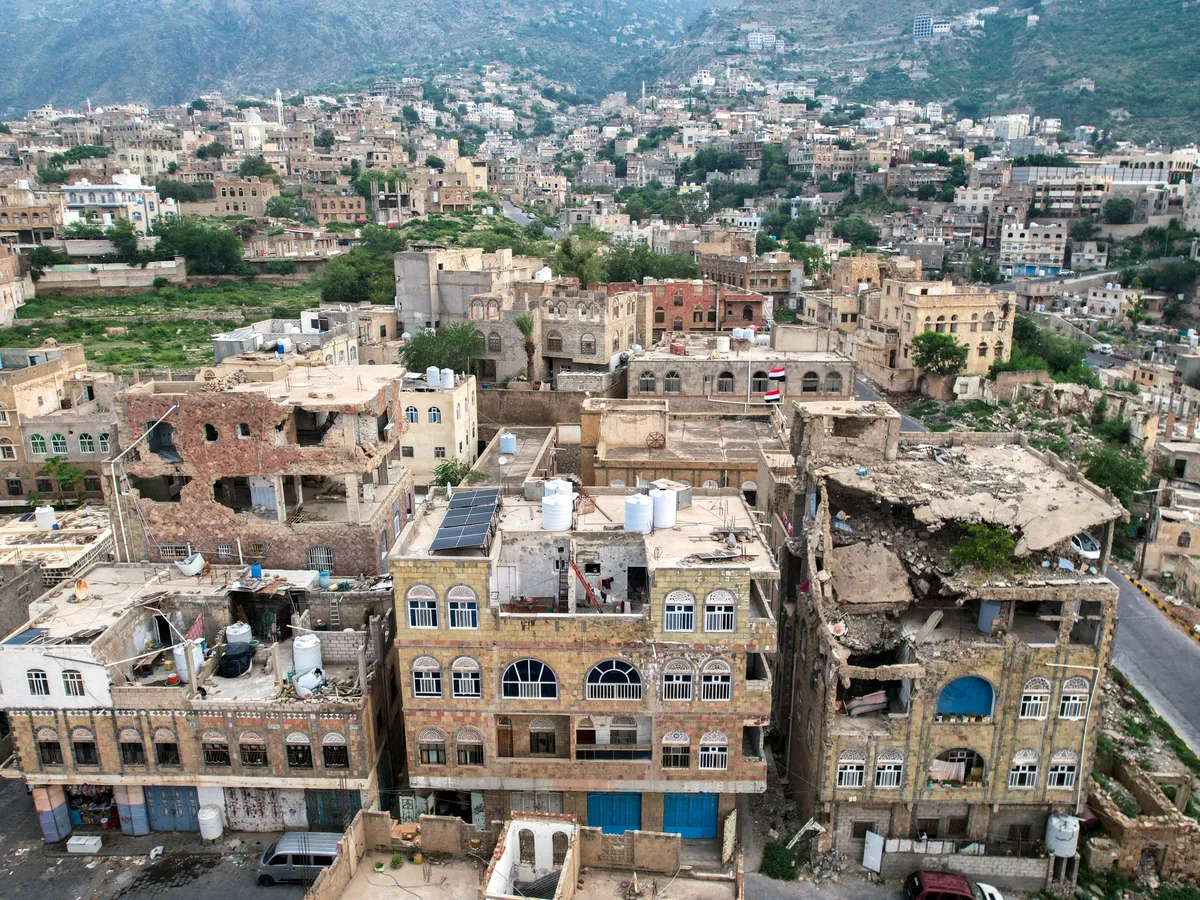
Al JazeeraFIG 01
Reading time
5min
Word count
1 109words
Sources cited
1cited
Entities identified
12entities
Quality score
100%
§ 01
Briefing Summary
AI-generatedNEWSAR · AI
Fighting has intensified in Yemen's Taiz governorate as the internationally recognized government and Iran-backed Houthis battle for control of key strategic locations. The government launched a major offensive to regain territory, while the Houthis aim to consolidate recent gains along the Red Sea coast. Taiz is strategically important due to its large population, location on the Red Sea, and proximity to the Bab al-Mandeb strait, a vital shipping route. The governorate also sits between Houthi-controlled north and government-held south, making its control crucial for isolating opposing forces. Heavy fighting is occurring around Taiz City, a populous urban center and a source of legitimacy for the government, with both sides reporting gains and civilian casualties reported.
Confidence 0.90Sources 1Claims 5Entities 12
§ 02
Article analysis
Model · rule-basedFraming
Conflict
Political Strategy
Tone
Measured
AI-assessed
CalmNeutralAlarmist
Factuality
0.70 / 1.00
Factual
LowHigh
Sources cited
1
Limited
FewMany
§ 03
Key claims
5 extracted01
Taiz governorate is Yemen’s most populous region, with nearly 4.5 million people.
statistic
Confidence
1.00
02
Rashad al-Alimi announced the start of a major offensive against the Houthis to regain lost territory.
factualRashad al-Alimi
Confidence
1.00
03
Government forces are engaged in a fierce struggle with Iran-backed Houthis for the Taiz governorate.
factual
Confidence
1.00
04
The Houthi advance threatens to isolate government forces from Aden, the southern coastal town where key state institutions are based.
factual
Confidence
0.90
05
The Houthis are trying to consolidate their gains after seizing much of Yemen’s Red Sea coast last month.
factualObservers and analysts
Confidence
0.80
§ 04
Full report
5 min read · 1 109 words§ 05
Entities
12 identifiedKey playerOppositionContextPositiveNeutralNegative
Organizations3
§ 06
Keywords & salience
8 termstaiz governorate
1.00
yemen conflict
1.00
houthi attacks
0.90
government forces
0.80
strategic importance
0.70
red sea coast
0.60
bab al-mandeb strait
0.50
humanitarian crisis
0.40
§ 07
Topic connections
Interactive graph Network visualization showing 51 related topics
View Full Graph Person Organization Location Event|Click node to navigate|Edge numbers = shared articles