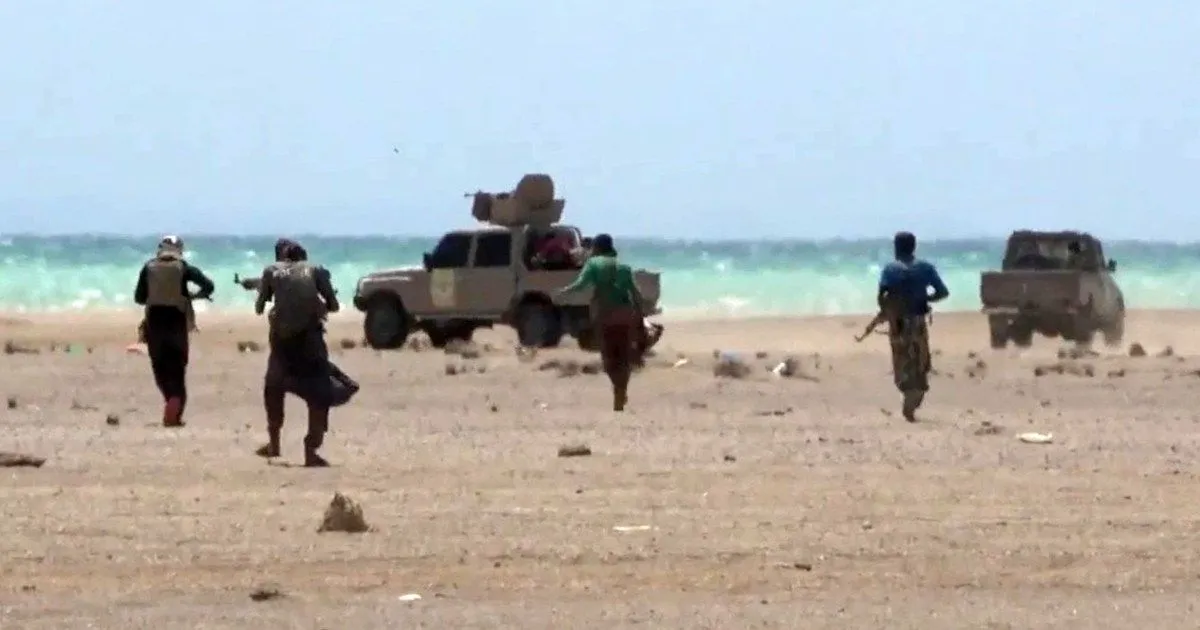
Territorial gains alone will not be enough to change the trajectory of the war.Published On 6 Oct 2026A screen grab taken from video footage released by the pro-Yemeni government Southern Giants Brigades in the Dhubab district of Taiz province in Yemen on October 6, 2026 [AFP]Two days after the announced counter-offensive by the internationally recognised Yemeni government, the operation named Yemen" class="entity-link entity-event" data-entity-id="214074" data-entity-type="event">Dawn of Yemen has already made significant advances. Its forces recaptured territory from the Houthis, an Iran-backed group, along the Red Sea coast near the Bab al-Mandeb strait.The Saudi-led coalition backing the government has deployed 100 fighter jets, flying round-the-clock to help secure the strait. In response, the Houthis have claimed attacks on Saudi territory.This is the most consequential escalation in the Yemen war since the UN-brokered truce of 2022. For four years, the war was managed as a frozen conflict. Now, both sides are trying to redraw the map.In the coming days, the success of the offensive will be determined not only by gains along three different fronts, but also by the ability of the forces loyal to the Yemeni government to maintain cohesion and force the Houthis to change their cost of conflict calculus.Keeping the Houthis overstretchedThe western coast is where the campaign will be won or lost, and the reason lies beyond Yemen. With Iran disrupting traffic through the Strait of Hormuz, the Red Sea has become the Gulf’s strategic lifeline. Saudi Arabia’s East-West pipeline to Yanbu is its main route around Hormuz, yet crude shipped from Yanbu to Asian markets must still pass through Bab al-Mandeb.A Houthi grip on the strait’s Yemeni shore turns that bypass into a hostage. The Arabian Peninsula would then be squeezed at both ends simultaneously, a scenario that no Gulf capital, and few oil importing economies, can tolerate for long.There is also a counterintuitive point here. The Houthis’ greatest gain of the year – the territories near Bab al-Mandeb – may also be their most exposed position. Their traditional strength lies in the mountains of the north, where terrain, tribal networks and short supply lines favour defence.The Tihama coast is the opposite: a flat plain, far from their highland base, with long and vulnerable supply routes and little cover from sustained airpower.If the government can win decisively anywhere, it is here. The immediate aim need not be to defeat the Houthis outright, but to push them back from the strait, retake the islands and deny them the ability to convert geography into regional leverage.The second decisive front is Taiz. The city is the hinge between the Houthi-held north, the government-held south and the western coastal theatre. If the Houthis keep the Aden road severed, any broader offensive is split in two. If government forces reopen it, they gain territorial continuity between Aden, Taiz and the coast.The third is Marib governorate, where fighting has escalated on the Raghwan front, and potentially al-Jawf.Despite sweeping rhetoric from the Yemeni government, an early march on Sanaa remains unlikely. The more plausible strategy is cumulative pressure: if the coast, Taiz and Marib are pressed at the same time, the Houthis will struggle to concentrate manpower, missiles, drones and logistics on any single axis. The government does not need breakthroughs everywhere; it needs to keep the Houthis overstretched.Support is not the problem, cohesion isThe government has rarely lacked external backers. Its recurring failure has been converting that support into coherent Yemeni military power. Saudi Arabia remains decisive, and its incentives are now direct rather than abstract: Aramco facilities are under fire, Saudi-linked shipping has been declared a target and the main route circumventing the Strait of Hormuz is exposed.The commitment of 100 aircraft signals that Riyadh is willing to invest heavily.Airpower can destroy positions, cut supply lines and break concentrations of force, but it cannot hold territory. That requires Yemeni forces to fight under a unified chain of command, support functioning local administration and maintain political agreement that prevents infighting between factions.Here the anti-Houthi camp is arguably weaker than at any point in the war. The Southern Transitional Council, which launched its own offensive across the south in December 2025, was dissolved in January after a Saudi-backed counteroffensive, and its leader, Aidarous al-Zubaidi, left the country. The southern units that fought under its banner remain armed and capable, but without a political roof, and their loyalty to the Yemeni government is conditional.Alongside them, Tareq Saleh’s National Resistance on the coast, the Southern Giants Brigades, and units aligned with the Islah Party in Taiz and Marib each answer to different leaderships, regional priorities and external patrons.The Houthis, by contrast, possess a centralised political and military command.This asymmetry is the offensive’s greatest vulnerability. If it is fought through fragmented chains of command, gains will be temporary: rival forces will compete over captured territory, revenues and authority, and the Houthis will regroup and counterattack.Recognising this reality, the Yemeni government has started preparing to hand out salary payments and undertake reconstruction in recovered areas. That is the right instinct. A town taken by airstrikes but left unpaid and ungoverned will not stay taken. This effort needs to be maintained.A turning point?The offensive should not be judged by whether it captures Sanaa. That benchmark is maximalist and almost guarantees a verdict of failure. The better question is whether it makes the conflict ripe for resolution.In the language of conflict studies, parties negotiate seriously when they perceive a mutually hurting impasse. Since 2022, the deadlock has hurt the Yemeni people, the government, Saudi Arabia and global shipping, but not the Houthis, who have had every reason to believe that time works in their favour. The purpose of Yemen" class="entity-link entity-event" data-entity-id="214074" data-entity-type="event">Dawn of Yemen, properly understood, is not total victory, but a change in the Houthis’ assessment of the costs of continued confrontation.There is a complication. The Houthis’ calculus is no longer purely Yemeni. Their decisions are now entangled with Tehran’s war and its bargaining with Washington. Even significant battlefield losses may not produce flexibility in the group if its leadership believes concessions should be traded within a wider regional deal. A specifically Yemeni settlement may therefore depend partly on movement in a negotiation that Yemenis do not control.Over the coming weeks, four indicators will tell us which way the war is turning: whether government forces retake and hold the coast and the strait islands; whether the Taiz-Aden road is reopened; whether the Houthis are forced to pull forces from Taiz to defend the coast and Marib; and whether recovered areas come under a single command and receive salaries and services.If most of these happen, the strategic geometry of the war may shift. If government forces advance only marginally, suffer heavy losses or turn on one another, the Houthis will claim to have survived yet another externally backed campaign, and that narrative will harden their conviction that they can outlast their opponents.All of this unfolds amid a deepening humanitarian catastrophe. The World Health Organization has recorded more than 5,000 casualties since early August, while nearly 200,000 people have been displaced and suspected cholera cases have tripled. A campaign that ignores this will exhaust international patience quickly, as happened with the operation to recapture Hodeidah in 2018, when government forces were pressured to stop to avert a humanitarian disaster.The offensive then is not the turning point itself. It is the opening of a test. The Yemeni government must do what it has struggled to do throughout this war: convert external support into unified political authority and sustainable military power. If it fails, the Houthis will emerge from another round more convinced than ever that time remains on their side.The views expressed in this article are the author’s own and do not necessarily reflect Al Jazeera’s editorial stance.
SRCAl Jazeera
LANGEN
LEANCenter
WORDS1 279
ENT12
TUE · 2026-10-06 · 16:46 GMTBRIEF NSR-2026-1006-116833
NSR-2026-1006-116833Analysis·EN·Political Strategy
What would it take for the Yemen offensive to succeed?
Yemeni government forces, backed by the Saudi-led coalition, have launched a significant counter-offensive named "Dawn of Yemen" along the Red Sea coast, recapturing territory from the Houthi group. This operation, the most consequential escalation since a 2022 truce, aims to secure the strategic Bab al-Mandeb strait, a vital shipping route.
Abdulla Banndar Al-EtaibiAl JazeeraFiled 2026-10-06 · 16:46 GMTLean · CenterRead · 6 min
Al JazeeraFIG 01
Reading time
6min
Word count
1 279words
Sources cited
0cited
Entities identified
12entities
Quality score
100%
§ 01
Briefing Summary
AI-generatedNEWSAR · AI
Yemeni government forces, backed by the Saudi-led coalition, have launched a significant counter-offensive named "Dawn of Yemen" along the Red Sea coast, recapturing territory from the Houthi group. This operation, the most consequential escalation since a 2022 truce, aims to secure the strategic Bab al-Mandeb strait, a vital shipping route. Success hinges on maintaining government force cohesion and overstretching Houthi resources across multiple fronts, including the western coast, Taiz, and Marib. While external support is present, the article highlights a lack of unified command and political agreement among anti-Houthi factions as a key challenge, contrasting with the Houthis' centralized leadership. The offensive's ultimate success will depend on more than just territorial gains, requiring the Houthis to reconsider their conflict calculus.
Confidence 0.90Claims 5Entities 12
§ 02
Article analysis
Model · rule-basedFraming
Political Strategy
Conflict
Tone
Measured
AI-assessed
CalmNeutralAlarmist
Factuality
0.60 / 1.00
Mixed
LowHigh
Sources cited
0
No named sources
FewMany
§ 03
Key claims
5 extracted01
The Red Sea has become the Gulf's strategic lifeline due to Iran disrupting traffic through the Strait of Hormuz.
factual
Confidence
0.95
02
The Yemeni government's 'Dawn of Yemen' counter-offensive has recaptured territory from the Houthis along the Red Sea coast.
factualYemeni government
Confidence
0.90
03
A Houthi grip on the Bab al-Mandeb strait's Yemeni shore would turn the Saudi East-West pipeline into a hostage.
factual
Confidence
0.85
04
The western coast is where the campaign will be won or lost.
factual
Confidence
0.80
05
The success of the offensive will be determined by territorial gains and the government forces' ability to maintain cohesion.
prediction
Confidence
0.70
§ 04
Full report
6 min read · 1 279 words§ 05
Entities
12 identifiedKey playerOppositionContextPositiveNeutralNegative
Organizations4
Locations7
§ 06
Keywords & salience
9 termsyemen war
1.00
bab al-mandeb strait
0.90
houthi offensive
0.80
saudi-led coalition
0.70
red sea coast
0.60
cost of conflict
0.50
territorial gains
0.50
strategic lifeline
0.40
iran
0.40
§ 07
Topic connections
Interactive graph Network visualization showing 51 related topics
View Full Graph Person Organization Location Event|Click node to navigate|Edge numbers = shared articles