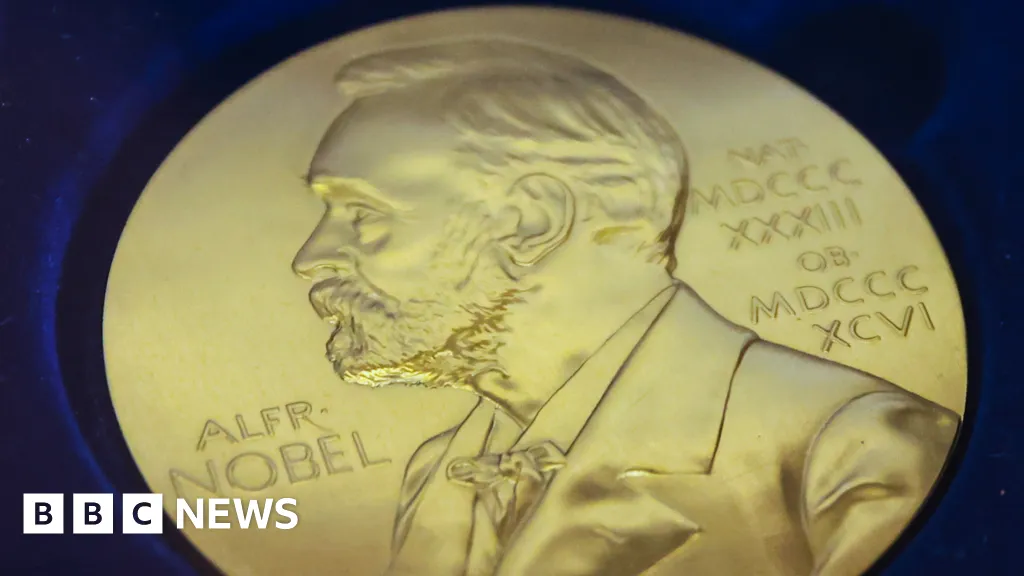
The Nobel Prize in Chemistry has been awarded to French scientist Henri B. Kagan and Japan's Kenso Soai for providing a solution to the chemical mystery of life's asymmetry.The researchers discovered how nature exclusively makes the correct version of a molecule - rather than its mirror image. For example, amino acid molecules, the building blocks of proteins, exist as two forms that are each other's mirror image. But living organisms on Earth only function with one of those forms. The Nobel laureates answered the question: why does life favour just one of these mirror image molecules over the other.In organic chemistry, this property is known as "chirality", so chiral molecules have both right and left-handed forms.You can think of them as looking like our hands - not identical, but each a mirror image of the other. And while nature almost exclusively produces the version it requires to function, chemical reactions in a lab usually create a 50-50 mix of both left- and right-handed molecules.When it comes to making drugs, this is particularly significant, because each version behaves differently when it interacts with our bodies.
SRCBBC News - World
LANGEN
LEANCenter
WORDS184
ENT10
WED · 2026-10-07 · 11:51 GMTBRIEF NSR-2026-1007-117027
NSR-2026-1007-117027News Report·EN·Technology
Chemistry Nobel awarded for solving mystery of life's asymmetry
Henri B. Kagan and Kenso Soai have been awarded the Nobel Prize in Chemistry for solving the mystery of life's asymmetry.
38 minutes agoShareSaveAdd as preferred on GoogleVictoria Gill and Esme StallardBBC Science teamBBC News - WorldFiled 2026-10-07 · 11:51 GMTLean · CenterRead · 1 min
BBC News - WorldFIG 01
Reading time
1min
Word count
184words
Sources cited
0cited
Entities identified
10entities
Quality score
100%
§ 01
Briefing Summary
AI-generatedNEWSAR · AI
Henri B. Kagan and Kenso Soai have been awarded the Nobel Prize in Chemistry for solving the mystery of life's asymmetry. Their work explains how nature exclusively produces one specific form of a molecule, rather than its mirror image. This phenomenon, known as chirality, is crucial because living organisms on Earth rely on only one of these mirror-image forms, such as in amino acids, the building blocks of proteins. While laboratory chemical reactions typically produce a 50-50 mix of both forms, nature's preference for a single form is vital for biological function and has significant implications for drug development, as each molecular form can interact differently with the body.
Confidence 0.90Claims 5Entities 10
§ 02
Article analysis
Model · rule-basedFraming
Technology
Human Interest
Tone
Measured
AI-assessed
CalmNeutralAlarmist
Factuality
0.90 / 1.00
Factual
LowHigh
Sources cited
0
No named sources
FewMany
§ 03
Key claims
5 extracted01
The difference in molecular forms is significant in drug development as each version can interact differently with the body.
factualarticle
Confidence
1.00
02
Chiral molecules have both right and left-handed forms, analogous to human hands.
factualarticle
Confidence
1.00
03
Amino acids, the building blocks of proteins, exist as two mirror-image forms, but living organisms use only one.
factualarticle
Confidence
1.00
04
Researchers discovered how nature exclusively makes one version of a molecule over its mirror image.
factualarticle
Confidence
1.00
05
The Nobel Prize in Chemistry was awarded for solving the mystery of life's asymmetry.
factualarticle
Confidence
1.00
§ 04
Full report
1 min read · 184 words§ 05
Entities
10 identifiedKey playerOppositionContextPositiveNeutralNegative
§ 06
Keywords & salience
8 termslife's asymmetry
1.00
chirality
0.90
mirror image molecules
0.80
organic chemistry
0.70
nobel prize in chemistry
0.60
building blocks of proteins
0.50
amino acid molecules
0.50
drug making
0.40
§ 07
Topic connections
Interactive graph Network visualization showing 4 related topics
View Full Graph Person Organization Location Event|Click node to navigate|Edge numbers = shared articles