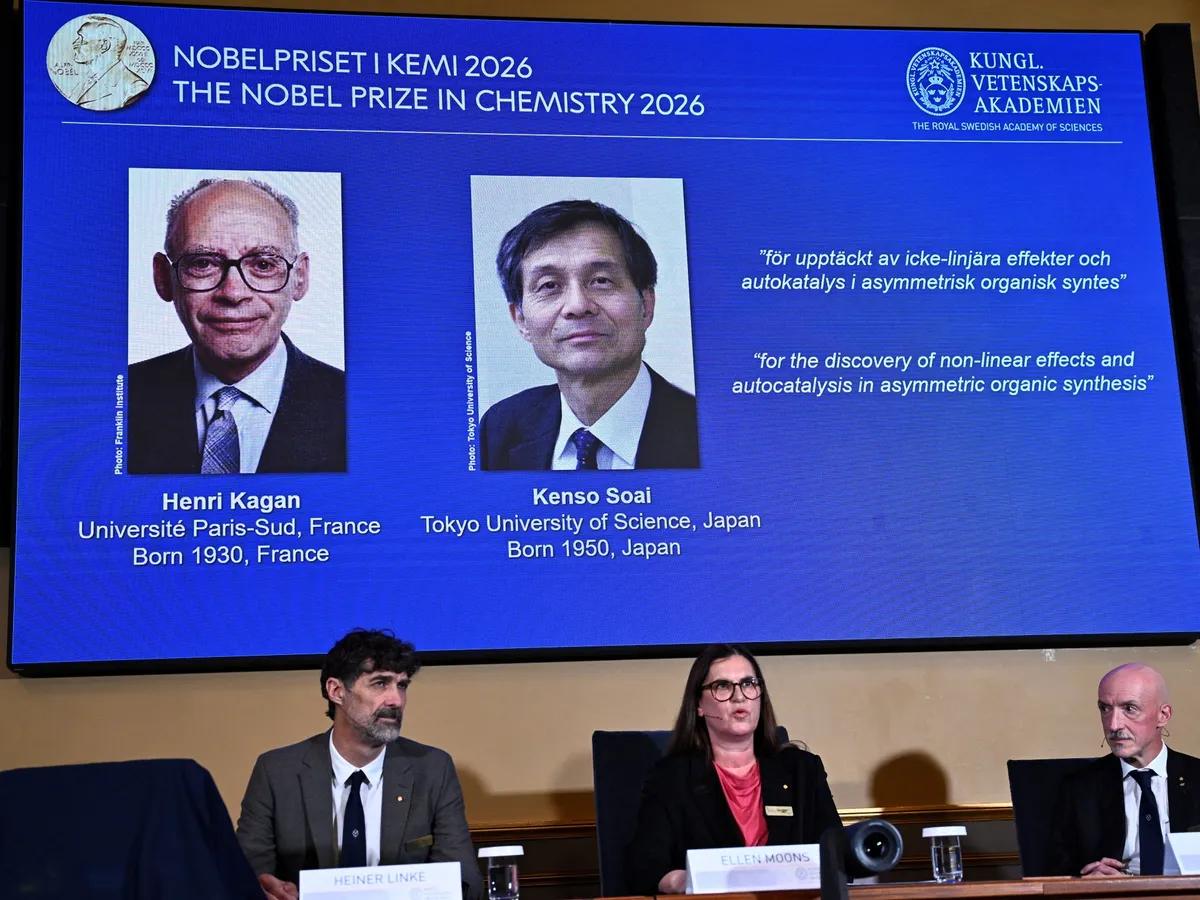
Henri Kagan, Kenso Soai win Nobel chemistry prize for ‘mirror image’ workScientists honoured for solving mystery of asymmetric ‘mirror image’ molecules that has helped in manufacture of pharmaceuticals.Scientists Henri Kagan and Kenso Soai have won the 2026 Nobel Prize in Chemistry for solving a longstanding riddle of asymmetric “mirror image” molecules, a discovery hugely important for pharmaceutical manufacturing.The Royal Swedish Academy of Sciences said on Wednesday the pair – Kagan, 95, from France; and Soai, 76, from Japan – were honoured “for the discovery of nonlinear effects and autocatalysis in asymmetric organic synthesis”.Recommended Stories list of 2 itemslist 1 of 2US support for Israel continues three years into the genocide in Gazalist 2 of 2Justina Shiroka Pula: Kosovo’s new president, elected during a crisisend of listTheir findings showed how chemical reactions can be driven to favour a single molecular mirror image, work that has been key for chemists who design reactions for the manufacture of pharmaceuticals.Many of the molecules essential to life exist in two forms that are mirror images of each other, like left and right hands. Yet living organisms almost exclusively use only one version, a phenomenon known as “homochirality” – from the Greek word for hand – that has puzzled chemists for more than a century.“The left-handed version of the drug can have one effect, and the right-handed version can have another effect, and then we need methods for selectively preparing them,” said Peter Somfai, a member of the Nobel Committee for Chemistry.“In developing such methods, the findings of this year’s laureates are important. They provided powerful tools for that,” he said.Heiner Linke, chair of the committee, said the two scientists provided “a solution to a chemical mystery that is over a century old: how homochirality can emerge spontaneously”, calling the chemical reactions they developed “spectacular”.
SRCAl Jazeera
LANGEN
LEANCenter
WORDS299
ENT11
WED · 2026-10-07 · 13:00 GMTBRIEF NSR-2026-1007-117054
NSR-2026-1007-117054News Report·EN·Technology
Henri Kagan, Kenso Soai win chemistry Nobel for ‘mirror image’ breakthrough
Henri Kagan and Kenso Soai have been awarded the 2026 Nobel Prize in Chemistry for their groundbreaking work on asymmetric organic synthesis. The Royal Swedish Academy of Sciences recognized their discovery of nonlinear effects and autocatalysis, which provides methods for selectively preparing single molecular mirror images.
Al Jazeera StaffAl JazeeraFiled 2026-10-07 · 13:00 GMTLean · CenterRead · 2 min
Al JazeeraFIG 01
Reading time
2min
Word count
299words
Sources cited
3cited
Entities identified
11entities
Quality score
100%
§ 01
Briefing Summary
AI-generatedNEWSAR · AI
Henri Kagan and Kenso Soai have been awarded the 2026 Nobel Prize in Chemistry for their groundbreaking work on asymmetric organic synthesis. The Royal Swedish Academy of Sciences recognized their discovery of nonlinear effects and autocatalysis, which provides methods for selectively preparing single molecular mirror images. This breakthrough addresses the long-standing mystery of "homochirality," where living organisms predominantly use only one of two mirror-image molecular forms. Their findings are crucial for pharmaceutical manufacturing, enabling chemists to design reactions that produce the desired molecular form for drugs. The committee highlighted the significance of their work in solving a chemical puzzle that has persisted for over a century.
Confidence 0.90Sources 3Claims 4Entities 11
§ 02
Article analysis
Model · rule-basedFraming
Technology
Public Health
Tone
Measured
AI-assessed
CalmNeutralAlarmist
Factuality
0.90 / 1.00
Factual
LowHigh
Sources cited
3
Well sourced
FewMany
§ 03
Key claims
4 extracted01
The scientists provided a solution to a chemical mystery over a century old: how homochirality can emerge spontaneously.
quoteHeiner Linke
Confidence
1.00
02
The laureates' findings provided powerful tools for selectively preparing single molecular mirror images, crucial for pharmaceuticals.
quotePeter Somfai
Confidence
1.00
03
Their discovery of nonlinear effects and autocatalysis in asymmetric organic synthesis is hugely important for pharmaceutical manufacturing.
factual
Confidence
1.00
04
Henri Kagan and Kenso Soai won the 2026 Nobel Prize in Chemistry for their work on asymmetric organic synthesis.
factualRoyal Swedish Academy of Sciences
Confidence
1.00
§ 04
Full report
2 min read · 299 words§ 05
Entities
11 identifiedKey playerOppositionContextPositiveNeutralNegative
People4
Organizations1
§ 06
Keywords & salience
10 termsmirror image molecules
1.00
asymmetric organic synthesis
1.00
nobel prize in chemistry
0.90
pharmaceutical manufacturing
0.80
nonlinear effects
0.70
autocatalysis
0.70
homochirality
0.60
henri kagan
0.50
kenso soai
0.50
molecular mirror image
0.40
§ 07
Topic connections
Interactive graph Network visualization showing 4 related topics
View Full Graph Person Organization Location Event|Click node to navigate|Edge numbers = shared articles