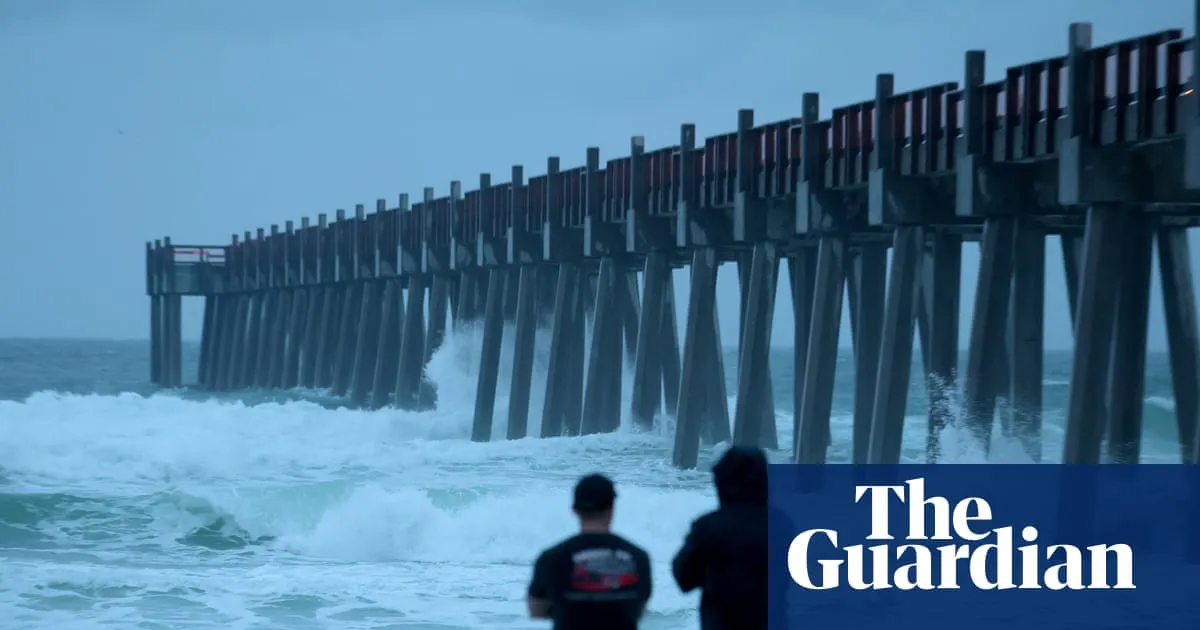
Isaias strengthened into a category 3 hurricane on Friday morning as it barreled toward the US Gulf coast, where states of emergency have been declared in Alabama, Florida and Mississippi.The hurricane, the first in the Atlantic in what has turned into a very late 2026 season, is expected to cause a “life-threatening storm surge”, officials said. Isaias is forecast to make landfall on Friday night, somewhere along the Alabama-Florida line with surging seas up to 7ft (2.1 meters) and waves as high as 30ft (9.1 meters).“Damaging hurricane-force winds are expected over portions of the Florida panhandle, southern Alabama and southern Mississippi, where a hurricane warning is in effect. Residents in these areas should prepare for the possibility of long-duration power outages,” the National Oceanic and Atmospheric Administration (Noaa) said.Noaa said a storm surge is expected from south-east Louisiana to Suwannee, in north-east Florida. Isaias could also dump up to 15in (380mm) of rain on coastal areas and even spawn tornadoes overnight on Friday into Saturday from Alabama to the Florida panhandle and south-western Georgia. The hurricane is expected to quickly weaken after coming ashore.Heavy rain began falling along the coast on Friday morning and winds were picking up sharply, with tropical storm conditions expected by early afternoon.Isaias had maximum sustained winds of 105mph (169km/h) on Friday morning, according to the National Hurricane Center (NHC). It was headed north-north-east at 15mph (24km/h) and was centered about 230 miles (370km) south of the mouth of the Mississippi River in Louisiana.The NHC said Dauphin Island, a barrier island off the Alabama coast, could see a 7ft (2.1-meter) storm surge, while Indian Pass, 200 miles (322km) to the east on the Florida coast, could see a 6ft (1.8-meter) surge.“Preparations should be rushed to completion as the weather will go downhill quickly today,” the NHC said. “While the storm is not expected to make landfall at peak intensity, it is likely that Isaias will still be a significant hurricane when it reaches the coast.”Alabama’s governor, Kay Ivey, ordered non-residents to immediately evacuate Dauphin Island, Gulf Shores and Orange Beach on Thursday, while officials encouraged voluntary evacuations for residents. Videos on social media showed traffic at a standstill on a highway leading out of Gulf Shores, where double red flags signaled that beaches were closed.Ivey has declared a state of emergency for 40 counties in Alabama, while Ron DeSantis, the governor of Florida, has declared a state of emergency in 27 counties. Several cities and counties in south Mississippi have done the same. DeSantis said 5,000 national guard troops were expected to mobilize in Florida, where at least four school districts cancelled late-week classes.The Atlantic hurricane season has been unusually quiet this year because of a strong El Niño, which disrupts storm formation over the Atlantic. The first hurricane of the season has not formed this late since 8 October 1905, which predates the satellite era (1960s) for tracking hurricanes.Ahead of the storm, oil and gas producers shut down a significant share of offshore production in the Gulf, which accounts for almost 15% of crude pumped annually in the US.skip past newsletter promotionafter newsletter promotionAs of Thursday, about 63% of the oil production in the region had been temporarily halted, taking nearly 1.3m barrels a day off the market, according to the Marine Minerals Administration. It said 121 of the Gulf’s 371 crewed oil platforms had been evacuated.The storm could be the first major test of the ability of the Federal Emergency Management Agency (Fema) to deploy a large workforce after the Trump administration’s sweeping cuts and restructuring of the agency, emergency management experts say.The Trump administration has said it wants to eliminate, or drastically downsize, Fema, putting more burden on states. More than 4,300 employees left the agency in fiscal year 2025, about 17% of the workforce, according to a recent US Government Accountability Office (GAO) report.The agency’s staffing reductions were not carried out systematically to ensure Fema could still meet its statutory obligations, said Chris Currie, director of homeland security and justice at the GAO.The Associated Press and Reuters contributed reporting
SRCThe Guardian - World News
LANGEN
LEANCenter-Left
WORDS677
ENT12
FRI · 2026-10-09 · 13:32 GMTBRIEF NSR-2026-1009-117642
NSR-2026-1009-117642News Report·EN·Public Health
Hurricane Isaias barrels toward Gulf coast as category 3 storm
Hurricane Isaias strengthened to a Category 3 storm and is nearing the US Gulf coast, prompting states of emergency in Alabama, Florida, and Mississippi. The hurricane is forecast to make landfall on Friday night along the Alabama-Florida line, bringing a life-threatening storm surge of up to 7 feet and waves as high as 30 feet.
Adam GabbattThe Guardian - World NewsFiled 2026-10-09 · 13:32 GMTLean · Center-LeftRead · 3 min
The Guardian - World NewsFIG 01
Reading time
3min
Word count
677words
Sources cited
3cited
Entities identified
12entities
Quality score
100%
§ 01
Briefing Summary
AI-generatedNEWSAR · AI
Hurricane Isaias strengthened to a Category 3 storm and is nearing the US Gulf coast, prompting states of emergency in Alabama, Florida, and Mississippi. The hurricane is forecast to make landfall on Friday night along the Alabama-Florida line, bringing a life-threatening storm surge of up to 7 feet and waves as high as 30 feet. Damaging hurricane-force winds are expected in parts of the Florida panhandle, southern Alabama, and southern Mississippi, with officials warning of long-duration power outages. Isaias could also bring heavy rain and tornadoes to coastal areas. In preparation, oil and gas producers have shut down significant offshore production, and evacuations are underway in some coastal communities.
Confidence 0.90Sources 3Claims 5Entities 12
§ 02
Article analysis
Model · rule-basedFraming
Public Health
Environmental
Tone
Mixed Tone
AI-assessed
CalmNeutralAlarmist
Factuality
0.90 / 1.00
Factual
LowHigh
Sources cited
3
Well sourced
FewMany
§ 03
Key claims
5 extracted01
States of emergency have been declared in Alabama, Florida, and Mississippi.
factualArticle
Confidence
1.00
02
Hurricane Isaias strengthened into a category 3 hurricane on Friday morning.
factualNational Hurricane Center (NHC)
Confidence
1.00
03
Damaging hurricane-force winds are expected over portions of the Florida panhandle, southern Alabama, and southern Mississippi.
factualNational Oceanic and Atmospheric Administration (Noaa)
Confidence
0.90
04
Isaias is expected to cause a 'life-threatening storm surge' with surging seas up to 7ft and waves as high as 30ft.
factualofficials
Confidence
0.90
05
Isaias could dump up to 15 inches of rain on coastal areas and spawn tornadoes.
factualNoaa
Confidence
0.80
§ 04
Full report
3 min read · 677 words§ 05
Entities
12 identifiedKey playerOppositionContextPositiveNeutralNegative
Organizations2
Locations8
§ 06
Keywords & salience
10 termshurricane isaias
1.00
gulf coast
0.90
category 3 hurricane
0.80
storm surge
0.70
hurricane warning
0.60
power outages
0.50
state of emergency
0.50
evacuations
0.40
landfall
0.40
noaa
0.40
§ 07
Topic connections
Interactive graph Network visualization showing 6 related topics
View Full Graph Person Organization Location Event|Click node to navigate|Edge numbers = shared articles