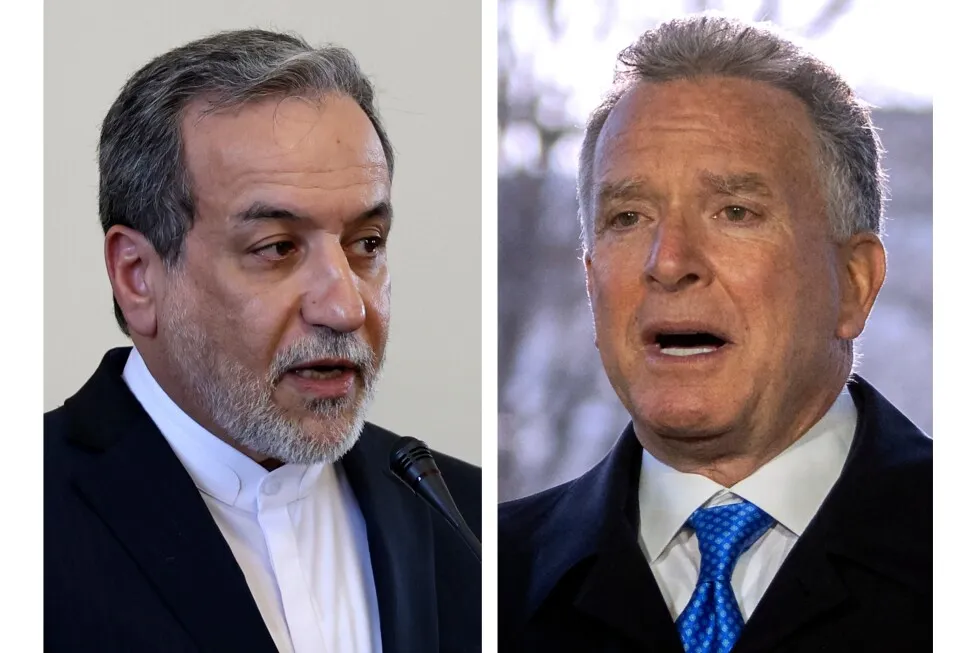
Iran and US set for talks in Oman over nuclear program after Tehran shaken by nationwide protests 1 of 5 | This combo shows Iranian Foreign Minister Abbas Araghchi, left, pictured in Tehran, Iran, on Feb. 25, 2025 and Steve Witkoff, right, White House special envoy, pictured in Washington, on March 19, 2025. (AP Photos Stringer, Mark Schiefelbein) 2 of 5 | People attend a state-organised rally in Tehran, Iran, Wednesday, Feb. 4, 2026, celebrating the birthday of Imam Mahdi, or “Hidden Imam,” a 9th-century saint whom Shiite Muslims believe will return at the end of time as a universal reformer to end tyranny and promote justice. (AP Photo/Vahid Salemi) 3 of 5 | People attend a state-organised rally in Tehran, Iran, Wednesday, Feb. 4, 2026, celebrating the birthday of Imam Mahdi, or “Hidden Imam,” a 9th-century saint whom Shiite Muslims believe will return at the end of time as a universal reformer to end tyranny and promote justice. (AP Photo/Vahid Salemi) 4 of 5 | In this photo released by the Iranian Foreign Ministry, Iranian Foreign Minister Abbas Araghchi, left, is welcomed by an unidentified Omani official, center, upon his arrival at Muscat, Oman, for negotiations with U.S. Mideast envoy Steve Witkoff, as Iranian Ambassador to Oman Mousa Farhang walks at right, May 11, 2025. (Iranian Foreign Ministry via AP, File) 5 of 5 | White House Special Envoy to the Middle East Steve Witkoff speaks at an event in the Oval Office of the White House, Thursday, Jan. 29, 2026, in Washington. (AP Photo/Allison Robbert,File) 1 of 5 This combo shows Iranian Foreign Minister Abbas Araghchi, left, pictured in Tehran, Iran, on Feb. 25, 2025 and Steve Witkoff, right, White House special envoy, pictured in Washington, on March 19, 2025. (AP Photos Stringer, Mark Schiefelbein) Add AP News on Google Add AP News as your preferred source to see more of our stories on Google. 2 of 5 People attend a state-organised rally in Tehran, Iran, Wednesday, Feb. 4, 2026, celebrating the birthday of Imam Mahdi, or “Hidden Imam,” a 9th-century saint whom Shiite Muslims believe will return at the end of time as a universal reformer to end tyranny and promote justice. (AP Photo/Vahid Salemi) Add AP News on Google Add AP News as your preferred source to see more of our stories on Google. 3 of 5 People attend a state-organised rally in Tehran, Iran, Wednesday, Feb. 4, 2026, celebrating the birthday of Imam Mahdi, or “Hidden Imam,” a 9th-century saint whom Shiite Muslims believe will return at the end of time as a universal reformer to end tyranny and promote justice. (AP Photo/Vahid Salemi) Add AP News on Google Add AP News as your preferred source to see more of our stories on Google. 4 of 5 In this photo released by the Iranian Foreign Ministry, Iranian Foreign Minister Abbas Araghchi, left, is welcomed by an unidentified Omani official, center, upon his arrival at Muscat, Oman, for negotiations with U.S. Mideast envoy Steve Witkoff, as Iranian Ambassador to Oman Mousa Farhang walks at right, May 11, 2025. (Iranian Foreign Ministry via AP, File) Add AP News on Google Add AP News as your preferred source to see more of our stories on Google. 5 of 5 White House Special Envoy to the Middle East Steve Witkoff speaks at an event in the Oval Office of the White House, Thursday, Jan. 29, 2026, in Washington. (AP Photo/Allison Robbert,File) Add AP News on Google Add AP News as your preferred source to see more of our stories on Google. Updated [hour]:[minute] [AMPM] [timezone], [monthFull] [day], [year] Muscat, Oman (AP) — Iran and the United States stood poised Friday to hold negotiations in Oman at least over Tehran’s nuclear program after a chaotic week that initially saw plans for regional countries to take part in talks in Turkey. The two countries have returned to Oman, a sultanate on the eastern edge of the Arabian Peninsula, months after rounds of meetings turned to ash following Israel’s launch of a 12-day war against Iran back in June. The U.S. bombed Iranian nuclear sites during that war, likely destroying many of the centrifuges that spun uranium to near weapons-grade purity. Israel’s attacks decimated Iran’s air defenses and targeted its ballistic missile arsenal as well. U.S. officials like Secretary of State Marco Rubio believe Iran’s theocracy is now at its weakest point since its 1979 Islamic Revolution after nationwide protests last month represented the greatest challenge to 86-year-old Supreme Leader Ayatollah Ali Khamenei’s rule. Khamenei’s forces responded with a bloody crackdown that killed thousands and reportedly saw tens of thousands arrested — and spurred new military threats by U.S. President Donald Trump to target the country. With the aircraft carrier USS Abraham Lincoln and other warships in the region along with more fighter jets, the U.S. now likely has the military firepower to launch an attack if it wanted. But whether attacks could be enough to force Iran to change its ways — or potentially topple its government — remains far from a sure thing. Meanwhile, Gulf Arab nations fear an attack could spark a regional war dragging them in as well. That threat is real — already, U.S. forces shot down an Iranian drone near the Lincoln and Iran attempted to stop a U.S.-flagged ship in the Strait of Hormuz. “President Trump seeks to corner Iran into reaching a negotiated solution, strong-arming its leaders into making concessions on the nuclear deal,” said Alissa Pavia, a fellow at the Atlantic Council. “The Iranians, on the other hand, are weakened after years of proxy warfare, economic crisis, and internal unrest. Trump is aware of this vulnerability and is hoping to use it to extract concessions and make inroads toward a renewed nuclear agreement.” Few details on talks ahead of meetingThe scope, nature and participants in the talks remain unclear, just hours before they were due to begin in Muscat, the Omani capital nestled in the Hajar Mountains. Officials at Oman’s borders on Thursday showed particular concern over anyone carrying cameras into the sultanate before the negotiations. On the Iranian side, Foreign Minister Abbas Araghchi arrived at night along with multiple Iranian diplomats, the state-run IRNA news agency reported. Flight-tracking data showed the plane that carried him to Muscat initially started its journey from Tabas, Iran, the site of the disastrous Operation Eagle Claw in 1980, when a U.S. Special Forces mission attempted to rescue hostages held after the 1979 U.S. Embassy takeover in Tehran. A sandstorm in Tabas aborted the mission and eight service members died when a helicopter crashed into a C-120 refueling aircraft there. Iran’s theocracy long has portrayed the mission as God defeating the Americans. Araghchi wrote on X that “Iran enters diplomacy with open eyes and a steady memory of the past year.”“Commitments need to be honored,” he wrote. “Equal standing, mutual respect and mutual interest are not rhetoric — they are a must and the pillars of a durable agreement.”Ahead of the meeting, a top adviser to Khamenei appeared to offer the theocracy’s support to the 63-year-old career diplomat. Araghchi “is a skilled, strategic and trustworthy negotiator at the highest levels of decision-making and military intelligence,” Ali Shamkhani wrote on X. “Soldiers of the nation in the armed forces & generals of diplomacy, acting under the order of the Leader, will safeguard the nation’s interests.” On the U.S. side, it appeared that talks would be led by U.S. Mideast special envoy Steve Witkoff, a 68-year-old billionaire New York real estate mogul and longtime friend to Trump. Traveling with Witkoff on his Mideast trip so far is Jared Kushner, Trump’s son-in-law who in recent weeks has shared proposals for the Gaza Strip and took part in trilateral talks with Russia and Ukraine in Abu Dhabi earlier on the trip. The two men had traveled from Abu Dhabi to Qatar on Thursday night for meetings with officials there, the Qatari-funded satellite news network Al Jazeera reported. Qatar, which shares an offshore natural gas field in the Persian Gulf with Iran, also hosts a major U.S. military installation that Iran attacked back in the June war. Nuclear program on the table at the least It remains unclear just what terms Iran will be willing to negotiate at the talks. Tehran has maintained that these talks only will be on its nuclear program. However, Al Jazeera reported that diplomats from Egypt, Turkey and Qatar offered Iran a proposal in which Tehran would halt enrichment for three years, send its highly enriched uranium out of the country and pledge “not initiate the use of ballistic missiles.” Russia had signaled it would take the uranium, but Shamkhani in an interview earlier this week had said ending the program or shipping out the uranium were nonstarters for the country. Meanwhile, the talks would not include any pledge by Iran over its self-described “Axis of Resistance,” a network of militias in the region allied to Tehran as a deterrent to both Israel and the U.S. However, Israeli attacks on the militias during its war on Hamas in the Gaza Strip decimated the network. Rubio, America’s top diplomat, said talks needed to include all those issues. “I think in order for talks to actually lead to something meaningful, they will have to include certain things, and that includes the range of their ballistic missiles,” Rubio told journalists Wednesday. “That includes their sponsorship of terrorist organizations across the region. That includes the nuclear program, and that includes the treatment of their own people.”He added: “I’m not sure you can reach a deal with these guys, but we’re going to try to find out.” ___The Associated Press receives support for nuclear security coverage from the Carnegie Corporation of New York and Outrider Foundation. The AP is solely responsible for all content. Gambrell is the news director for the Gulf and Iran for The Associated Press. He has reported from each of the Gulf Cooperation Council countries, Iran and other locations across the world since joining the AP in 2006.
SRCAssociated Press (AP)
LANGEN
LEANCenter
WORDS1 670
ENT10
FRI · 2026-02-06 · 04:23 GMTBRIEF NSR-2026-0206-13827
NSR-2026-0206-13827News Report·EN·Diplomatic
Iran and US set for talks in Oman over nuclear program after Tehran shaken by nationwide protests
Iran and the United States are scheduled to hold talks in Oman to discuss Iran's nuclear program. The meetings are occurring after Iran has experienced nationwide protests.
By
JON GAMBRELLAssociated Press (AP)Filed 2026-02-06 · 04:23 GMTLean · CenterRead · 7 min
Associated Press (AP)FIG 01
Reading time
7min
Word count
1 670words
Sources cited
0cited
Entities identified
10entities
Quality score
100%
§ 01
Briefing Summary
AI-generatedNEWSAR · AI
Iran and the United States are scheduled to hold talks in Oman to discuss Iran's nuclear program. The meetings are occurring after Iran has experienced nationwide protests. Iranian Foreign Minister Abbas Araghchi and White House special envoy Steve Witkoff are expected to participate in the negotiations. Oman is acting as the location for these talks. The specific reasons for choosing Oman and the exact agenda of the talks have not been disclosed in the provided information.
Confidence 0.90Claims 4Entities 10
§ 02
Article analysis
Model · rule-basedFraming
Diplomatic
National Security
Tone
Measured
AI-assessed
CalmNeutralAlarmist
Factuality
0.80 / 1.00
Factual
LowHigh
Sources cited
0
No named sources
FewMany
§ 03
Key claims
4 extracted01
Negotiations occurred in Muscat, Oman.
factualIranian Foreign Ministry
Confidence
1.00
02
Iranian Foreign Minister Abbas Araghchi and US Mideast envoy Steve Witkoff are involved.
factual
Confidence
1.00
03
The talks are happening after Tehran was shaken by nationwide protests.
factual
Confidence
1.00
04
Iran and US are set for talks in Oman over the nuclear program.
factual
Confidence
1.00
§ 04
Full report
7 min read · 1 670 words§ 05
Entities
10 identifiedKey playerOppositionContextPositiveNeutralNegative
Organizations1
§ 06
Keywords & salience
8 termsnuclear program
0.90
iran
0.90
us
0.80
nationwide protests
0.70
talks
0.70
oman
0.60
negotiations
0.50
tehran
0.50
§ 07
Topic connections
Interactive graph Network visualization showing 51 related topics
View Full Graph Person Organization Location Event|Click node to navigate|Edge numbers = shared articles