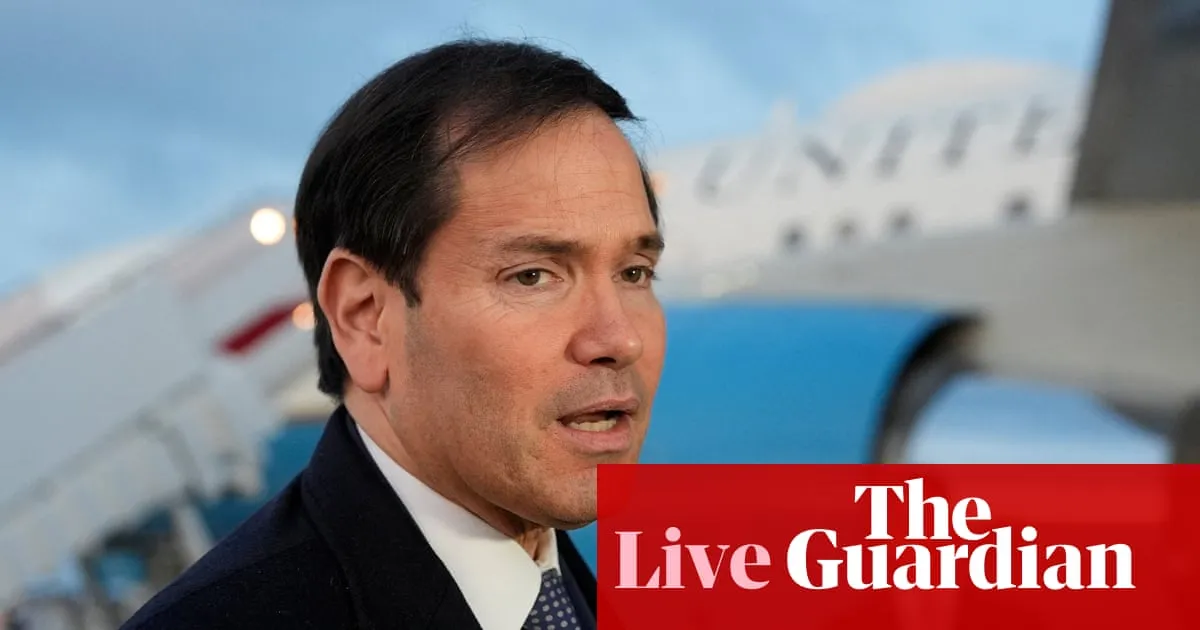
From 3h agoMorning opening: World order 'under destruction'Jakub KrupaGood morning from Munich, where dozens of global leaders are set to meet at the Bayerischer Hof Hotel to discuss the latest in EU-US ties – and other burning global issues, such as Ukraine, Gaza, Iran – amid rapidly changing security and defence situation.A general view of the Hotel Bayerischer Hof, the venue of the annual Munich-security-conference" class="entity-link entity-event" data-entity-id="16334" data-entity-type="event">Munich Security Conference, in Munich, Germany. Photograph: Thilo Schmülgen/ReutersFlying in to Munich, US secretary of state Marco Rubio issued a rather stark warning, saying: “The world is changing very fast, right in front of us: the old world is gone, frankly, the world I grew up in, and we live in a new era in geopolitics, and it’s going to require all of us to sort of re-examine what that looks like and what our role is going to be.” Earlier this week, the organisers’ assessment of the situation was even more blunt as they argued the post-war world order was “under destruction,” as we enter “a period of wrecking ball politics” where “sweeping destruction – rather than careful reforms and policy corrections – is the order of the day”.It added: “The most prominent of those who promise to free their country from the existing order’s constraints and rebuild a stronger, more prosperous nation is the current US administration. As a result, more than 80 years after construction began, the US-led post-1945 international order is now under destruction.” The US ambassador to Nato, Matthew Whitaker, rejected this assessment when he responded to the report’s findings earlier this week (Europe Live, Monday), but there is no doubt that many Europeans do see it that way.The attendees here will be looking to Rubio’s speech on Saturday to provide some reassurance, hoping he will hit some more diplomatic tones than US vice-president JD Vance who attended the event last year.But before we get to hear from Rubio, he have some of the European leaders lined up to take to the main stage today, including the German chancellor, Friedrich Merz, and the French president, Emmanuel Macron.We will bring you all the lines from all the key speeches at the MSC, some colour from behind the scenes, and first analysis to what we hear from global leaders here.It’s Friday, 13 February 2026, it’s Jakub Krupa here, and this is Europe Live.Good morning. Or Guten Tag!Key events16s agoWhat does Europe’s future look like? - Q&A with Jon Henley3m ago'No shah, no mullah' Iran protest outside Munich conference33m agoUS Rubio expected to speak with Danish, Greenlandic leaders on sidelines of Munich conference41m agoKey events of the day51m agoWhat to expect from 2026 Munich-security-conference" class="entity-link entity-event" data-entity-id="16334" data-entity-type="event">Munich Security Conference? - video1h agoNato's Rutte talks up 'shift in mindset' among leaders as he warns against falling for Russian propaganda1h agoEU's von der Leyen, Nato's Rutte arrive for talks in Munich1h agoWe only see tip of iceberg as Munich becomes place to do business this weekend - snap analysis2h agoRubio lands at Munich airport ahead of key speech2h agoEuropeans 'want honesty, want to know where we are going', Rubio says ahead of Munich speech3h agoMorning opening: World order 'under destruction'3h agoOpening SummaryShow key events onlyPlease turn on JavaScript to use this featureWhat does Europe’s future look like? - Q&A with Jon HenleyJon HenleySeparately, our Europe correspondent Jon Henley is now answering your questions on Europe’s future on our reader Q&A below.Feel free to join the chat with Jon as he offers his insight on what lies ahead for Europe.'No shah, no mullah' Iran protest outside Munich conferenceJakub Krupain MunichAhead of the conference getting under way, there is a demonstration not too far from the main venue, calling for a regime change in Iran.Protest against the Iranian government, on the first day of the Munich-security-conference" class="entity-link entity-event" data-entity-id="16334" data-entity-type="event">Munich Security Conference (MSC), in Munich. Photograph: Liesa Johannssen/ReutersI just popped out there since it was billed on social media as potentially attracting “thousands” of people.It’s not quite that big – at least not yet – but several hundreds dressed in yellow caps and yellow vests are chanting “No Shah, no mullah”.They are not happy about the involvement of Reza Pahlavi, the US exiled son of Iran’s former pro-western monarch.“The Iranian people have rejected all forms of dictatorship, be it the Shah or the supreme leader. The presence of the son of the deposed dictator of Iran at the Munich-security-conference" class="entity-link entity-event" data-entity-id="16334" data-entity-type="event">Munich Security Conference leave a shameful stain on the conference,” a speaker said from the main stage.She added that it reminded Iranians of the 1953 coup “that inflicted immeasurable pain and suffering on our people.”“Our message today is … clear, simple and unwavering: the changing will come from within Iran, not from foreign intervention,” the speaker said.Walking into the crowd, I spoke with Muhammad, who attended the protest with three other people, waving the Iranian flag.He told me “the signal to leaders was simple, we just want our freedom, nothing more.”Earlier I also met a 20-year-old Ukrainian Nikita, who wanted to express his solidarity with the protesters.Here’s our diplomatic editor, Patrick Wintour, giving more context on Pahlavi and this discussion on who could lead Iran in the future.Reza Pahlavi: is the last shah's son a viable opposition leader for Iran? – video explainerUS Rubio expected to speak with Danish, Greenlandic leaders on sidelines of Munich conferenceOne of the most closely watched side meetings will be that between US secretary of state Marco Rubio and the Danish prime minister, Mette Frederiksen and the Greenlandic prime minister, Jens-Frederik Nielsen.Obviously, the context of the meeting is the continued US interest in controlling the semi-autonomous Danish territory.The US, Denmark and Greenland have been locked in talks about the future of the territory for over a month now, and Rubio said last month the process could take months before they get somewhere with it.Asked about Greenland last night before departing for Munich, Rubio said: “We’re working on that, we feel good about it.” Key events of the dayMy picks in bold.All in local CET, -1 for GMT13:30 Conference opening13:45 German chancellor Friedrich Merz14:30 EU foreign policy chief Kaja Kallas, US UN ambassador Michael Waltz, Saudi foreign minister Prince Faisal bin Farhan Al Saud15:30 Finnish president Alexander Stubb, German finance minister Lars Klingbeil16:30 California governon Gavin Newsom17:30 Swedish PM Ulf Kristersson, Moldovan president Maia Sandu, German intelligence chief Martin Jäger, Nato military committee chair Giuseppe Cavo Dragone17:30 Czech president Petr Pavel, US senator Alexandria Ocasio-Cortez18:15 EU technology commissioner Henna Virkkunen18:30 Ukraine panel: French foreign minister Jean-Noël Barrot, UK foreign minister Yvette Cooper, Ukrainian foreign minister Andrii Sybiha, Dutch foreign minister David van Weel, US senator Jeanne Shaheen18:45 Reza Pahlavi19:00 French president Emmanuel Macron22:00 US senator Alexandria Ocasio-Cortez, US Nato ambassador Matthew Whitaker, Michigan governor Gretchen WhitmerThat’s just from the main programme, before we look at 250+ side events across Munich…What to expect from 2026 Munich-security-conference" class="entity-link entity-event" data-entity-id="16334" data-entity-type="event">Munich Security Conference? - videoJakub KrupaIf you need a primer on what’s on the agenda for the next three days, I spoke with the MSC’s head of policy Nicole Koenig, the author of the European part of their security report published ahead of the meeting.I asked her what is most likely to be the focus of this year’s forum, will Rubio deliver a “JD Vance 2.0” speech or say something more (nomen omen) diplomatic, and what other topics are likely to come up.Here is what she said:Munich-security-conference" class="entity-link entity-event" data-entity-id="16334" data-entity-type="event">Munich Security Conference 2026: where does the US-EU relationship stand? – videoNato's Rutte talks up 'shift in mindset' among leaders as he warns against falling for Russian propagandaNato’s Rutte begins by commenting on yesterday’s Nato ministerial in Brussels, where he says he could feel “a shift in the mindset” of the leaders around the table. “We have had years, decades of complaints by the US about the fact that in Europe, we were not spending enough on defence. That has changed since the summit in The Hague. The shift in mindset is that yesterday in the room, what we felt, all of us, there was a clear coming together of vision and of unity. Europe really is stepping up, Europe is taking more of a leadership role within Nato.” On Ukraine, he says that Nato needs to continue its support for Ukraine, and “do more for Ukraine.”But he also says that Russia is recording “staggering losses” as it continues its aggression, mockingly saying that: “They want [us] to perceive the Russians as a mighty bear, but you could argue they are moving through Ukraine at the stilted speed of a garden snail, so let’s not fall the trap of the Russian propaganda.” His comments bring a bit of a snark from the attendees.EU's von der Leyen, Nato's Rutte arrive for talks in MunichAs leaders start to arrive, some will speak to the media – either at the Hof, or at multiple side events accompanying the conference.European Commission president Ursula von der Leyen is now speaking alongside Nato’s Mark Rutte and German foreign minister Johann Wadephul at a side event organised by Germany’s ruling CDU party.You can watch it here:Von der Leyen, Rutte, Wadephul and Soder hold press conference – watch liveWe only see tip of iceberg as Munich becomes place to do business this weekend - snap analysisJakub Krupain MunichOne of the peculiarities of the Munich-security-conference" class="entity-link entity-event" data-entity-id="16334" data-entity-type="event">Munich Security Conference is that it’s programme famously lands very late.People line up at a security check to enter the Hotel Bayerischer Hof, venue of the Munich-security-conference" class="entity-link entity-event" data-entity-id="16334" data-entity-type="event">Munich Security Conference (MSC) in Munich, southern Germany. Photograph: Thomas Kienzle/AFP/Getty ImagesWe only got it in full this morning, and I will bring you all the highlights shortly to help you plan your day. But don’t worry: we will cover everything that matters here.This sort of last announcement is unusual for a conference of this size, but highlights the other, at least equally if not more important, side of this event: a chance for so many national and security leaders to speak in private in pre-arranged and ad hoc meetings.This also explains a pretty complicated system of differently coloured IDs that regulate your access across the site. The closer to the actual power you are, the better colours (and holograms!) you get.To give you an idea of just how busy this weekend will be for the leaders, a few European delegations I spoke with today said they each had more than 40 meetings on their schedule: be it in bilateral, one on one settings, or some other variously defined regional arrangements, or with broader panels.And that’s before the (inevitable) “pull asides” and “bump intos,” some of which are carefully choreographed, others are just “things that pop up.”It’s worth keeping in mind that what we see in the public part of the event is just the tip of the iceberg of the activity happening here.Jakub Krupain MunichIt’s fascinating how much the city centre of Munich has changed overnight: last night you could walk relatively freely around the main hotel, getting a chance to feel like Merz or Starmer near that elegant Bayerischer Hof entrance.Journalists line up at a security checkpoint in front of the 'Bayerischer Hof' hotel, the venue of the 60th Munich-security-conference" class="entity-link entity-event" data-entity-id="16334" data-entity-type="event">Munich Security Conference (MSC), in Munich, Germany. Photograph: Ronald Wittek/EPAIt’s a completely different story today, with large parts around the venue locked and with several layers of security, and going inside for a meeting, you have to go through two or three checkpoints.Expect that to be stepped up even further as the day goes as we expect more high-profile arrivals.Police are stationed outside the 62nd Munich-security-conference" class="entity-link entity-event" data-entity-id="16334" data-entity-type="event">Munich Security Conference in Munich, Germany. Photograph: Johannes Simon/Getty ImagesRubio lands at Munich airport ahead of key speechThis morning, Rubio landed at Munich airport – a day after it was hit by a Lufthansa strike, causing widespread travel disruption (not that they would affect his fancy secretary of state-branded plane).US secretary of state Marco Rubio disembarks from his plane at Munich airport, Germany. Photograph: Alex Brandon/AFP/Getty ImagesHe is expected to hold a number of bilateral meetings with EU foreign ministers today, ahead of his speech tomorrow, we understand.Europeans 'want honesty, want to know where we are going', Rubio says ahead of Munich speechBefore leaving for Munich, Rubio was asked if the Europeans should expect another combative speech like from JD Vance last year, or a more conciliatory one.He said: “You got to wait till Saturday. It’ll be good, we’ll be good. I think it’ll be well received. We’ll see. I think they want honesty. They want to know where we’re going, where we’d like to go, where we’d like to go with them. so that’s our hope.” He added: “Europe’s important to us. We’re very tightly linked to Europe. I think most people in this country can trace either their cultural or their personal heritage back to Europe. So we’re deeply tied to Europe, and our futures have always been linked, and will continue to be. So we just got to talk about what that future looks like.” Guardian staff:The US secretary of state, Marco Rubio, has said he will have a chance to meet Volodymyr Zelenskyy at this week’s Munich-security-conference" class="entity-link entity-event" data-entity-id="16334" data-entity-type="event">Munich Security Conference.A year after the vice-president, JD Vance, stunned assembled dignitaries with a verbal assault on many of the US’s closest allies in Europe, Rubio plans to take a less contentious but philosophically similar approach when he addresses the annual gathering on Saturday, US officials say.Before boarding his flight on Thursday evening, Rubio used reassuring words as he described Europe as important for Americans. “We’re very tightly linked together with Europe,” he told reporters. But he also made clear it wouldn’t be business as usual, saying: “We live in a new era in geopolitics, and it’s going to require all of us to reexamine what that looks like.”Opening SummaryWorld leaders and policymakers from around 120 countries are set to gather in Germany on Friday for the 62nd Munich-security-conference" class="entity-link entity-event" data-entity-id="16334" data-entity-type="event">Munich Security Conference.Much of the three-day conference is expected to be taken up with discussions about the erosion of the rules-based international order, with the organisers saying this year’s meeting takes place at a “fundamental inflection point”.Speakers include German chancellor Friedrich Merz, UK prime minister Keir Starmer, French president Emmanuel Macron and the president of the European Commission, Ursula von der Leyen.In Munich on Friday and Saturday, US secretary of state Marco Rubio is expected to keep pushing Europe to share the burden on matters of common defence.But the gathering comes against a backdrop of deepening geopolitical uncertainty as the US adopts an increasingly volatile tone towards its traditional allies and a major breakdown in trust between Washington and European capitals. Donald Trump has repeatedly voiced grievances against Nato and made threats to seize Greenland. something that has pushed away even some of his own ideological allies in Europe.With a broader realignment underway as countries balance trade interdependence with concerns over technology and security, Russia continues to press on with its war in Ukraine. Meanwhile, in the Middle East, unresolved conflicts and regional power struggles – from Gaza to the Gulf – add another layer of volatility in an already highly contested global landscape.Stay tuned as we bring you all the major developments from Munich this weekend.Morning opening: World order 'under destruction'Jakub KrupaGood morning from Munich, where dozens of global leaders are set to meet at the Bayerischer Hof Hotel to discuss the latest in EU-US ties – and other burning global issues, such as Ukraine, Gaza, Iran – amid rapidly changing security and defence situation.A general view of the Hotel Bayerischer Hof, the venue of the annual Munich-security-conference" class="entity-link entity-event" data-entity-id="16334" data-entity-type="event">Munich Security Conference, in Munich, Germany. Photograph: Thilo Schmülgen/ReutersFlying in to Munich, US secretary of state Marco Rubio issued a rather stark warning, saying: “The world is changing very fast, right in front of us: the old world is gone, frankly, the world I grew up in, and we live in a new era in geopolitics, and it’s going to require all of us to sort of re-examine what that looks like and what our role is going to be.” Earlier this week, the organisers’ assessment of the situation was even more blunt as they argued the post-war world order was “under destruction,” as we enter “a period of wrecking ball politics” where “sweeping destruction – rather than careful reforms and policy corrections – is the order of the day”.It added: “The most prominent of those who promise to free their country from the existing order’s constraints and rebuild a stronger, more prosperous nation is the current US administration. As a result, more than 80 years after construction began, the US-led post-1945 international order is now under destruction.” The US ambassador to Nato, Matthew Whitaker, rejected this assessment when he responded to the report’s findings earlier this week (Europe Live, Monday), but there is no doubt that many Europeans do see it that way.The attendees here will be looking to Rubio’s speech on Saturday to provide some reassurance, hoping he will hit some more diplomatic tones than US vice-president JD Vance who attended the event last year.But before we get to hear from Rubio, he have some of the European leaders lined up to take to the main stage today, including the German chancellor, Friedrich Merz, and the French president, Emmanuel Macron.We will bring you all the lines from all the key speeches at the MSC, some colour from behind the scenes, and first analysis to what we hear from global leaders here.It’s Friday, 13 February 2026, it’s Jakub Krupa here, and this is Europe Live.Good morning. Or Guten Tag!
SRCThe Guardian - World News
LANGEN
LEANCenter-Left
WORDS2 900
ENT11
FRI · 2026-02-13 · 10:41 GMTBRIEF NSR-2026-0213-15922
NSR-2026-0213-15922News Report·EN·National Security
Munich Security Conference: Rubio flies in amid testing times for US-Europe ties – live
The Munich Security Conference is underway, bringing together global leaders to discuss pressing issues like Ukraine, Gaza, Iran, and the state of EU-US relations. Marco Rubio, the US Secretary of State, arrived in Munich warning of a new era in geopolitics and the need to re-examine global roles.
Jakub Krupa in MunichThe Guardian - World NewsFiled 2026-02-13 · 10:41 GMTLean · Center-LeftRead · 12 min
The Guardian - World NewsFIG 01
Reading time
12min
Word count
2 900words
Sources cited
3cited
Entities identified
11entities
Quality score
100%
§ 01
Briefing Summary
AI-generatedNEWSAR · AI
The Munich Security Conference is underway, bringing together global leaders to discuss pressing issues like Ukraine, Gaza, Iran, and the state of EU-US relations. Marco Rubio, the US Secretary of State, arrived in Munich warning of a new era in geopolitics and the need to re-examine global roles. The conference organizers have described the current global order as being "under destruction," a view not universally shared, including by the US ambassador to NATO. Attendees are anticipating Rubio's speech on Saturday, hoping for reassurance regarding US commitment to the international order. The conference, taking place at the Bayerischer Hof Hotel, will feature speeches from European leaders like the German chancellor and the French president.
Confidence 0.90Sources 3Claims 5Entities 11
§ 02
Article analysis
Model · rule-basedFraming
National Security
Diplomatic
Tone
Measured
AI-assessed
CalmNeutralAlarmist
Factuality
0.70 / 1.00
Factual
LowHigh
Sources cited
3
Well sourced
FewMany
§ 03
Key claims
5 extracted01
German chancellor, Friedrich Merz, and the French president, Emmanuel Macron are scheduled to speak.
factualJakub Krupa
Confidence
1.00
02
Matthew Whitaker rejected the report's findings.
factualMatthew Whitaker
Confidence
1.00
03
Organisers assessed the post-war world order was 'under destruction'.
quoteMunich Security Conference Organizers
Confidence
0.90
04
Marco Rubio warned that the 'old world is gone' and a new era in geopolitics requires re-examination of roles.
quoteMarco Rubio
Confidence
0.90
05
The US-led post-1945 international order is now under destruction.
factualMunich Security Conference Organizers
Confidence
0.70
§ 04
Full report
12 min read · 2 900 words§ 05
Entities
11 identifiedKey playerOppositionContextPositiveNeutralNegative
People4
Locations6
§ 06
Keywords & salience
10 termsmunich security conference
1.00
us-europe ties
0.90
world order
0.80
geopolitics
0.70
marco rubio
0.60
security
0.60
international order
0.50
defence
0.50
ukraine
0.40
gaza
0.40
§ 07
Topic connections
Interactive graph No topic relationship data available yet. This graph will appear once topic relationships have been computed.