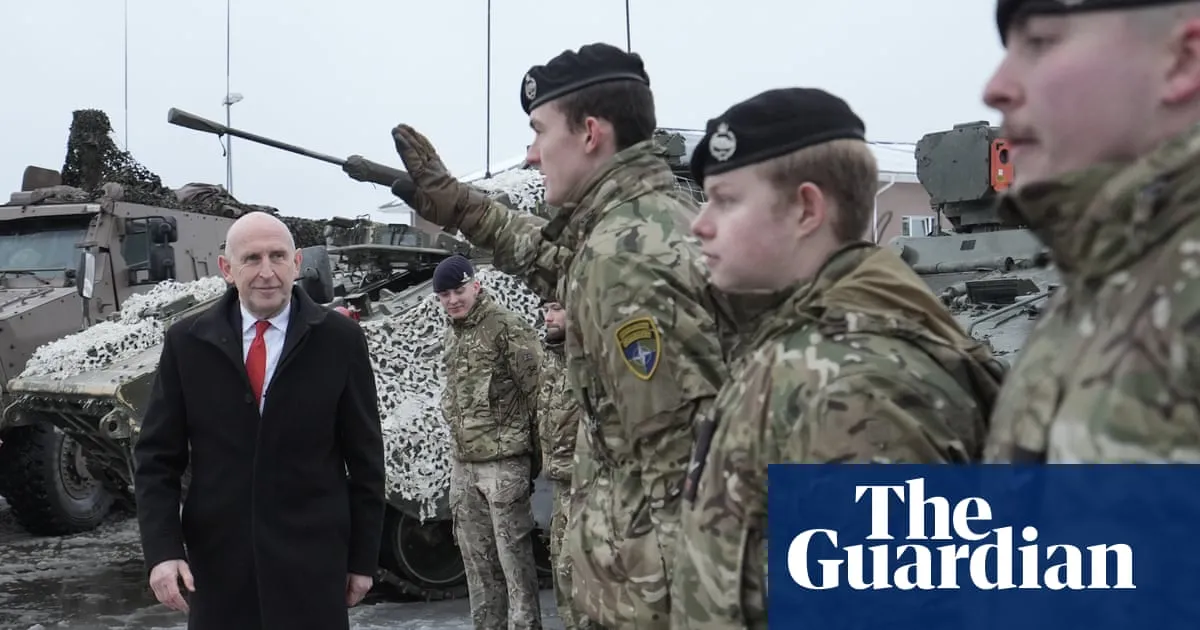
Britain and Germany’s highest ranking military leaders have made an unprecedented joint appeal to the public to accept the “moral” case for rearmament and prepare for the threat of war with Russia.The pair said they were making the plea not just as the military leaders of two of Europe’s largest military spenders, but “as voices for a Europe that must now confront uncomfortable truths about its security”.Air Chief Marshal Richard Knighton, the UK’s chief of the defence staff, and Gen Carsten Breuer, Germany’s chief of defence, said Russia’s military stance had “shifted decisively westward” and a “step change” was needed in Europe’s defence and security.In a joint article published in The Guardian and the German newspaper Die Welt, in the wake of the Munich Security Conference, the soldiers said they had a duty “to explain what is at stake so that the public could understand why the UK and Germany have committed to the biggest sustained increases in defence spending since the end of the cold war”.“There is a moral dimension to this endeavour. Rearmament is not warmongering; it is the responsible action of nations determined to protect their people and preserve peace,” they write.There is significant reluctance among voters in Britain and Germany to accept economic pain in return for rearmament, even while majorities in both countries believe the outbreak of a third world war is more likely than not in the next five years.In Britain, polling this month by YouGov found that a minority favour tax rises (25%) or spending cuts (24%) to fund greater spending on the armed forces – including those who say it is very important to increase UK hard power.German and French voters are also now less likely than they were last year to support increased defence budgets if it meant a trade-off with other investment, according to a poll for Politico this month.The UK prime minister, Keir Starmer, said at the weekend that there was an urgent need for Britain to have a closer defence relationship with Europe, covering procurement and manufacturing, so that the UK would be at the centre of a stronger European defence setup.In a visit to the Munich Security Conference, he told the audience: “We are not the Britain of the Brexit years” as he argued that the long-term threat posed by Russia and the need for Europe to take greater responsibility for its own defence required the UK to integrate more closely on defence procurement with European allies.Europe was, he said, “a sleeping giant” but there had been fragmented industrial planning and procurementKnighton and Breuer write: “If Russia perceives Europe as weak or divided, it may be emboldened to extend its aggression beyond Ukraine. History teaches us that deterrence fails when adversaries sense disunity and weakness. We know that Russian aggression and intentions extend beyond Ukraine.”Echoing language used by government figures in Britain, Germany and other European states, Knighton and Breuer said the complexity of threats demanded a “an honest continent-wide conversation with our publics that defence cannot be the preserve of uniformed personnel alone”.They called for a “whole-of-society defence” with resilient infrastructure, research and development in technology from the private sector, and national institutions prepared to function under increasing threats.The UK and Germany have committed to deepening security and defence cooperation and signed what became known as the Trinity House agreement in 2024.The German government is under pressure to meet its promise to revive economic growth after a prolonged downturn and to ramp up defence spending amid concerns over Russian aggression.Germany is permanently stationing a combat brigade of 4,000-5,000 troops to Nato’s eastern flank and has amended its constitution to make essentially unrestricted funding available for defence.Procurement of several thousand armoured vehicles has also started, alongside an expansion of industrial capacity.Britain is building as many as six munitions factories, which are aimed at generating what the Ministry of Defence describes as an “always on” capability to sustain munitions stockpiles.The debate about European security – almost four years after Vladimir Putin’s full-scale invasion of Ukraine, and amid increasing ambiguity around the extent of US support for Nato after Donald Trump’s return to the White House – comes as the governments in Germany and the UK seek to rebalance spending after an era of investing a supposed “peace dividend” in public services.Nato leaders at last year’s summit in The Hague committed to spending 5% of GDP on defence and security by 2035.Such a move would expand the British economy in the short term, according to research, but there is still opposition on the left of the Labour party to defence hikes at the cost of spending on health and alleviating poverty. That debate is even more polarised in Germany, with opposition to increased defence spending on the left and, to a degree, from the far-right Alternative für Deutschland party.Speaking on the opening day of the Munich conference, Germany’s chancellor, Friedrich Merz, singled out the threat Russia posed to Europe, warning “freedom can no longer be taken for granted”.“We have to understand that in the era of big powers, our freedom is no longer a given. It is at stake. We will need to show firmness and determination to assert this freedom,” he said.Merz also disclosed he had held initial talks with the French president, Emmanuel Macron, over the possibility of joining France’s nuclear umbrella, underlining his call for Europe to develop a stronger self-standing security strategy.
SRCThe Guardian - World News
LANGEN
LEANCenter-Left
WORDS897
ENT11
SUN · 2026-02-15 · 18:02 GMTBRIEF NSR-2026-0215-16483
NSR-2026-0215-16483News Report·EN·National Security
Top British and German military chiefs press ‘moral’ case for rearmament
The top military chiefs of Britain and Germany, Air Chief Marshal Richard Knighton and Gen Carsten Breuer, have jointly appealed to the public for rearmament in response to Russia's westward-shifting military stance. In a joint article published after the Munich Security Conference, they emphasized the "moral" imperative to protect their people and preserve peace, advocating for increased defense spending.
Ben Quinn Political correspondentThe Guardian - World NewsFiled 2026-02-15 · 18:02 GMTLean · Center-LeftRead · 4 min
The Guardian - World NewsFIG 01
Reading time
4min
Word count
897words
Sources cited
4cited
Entities identified
11entities
Quality score
100%
§ 01
Briefing Summary
AI-generatedNEWSAR · AI
The top military chiefs of Britain and Germany, Air Chief Marshal Richard Knighton and Gen Carsten Breuer, have jointly appealed to the public for rearmament in response to Russia's westward-shifting military stance. In a joint article published after the Munich Security Conference, they emphasized the "moral" imperative to protect their people and preserve peace, advocating for increased defense spending. This appeal comes amid public reluctance in both countries to accept economic sacrifices for rearmament, despite growing concerns about a potential third world war. UK Prime Minister Keir Starmer has also called for closer UK-Europe defense ties, including procurement and manufacturing, to strengthen European defense capabilities. He emphasized the need for Europe to take greater responsibility for its own defense, requiring closer integration with European allies.
Confidence 0.90Sources 4Claims 5Entities 11
§ 02
Article analysis
Model · rule-basedFraming
National Security
Political Strategy
Tone
Mixed Tone
AI-assessed
CalmNeutralAlarmist
Factuality
0.70 / 1.00
Factual
LowHigh
Sources cited
4
Well sourced
FewMany
§ 03
Key claims
5 extracted01
A minority favour tax rises (25%) or spending cuts (24%) to fund greater spending on the armed forces in Britain.
statisticYouGov
Confidence
1.00
02
Britain and Germany’s highest ranking military leaders have made an unprecedented joint appeal to the public to accept the “moral” case for rearmament.
factual
Confidence
1.00
03
There is significant reluctance among voters in Britain and Germany to accept economic pain in return for rearmament.
factual
Confidence
0.90
04
Russia’s military stance had “shifted decisively westward” and a “step change” was needed in Europe’s defence and security.
quoteAir Chief Marshal Richard Knighton, Gen Carsten Breuer
Confidence
0.90
05
If Russia perceives Europe as weak or divided, it may be emboldened to extend its aggression beyond Ukraine.
predictionKnighton and Breuer
Confidence
0.70
§ 04
Full report
4 min read · 897 words§ 05
Entities
11 identifiedKey playerOppositionContextPositiveNeutralNegative
People3
Locations4
§ 06
Keywords & salience
9 termsrearmament
1.00
defence spending
0.80
russia
0.70
european security
0.70
moral case
0.60
military threat
0.60
defence relationship
0.50
public opinion
0.50
munich security conference
0.40
§ 07
Topic connections
Interactive graph Network visualization showing 51 related topics
View Full Graph Person Organization Location Event|Click node to navigate|Edge numbers = shared articles