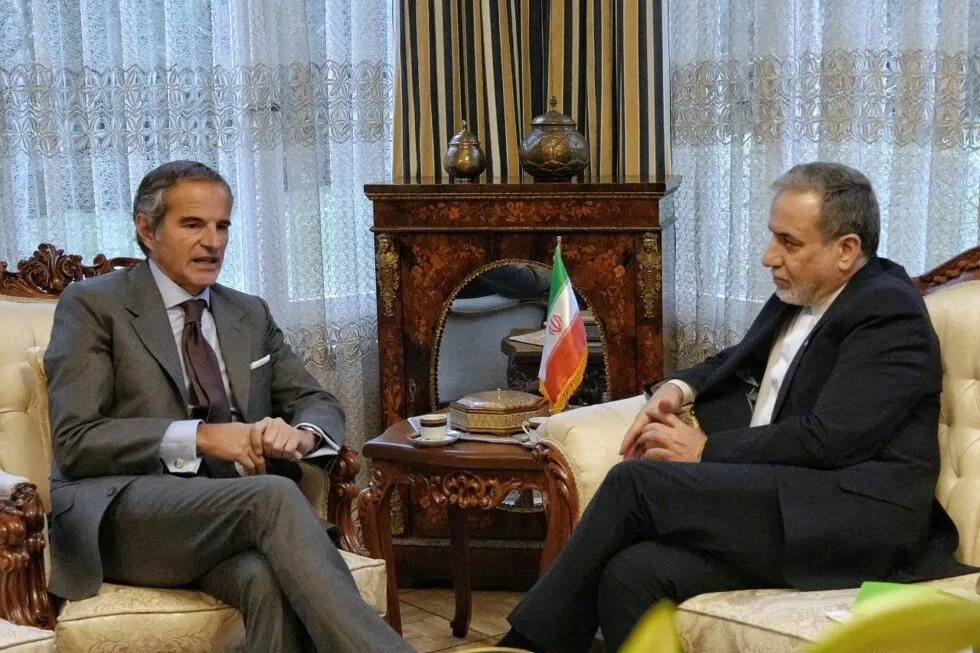
Iran meets UN nuclear watchdog in Geneva ahead of a second round of US talks 1 of 4 | In this photo released by the Iranian Foreign Ministry, Iranian Foreign Minister Abbas Araghchi, right, and International Atomic Energy Agency (IAEA) Director-General Rafael Grossi, left, hold a meeting in Geneva, Switzerland, Monday, Feb. 16, 2026. (Iranian Foreign Ministry via AP) 2 of 4 | In this photo released by the Iranian Foreign Ministry, Iranian Foreign Minister Abbas Araghchi, left, shakes hands with International Atomic Energy Agency (IAEA) Director-General Rafael Grossi during their meeting in Geneva, Switzerland, Monday, Feb. 16, 2026. (Iranian Foreign Ministry via AP) 3 of 4 | Iranian Foreign Minister Abbas Araghchi looks on during a meeting with Director General of the International Atomic Energy Agency (IAEA) Rafael Grossi, and Egyptian Foreign Minister Badr Abdelatty, at Tahrir Palace in Cairo, Tuesday, Sept. 9, 2025. (AP Photo/Khaled Elfiqi, File) 4 of 4 | Director General of the International Atomic Energy Agency (IAEA) Rafael Grossi looks on during a meeting with Egyptian Foreign Minister Badr Abdelatty and Iranian Foreign Minister Abbas Araghchi at Tahrir Palace in Cairo, Tuesday, Sept. 9, 2025. (AP Photo/Khaled Elfiqi, File) 1 of 4 In this photo released by the Iranian Foreign Ministry, Iranian Foreign Minister Abbas Araghchi, right, and International Atomic Energy Agency (IAEA) Director-General Rafael Grossi, left, hold a meeting in Geneva, Switzerland, Monday, Feb. 16, 2026. (Iranian Foreign Ministry via AP) Add AP News on Google Add AP News as your preferred source to see more of our stories on Google. 2 of 4 In this photo released by the Iranian Foreign Ministry, Iranian Foreign Minister Abbas Araghchi, left, shakes hands with International Atomic Energy Agency (IAEA) Director-General Rafael Grossi during their meeting in Geneva, Switzerland, Monday, Feb. 16, 2026. (Iranian Foreign Ministry via AP) Add AP News on Google Add AP News as your preferred source to see more of our stories on Google. 3 of 4 Iranian Foreign Minister Abbas Araghchi looks on during a meeting with Director General of the International Atomic Energy Agency (IAEA) Rafael Grossi, and Egyptian Foreign Minister Badr Abdelatty, at Tahrir Palace in Cairo, Tuesday, Sept. 9, 2025. (AP Photo/Khaled Elfiqi, File) Add AP News on Google Add AP News as your preferred source to see more of our stories on Google. 4 of 4 Director General of the International Atomic Energy Agency (IAEA) Rafael Grossi looks on during a meeting with Egyptian Foreign Minister Badr Abdelatty and Iranian Foreign Minister Abbas Araghchi at Tahrir Palace in Cairo, Tuesday, Sept. 9, 2025. (AP Photo/Khaled Elfiqi, File) Add AP News on Google Add AP News as your preferred source to see more of our stories on Google. Updated [hour]:[minute] [AMPM] [timezone], [monthFull] [day], [year] Geneva (AP) — Iran’s top diplomat met with the head of the U.N. nuclear watchdog agency on Monday, ahead of a second round of negotiations with the United States over Tehran’s nuclear program.Iranian Foreign Minister Abbas Araghchi met with Rafael Grossi, director-general of the International Atomic Energy Agency, and said he would also meet with Foreign Minister Badr al-Busaidi of Oman, which is hosting the U.S.-Iran talks in Geneva on Tuesday.“I am in Geneva with real ideas to achieve a fair and equitable deal,” Araghchi wrote on X. “What is not on the table: submission before threats.” Iran open to compromise in exchange for sanctions reliefOn Sunday, Iran’s Deputy Foreign Minister Majid Takht-Ravanchi signaled that Tehran could be open to compromise on the nuclear issue, but is looking for an easing of international sanctions led by the United States.“The ball is in America’s court. They have to prove they want to have a deal with us,” Takht-Ravanchi told the BBC. “If we see a sincerity on their part, I am sure that we will be on a road to have an agreement.”“We are ready to discuss this and other issues related to our program provided that they are also ready to talk about the sanctions,” he added. Oman hosted a first round of indirect talks between the U.S. and Iran on Feb. 6.The U.S. is also hosting talks between envoys from Russia and Ukraine in Geneva on Tuesday and Wednesday, days ahead of the fourth anniversary of the all-out Russian invasion of its neighbor.Similar talks last year between the U.S. and Iran about Iran’s nuclear program broke down after Israel launched what became a 12-day war on Iran, that included the U.S. bombing Iranian nuclear sites. US keeps military pressure highU.S. President Donald Trump initially threatened to take military action over Iran’s bloody crackdown on nationwide protests last month, but then shifted to a pressure campaign in recent weeks to try to get Tehran to make a deal over its nuclear program.Trump said Friday the USS Gerald R. Ford, the world’s largest aircraft carrier, was being sent from the Caribbean to the Mideast to join other military assets the U.S. has built up in the region. He also said a change in power in Iran “would be the best thing that could happen.”Iran has said if the U.S. attacks, it will respond with an attack of its own. The Trump administration has maintained that Iran can have no uranium enrichment under any deal. Tehran says it won’t agree to that.Iran has insisted its nuclear program is for peaceful purposes. However, its officials increasingly threaten to pursue a nuclear weapon. Before the June war, Iran had been enriching uranium up to 60% purity, a short, technical step away from weapons-grade levels.The direct meeting with Grossi is a significant step after Iran suspended all cooperation with the IAEA following the June war with Israel. The two also met briefly on the sidelines of the United Nations General Assembly in September. The IAEA said it has been unable to verify the status of Iran’s near weapons-grade uranium stockpile since the war. Iran has allowed IAEA some access to sites that were not damaged, but has not allowed inspectors to visit other sites. Iran’s stockpile of uranium enriched to 60% could allow Iran to build as many as 10 nuclear bombs, should it decide to weaponize its program, Grossi previously told The Associated Press. He added that it doesn’t mean that Iran has such a weapon.Israeli Prime Minister Benjamin Netanyahu rushed to Washington last week to urge Trump to ensure that any deal to include steps to neutralize Iran’s ballistic missile program and end its funding for proxy groups such as Hamas and Hezbollah.___ Liechtenstein reported from Vienna. Associated Press writer Melanie Lidman in Tel Aviv, Israel, contributed to this report. ___The Associated Press receives support for nuclear security coverage from the Carnegie Corporation of New York and Outrider Foundation. The AP is solely responsible for all content.___Additional AP coverage of the nuclear landscape: https://apnews.com/projects/the-new-nuclear-landscape/ Keaten is the chief Associated Press reporter in Geneva. He previously was posted in Paris and has reported from Afghanistan, the Middle East, North Africa and across Europe.
SRCAssociated Press (AP)
LANGEN
LEANCenter
WORDS1 155
ENT11
MON · 2026-02-16 · 11:23 GMTBRIEF NSR-2026-0216-16644
NSR-2026-0216-16644News Report·EN·Diplomatic
Iran meets UN nuclear watchdog in Geneva ahead of a second round of US talks
On February 16, 2026, Iranian Foreign Minister Abbas Araghchi met with International Atomic Energy Agency (IAEA) Director-General Rafael Grossi in Geneva, Switzerland. The meeting took place ahead of a second round of talks with the United States.
By
JAMEY KEATEN and STEPHANIE LIECHTENSTEINAssociated Press (AP)Filed 2026-02-16 · 11:23 GMTLean · CenterRead · 5 min
Associated Press (AP)FIG 01
Reading time
5min
Word count
1 155words
Sources cited
2cited
Entities identified
11entities
Quality score
100%
§ 01
Briefing Summary
AI-generatedNEWSAR · AI
On February 16, 2026, Iranian Foreign Minister Abbas Araghchi met with International Atomic Energy Agency (IAEA) Director-General Rafael Grossi in Geneva, Switzerland. The meeting took place ahead of a second round of talks with the United States. The purpose of the meeting was likely to discuss Iran's nuclear program and cooperation with the IAEA. This meeting follows previous discussions between Araghchi and Grossi, including one in Cairo in September 2025. The talks are part of ongoing efforts to address concerns about Iran's nuclear activities.
Confidence 0.90Sources 2Claims 3Entities 11
§ 02
Article analysis
Model · rule-basedFraming
Diplomatic
National Security
Tone
Measured
AI-assessed
CalmNeutralAlarmist
Factuality
0.90 / 1.00
Factual
LowHigh
Sources cited
2
Limited
FewMany
§ 03
Key claims
3 extracted01
Iranian Foreign Minister Abbas Araghchi met with IAEA Director-General Rafael Grossi in Geneva.
factualIranian Foreign Ministry via AP
Confidence
1.00
02
The meeting took place ahead of a second round of US talks.
factualAP
Confidence
1.00
03
Iran's top diplomat met with the head of the U.N. nuclear watchdog agency on Monday in Geneva.
factualAP
Confidence
1.00
§ 04
Full report
5 min read · 1 155 words§ 05
Entities
11 identifiedKey playerOppositionContextPositiveNeutralNegative
People3
Organizations2
§ 06
Keywords & salience
9 termsiran
0.90
un nuclear watchdog
0.80
iaea
0.80
nuclear
0.70
us talks
0.70
meeting
0.60
abbas araghchi
0.50
rafael grossi
0.50
geneva
0.50
§ 07
Topic connections
Interactive graph No topic relationship data available yet. This graph will appear once topic relationships have been computed.