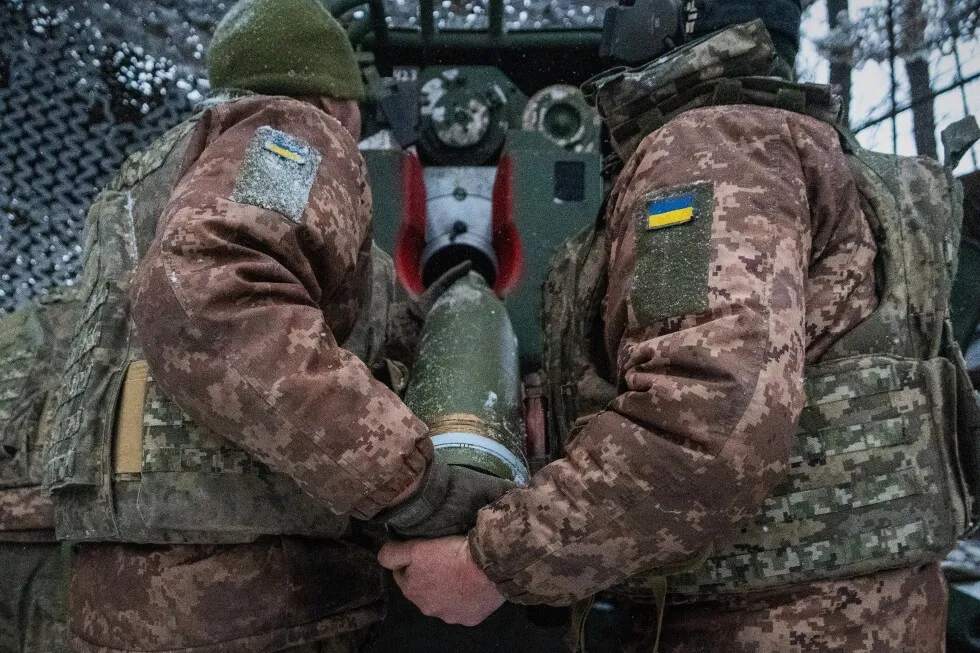
After 4 years of war by Russia in Ukraine, peace is still elusive despite a US push for a settlement 1 of 4 | Ukrainian servicemen load an artillery shell before firing at Russian positions on the front line in Kharkiv region of Ukraine, Wednesday, Feb. 18, 2026. (AP Photo/Andrii Marienko, File) 2 of 4 | Ukrainian soldiers fire at Russian positions on the front line in the Kharkiv region of Ukraine, Wednesday, Feb. 18, 2026. (AP Photo/Andrii Marienko, File) 3 of 4 | President Donald Trump, right, and Ukraine’s President Volodymyr Zelenskyy shake hands at the start of a joint news conference following a meeting at Trump’s Mar-a-Lago club, Dec. 28, 2025, in Palm Beach, Fla. (AP Photo/Alex Brandon, File) 4 of 4 | U.S. President Donald Trump greets Russian President Vladimir Putin, Aug. 15, 2025, at Joint Base Elmendorf-Richardson, Alaska. (AP Photo/Julia Demaree Nikhinson, File) 1 of 4 Ukrainian servicemen load an artillery shell before firing at Russian positions on the front line in Kharkiv region of Ukraine, Wednesday, Feb. 18, 2026. (AP Photo/Andrii Marienko, File) Add AP News on Google Add AP News as your preferred source to see more of our stories on Google. 2 of 4 Ukrainian soldiers fire at Russian positions on the front line in the Kharkiv region of Ukraine, Wednesday, Feb. 18, 2026. (AP Photo/Andrii Marienko, File) Add AP News on Google Add AP News as your preferred source to see more of our stories on Google. 3 of 4 President Donald Trump, right, and Ukraine’s President Volodymyr Zelenskyy shake hands at the start of a joint news conference following a meeting at Trump’s Mar-a-Lago club, Dec. 28, 2025, in Palm Beach, Fla. (AP Photo/Alex Brandon, File) Add AP News on Google Add AP News as your preferred source to see more of our stories on Google. 4 of 4 U.S. President Donald Trump greets Russian President Vladimir Putin, Aug. 15, 2025, at Joint Base Elmendorf-Richardson, Alaska. (AP Photo/Julia Demaree Nikhinson, File) Add AP News on Google Add AP News as your preferred source to see more of our stories on Google. Updated [hour]:[minute] [AMPM] [timezone], [monthFull] [day], [year] When Russia’s full-scale invasion of Ukraine surpassed 1,418 days last month, it officially exceeded a historic milestone — the same span of time it took Moscow to defeat Nazi Germany in World War II.And unlike the Red Army that pushed all the way to Berlin eight decades ago in what it called the Great Patriotic War, Russia’s 4-year-old, all-out invasion of its neighbor is still struggling to fully capture Ukraine’s eastern industrial heartland.After Moscow failed to seize the capital of Kyiv and install a puppet government in February 2022, the conflict turned into trench warfare with tremendous cost. By some estimates, nearly 2 million soldiers are dead, wounded or missing on both sides in Europe’s most devastating conflict since World War II.Russia has occupied about 20% of Ukrainian territory since illegally annexing Crimea in 2014, but its gains after the Feb. 24, 2022, invasion have been slow. NATO Secretary-General Mark Rutte this month likened Moscow’s advance to “the speed of a garden snail.” Russian troops have moved only about 50 kilometers (about 30 miles) into the Donetsk region of eastern Ukraine in the past two years in a grinding battle for control of a few strongholds. Despite the slow pace and high cost, President Vladimir Putin has maintained his maximalist demands in U.S.-mediated peace talks, saying Kyiv must pull its forces from the four Ukrainian regions that Moscow illegally annexed but never fully captured. He has repeatedly brandished his nuclear arsenal to prevent the West from boosting military support for Kyiv. A war of attritionInitially involving quick movements of large numbers of troops and tanks in Russia’s opening blitz and Ukraine’s counteroffensive in fall 2022, the fighting morphed into bloody positional warfare along the 1,200-kilometer (750-mile) front line.The Washington-based Center for Strategic and International Studies estimated Russian military casualties at 1.2 million, including 325,000 killed. It put Ukrainian troop casualties at up to 600,000, including up to 140,000 killed.“Russia has suffered the highest casualty rate of any major power in any war since World War II, and its military has performed poorly, with historically slow rates of advance and little new territory to show for its efforts over the last two years,” it said, noting Russian troops were advancing an average of 70 meters (76 1/2 yards) a day in two years to capture the transport hub of Pokrovsk. For the first time in military history, drones are playing a decisive role, making it effectively impossible for either side to covertly mass significant numbers of troops.Since early in the conflict, Ukraine has relied on drones to offset Moscow’s edge in firepower and stem its advances, but Russia has drastically expanded drone operations and introduced longer-range optical fiber-tethered drones to avoid electronic jamming. They widened the kill zone to 50 kilometers (about 30 miles) from the front, leaving the terrain tangled in strands of filament.The mixture of high-tech drones and World War I-style trench fighting has seen small groups of infantry — often just two or three soldiers — try to infiltrate enemy positions into towns flattened by Russian heavy artillery and glide bombs. Ferrying supplies and evacuating the wounded is a major challenge as drones target supply routes. Long-range attacksUkrainian officials described this winter as the most challenging of the war. Russia exponentially increased its strikes on the country’s energy system, causing blackouts in Kyiv where power supplies to many were cut to a few hours a day amid bitter cold.Russia also has increasingly targeted power lines aiming to halt energy transfers and split Ukraine’s power grid into isolated islands, increasing pressure on the grid.Ukraine retaliated with long-range drone attacks on oil refineries and other energy facilities deep inside Russia, aiming to drain Moscow’s export revenues.Its drones and missiles sank several Russian warships in the Black Sea, forcing Moscow to redeploy its fleet from Russia-occupied Crimea to Novorossiysk. And in an audacious attack code-named “Spiderweb,” Ukraine used drones from trucks to hit several air bases hosting long-range bombers across Russia in June, a humiliating blow to the Kremlin. US pressure, conflicting demandsU.S. President Donald Trump, who once promised to end the war in a day, has pushed to end the fighting, but mediation efforts have run into sharply conflicting demands.Putin wants Ukraine to pull its troops from the part of the Donetsk region it still controls, abandon its bid to join NATO, curb its military and grant official status to the Russian language, among other demands Ukraine has rejected.Russia left the door open to Kyiv’s prospective European Union membership, but it firmly ruled out any European peacekeepers deployed to Ukraine as part of a settlement. Ukrainian President Volodymyr Zelenskyy wants a ceasefire along the existing line of contact, but Putin rules out a truce, demanding a comprehensive peace agreement. “The territorial issue is important to the Kremlin, but the war has a more ambitious goal: to create a Ukraine that would be entirely within Russia’s sphere of influence and not perceived by Moscow as ‘anti-Russia,’” observed Tatiana Stanovaya of Carnegie Russia Eurasia Center.Ukraine and its allies accuse Putin of dragging out talks while he seizes more territory. The Kremlin accuses Kyiv and its European supporters of trying to undermine a tentative agreement reached by Trump and Putin at their Alaska summit.While sticking to their positions, Putin and Zelenskyy have praised U.S. mediation and tried to curry favor with Trump.After a disastrous White House meeting a year ago, Zelenskyy has adopted a more practical negotiating stance, emphasizing Ukraine’s goodwill.After Trump called for a presidential election in Ukraine, Zelenskyy signaled readiness for it even though it’s banned under martial law. The election could be coupled with a referendum on a peace deal, he said, but insisted the vote was only possible once a ceasefire is established and Ukraine gets security guarantees from the U.S. and other allies.Elusive settlementZelenskyy said the White House has set a June deadline for the war’s end and will likely pressure both sides to meet it. But even as Trump appears eager for a peace deal before the U.S. midterm elections, challenges remain.With Putin insisting on Ukraine’s pullback from Donetsk and Zelenskyy ruling it out, a quick deal appears unlikely. Zelenskyy also expressed skepticism about a compromise U.S. proposal to turn the eastern region into a free economic zone.The Kremlin expects its attacks eventually will force Kyiv to accept Moscow’s terms. Ukraine hopes it can hold on until Trump loses patience and increases sanctions on Russia, forcing Putin to halt his aggression. But Trump often appears to be losing patience with Zelenskyy instead.The war and Western sanctions have increasingly strained Russia’s economy. Growth has slowed to a near halt, due to persistent inflation and labor shortages. The latest U.S. sanctions on Russian oil exports have added to the strain.But even with the economic challenges, Russia’s defense plants have increased weapons output and its government has shielded key social groups like soldiers and industrial workers from hardship.“Its economy is poorer, less efficient and less promising than it might otherwise have been,” wrote Richard Connolly of the Royal United Services Institute. “But it remains capable of sustaining the war. Its elites are more dependent on the regime, not less. Its political system is insulated from the transmission of economic discontent into pressure for regime change.”
SRCAssociated Press (AP)
LANGEN
LEANCenter
WORDS1 562
ENT11
SUN · 2026-02-22 · 17:23 GMTBRIEF NSR-2026-0222-18338
NSR-2026-0222-18338News Report·EN·Conflict
After 4 years of war by Russia in Ukraine, peace is still elusive despite a US push for a settlement
After four years, the war between Russia and Ukraine continues despite efforts to reach a settlement, including a push from the United States. The conflict, which began with Russia's full-scale invasion of Ukraine, has now lasted longer than Russia's involvement in World War II.
By
THE ASSOCIATED PRESSAssociated Press (AP)Filed 2026-02-22 · 17:23 GMTLean · CenterRead · 7 min
Associated Press (AP)FIG 01
Reading time
7min
Word count
1 562words
Sources cited
0cited
Entities identified
11entities
Quality score
100%
§ 01
Briefing Summary
AI-generatedNEWSAR · AI
After four years, the war between Russia and Ukraine continues despite efforts to reach a settlement, including a push from the United States. The conflict, which began with Russia's full-scale invasion of Ukraine, has now lasted longer than Russia's involvement in World War II. The fighting persists, with Ukrainian servicemen actively engaging Russian positions in regions like Kharkiv. Diplomatic efforts have included meetings between U.S. President Donald Trump and both Ukrainian President Volodymyr Zelenskyy and Russian President Vladimir Putin, but a resolution remains elusive. The ongoing war highlights the deep-seated challenges in achieving peace between the two nations.
Confidence 0.90Claims 4Entities 11
§ 02
Article analysis
Model · rule-basedFraming
Conflict
Political Strategy
Tone
Measured
AI-assessed
CalmNeutralAlarmist
Factuality
0.70 / 1.00
Factual
LowHigh
Sources cited
0
No named sources
FewMany
§ 03
Key claims
4 extracted01
Russia has occupied about 20% of Ukrainian territory since illegally annexing Crimea in 2014.
factual
Confidence
1.00
02
Russia's invasion exceeded the span of time it took Moscow to defeat Nazi Germany in World War II.
factual
Confidence
1.00
03
Russia's full-scale invasion of Ukraine surpassed 1,418 days last month.
factual
Confidence
1.00
04
By some estimates, nearly 2 million soldiers are dead, wounded or missing on both sides.
statistic
Confidence
0.70
§ 04
Full report
7 min read · 1 562 words§ 05
Entities
11 identifiedKey playerOppositionContextPositiveNeutralNegative
Organizations1
Locations6
§ 06
Keywords & salience
8 termsrussia ukraine war
1.00
peace settlement
0.80
us push
0.70
invasion
0.60
volodymyr zelenskyy
0.50
donald trump
0.50
kharkiv region
0.50
vladimir putin
0.50
§ 07
Topic connections
Interactive graph Network visualization showing 51 related topics
View Full Graph Person Organization Location Event|Click node to navigate|Edge numbers = shared articles