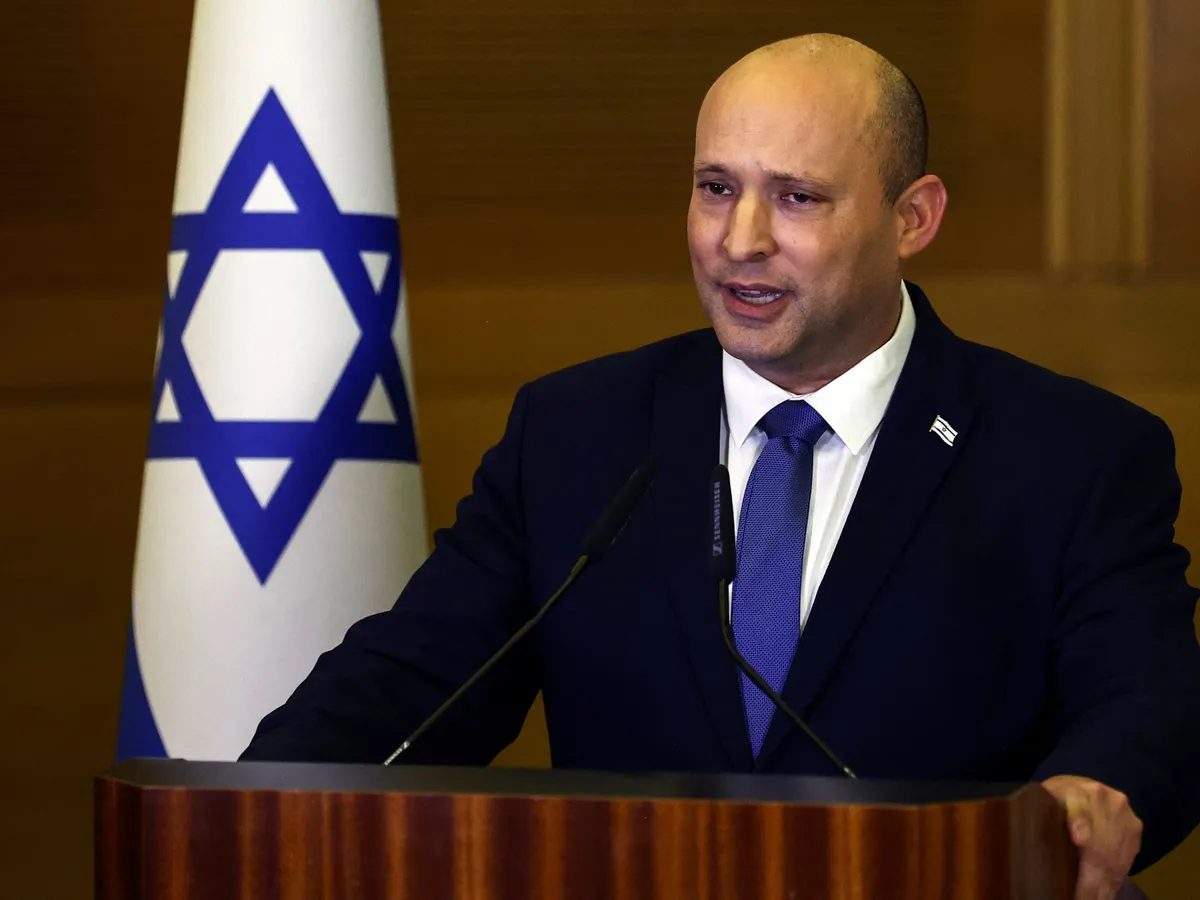
Relations between Israel and Turkiye continue to deteriorate amid accusations and heightened geopolitical tensions.Former Israeli Prime Minister Naftali Bennett told a conference last week that Turkiye was 'the new Iran' [File: Ronen Zvulun/Reuters]Published On 23 Feb 2026With the likelihood increasing of a United States attack on Iran, Israeli politicians are already turning their attention to another regional rival: Turkiye.Former Israeli Prime Minister Naftali Bennett, who is expected to run and do well in the country’s elections this year, was the latest prominent politician to declare Turkiye a threat to Israel.Recommended Stories list of 4 itemslist 1 of 4Iran hails ‘encouraging signals’ from US before nuclear talks on Thursdaylist 2 of 4Netanyahu says Israel will forge regional alliance to rival ‘radical axes’list 3 of 4The Carlson-Huckabee interview may be the wake-up call Americans neededlist 4 of 4Israel designates five Palestinian news outlets as ‘terrorist’ groupsend of listSpeaking at a conference last week, Bennett said that Israel must not “turn a blind eye” to Turkiye, accusing it of being part of a regional axis “similar to the Iranian one”.“A new Turkish threat is emerging,” Bennett said. “We must act in different ways, but simultaneously against the threat from Tehran and against the hostility from Ankara.”Other Israeli politicians have said similar things in the past few months, with Turkiye a strong critic of Israel’s actions towards the Palestinians and its genocidal war on Gaza, and also getting closer to regional powers such as Saudi Arabia and Egypt.The tone indicates that while the Iranian government remains in power in Tehran, Israel is already looking for a new regional nemesis, with a network of like-minded states around it.On Sunday, Israeli Prime Minister Benjamin Netanyahu, while announcing the forthcoming visit of Indian Prime Minister Narendra Modi, declared his intention to forge a new “hexagon” of alliances that would outflank a so-called “emerging radical Sunni [Muslim] axis”, and cement Israel’s regional influence.Included in that alliance would be countries like Greece and Cyprus, which have historically had antagonistic relations with Turkiye.According to Alon Pinkas, a former Israeli ambassador, the timing of the apparent campaign against Turkiye may not be strange, even if it is being made simultaneously with the push for war against Iran.“Politicians like Naftali Bennett and Benjamin Netanyahu rely on the perpetual threat of war,” Pinkas told Al Jazeera. If it wasn’t Turkiye, it would be Iraq. If it wasn’t Iraq, it would be Hezbollah. If it wasn’t Hezbollah, it would be the Muslim Brotherhood. It doesn’t matter who. There just always needs to be a threat.”Worsening relationsIsrael has existed in a heightened state of war since the attack led by Hamas on October 7, 2023. Since then, Israel has carried out a genocide in Gaza, invaded Lebanon, bombed Yemen, occupied parts of Syria, launched a war against regional power Iran, and most recently defied global opinion and international law by moving closer to annexing territory in the occupied West Bank.Against this background, analysts explained, talk of more threats – such as the one from Turkiye – and fresh alliances are cast from the same mould. Despite being political opponents, Netanyahu and Bennett are both right-wing Israelis who are completely opposed to a Palestinian state, and who share similar beliefs on pushing for Israeli regional hegemony.“This has always been what Naftali Bennett has been about,” political analyst Ori Goldberg said.“Liberal [Israelis] have been projecting their own hopes onto him for years, simply because he was an opponent of Benjamin Netanyahu. That’s to miss the point,” he said, referencing both men’s apparent contempt for Palestinians. “He isn’t even pretending now. He’s just trying to overtake Netanyahu on his right.”But a focus on Turkiye as a threat is both complicated – the two countries have a decades-long relationship, and Turkiye is a member of NATO – while also an understandable objective for an Israeli right keen to ensure that a new bogeyman exists.While Israel has had an antagonistic relationship with Iran since the latter’s 1979 Islamic Revolution, Israel-Turkiye relations have been more pragmatic, with Israel’s continued repression of Palestinians historically often a point of negotiated dispute, rather than open threats spurring aggressively hostile rhetoric.However, since coming to power in the early 2000s, Turkish President Recep Tayyip Erdogan has been increasingly critical of Israel.Israel’s attack on a flotilla travelling to Gaza in 2010, ultimately killing 10 Turkish activists, was one of the defining moments in the relationship’s downturn, with fierce political rhetoric and diplomatic downgrades following.Subsequent Israeli military operations in Gaza and Syria have further fuelled public and government anger in Turkiye, with Ankara adopting an increasingly confrontational stance to Israel’s genocide and territorial ambitions, leaving bilateral ties strained and the suggestion of Turkiye’s involvement in Gaza’s proposed interim security force politically toxic in Israel.But beyond their clear opposition to Israel, comparisons between Ankara and Tehran border upon the ludicrous, analysts said.“Israel has worked alongside Turkiye numerous times,” said Pinkas. “It wasn’t all that long ago that policymakers in Israel talked of the Middle East being overseen by two superpowers, Israel and Turkiye, in opposition to Iran. And now they’re trying to supplant Iran with Turkiye? What are they talking about, armed conflict? Turkiye is a NATO power.”Pinkas noted further points of difference. “Has the leadership in Turkiye ever denied Israel’s right to exist, or threatened to wipe it from the map?” he asked.“No,” he said. “It’s ridiculous.”Hexagonal alliancesWhile the alliance with the US is ultimately Israel’s biggest protection, it has also sought to broaden its network.At the forefront of this, Netanyahu explained, would be the support of India’s Modi and what he described as a “hexagon” of allied states, including India, the aforementioned Greece and Cyprus, and various unspecified Arab, African, and Asian nations.“The intention here is to create an axis of nations that see eye to eye on the reality, challenges, and goals against the radical axes, both the radical Shia axis, which we have struck very hard, and the emerging radical Sunni axis,” Netanyahu said, without specifying the “radical” states he was referring to.Netanyahu stressed that his proposed new hexagon of alliances was intended to complement, rather than replace, Israel’s typical reliance on the US. But some believe – as support for Israel is becoming more politically toxic in the US – that Tel Aviv now needs to hedge its bets.Political analyst Goldberg called the moves by Netanyahu “desperate”.“All of this because we’ve burnt through past alliances with Russia and now the United States, so we’re [now] claiming that India will be leading this hexagon of ‘moderate states’,” Goldberg said. “Not even people in Israel, not even the most deluded, have any belief that Israel might still be a moderate state.”And the talk of the Turkish threat and hexagonal alliances was evidence that Israel is not as central to decision-making on any US attack on Iran, said Yossi Mekelberg, an expert with Chatham House.“It’s all deflection; there just isn’t any honesty, and it just gets worse and worse,” Mekelberg said of Netanyahu’s framing of events. “The big issue is Iran. [That is] what they’re interested in. Turkiye is just so much noise.”While the intention may be to distract by talking up the Turkish threat, it still carries risks, Mekelberg cautioned.“Most leaders, at least the devious ones, can separate rhetoric and reality, so there’s no real chance of one spilling over into the other,” he said. “The risk is that as Israel ramps up its rhetoric against Turkiye, it risks making it a genuine opponent.”
SRCAl Jazeera
LANGEN
LEANCenter
WORDS1 238
ENT12
MON · 2026-02-23 · 18:35 GMTBRIEF NSR-2026-0223-18618
NSR-2026-0223-18618News Report·EN·National Security
Turkish ‘threat’ talked up in Israel as Netanyahu focuses on new alliances
Israeli politicians are increasingly focusing their attention on Turkey amid heightened geopolitical tensions with Iran. Former Israeli Prime Minister Naftali Bennett recently stated that Turkey is "the new Iran" and a threat to Israel.
Simon Speakman CordallAl JazeeraFiled 2026-02-23 · 18:35 GMTLean · CenterRead · 5 min
Al JazeeraFIG 01
Reading time
5min
Word count
1 238words
Sources cited
3cited
Entities identified
12entities
Quality score
100%
§ 01
Briefing Summary
AI-generatedNEWSAR · AI
Israeli politicians are increasingly focusing their attention on Turkey amid heightened geopolitical tensions with Iran. Former Israeli Prime Minister Naftali Bennett recently stated that Turkey is "the new Iran" and a threat to Israel. Bennett's comments were made during a conference last week, where he emphasized the need for Israel to act against Turkish aggression. Israeli Prime Minister Benjamin Netanyahu has also declared his intention to forge a new alliance with countries like Greece and Cyprus to counter what he calls an "emerging radical Sunni axis." This move is seen as part of a broader effort to strengthen Israel's regional influence. The timing of this campaign against Turkey may be linked to the push for war against Iran, which has been heightened due to increased US military presence in the region.
Confidence 0.90Sources 3Claims 5Entities 12
§ 02
Article analysis
Model · rule-basedFraming
National Security
Political Strategy
Tone
Mixed Tone
AI-assessed
CalmNeutralAlarmist
Factuality
0.60 / 1.00
Mixed
LowHigh
Sources cited
3
Well sourced
FewMany
§ 03
Key claims
5 extracted01
Netanyahu intends to forge a new “hexagon” of alliances to outflank a so-called “emerging radical Sunni axis”.
quoteBenjamin Netanyahu
Confidence
1.00
02
Naftali Bennett said Turkiye was 'the new Iran'.
quoteNaftali Bennett
Confidence
1.00
03
Turkiye is a strong critic of Israel’s actions towards the Palestinians and its war on Gaza.
factual
Confidence
0.90
04
Israeli politicians are turning their attention to Turkiye as a regional rival.
factual
Confidence
0.80
05
Politicians like Bennett and Netanyahu rely on the perpetual threat of war.
quoteAlon Pinkas
Confidence
0.70
§ 04
Full report
5 min read · 1 238 words§ 05
Entities
12 identifiedKey playerOppositionContextPositiveNeutralNegative
People4
§ 06
Keywords & salience
6 termsbenjamin netanyahu
0.80
turkish threat
0.80
turkish-iranian axis
0.70
israel-turkey relations
0.70
regional rivalry
0.60
iran-israel conflict
0.50
§ 07
Topic connections
Interactive graph Network visualization showing 51 related topics
View Full Graph Person Organization Location Event|Click node to navigate|Edge numbers = shared articles