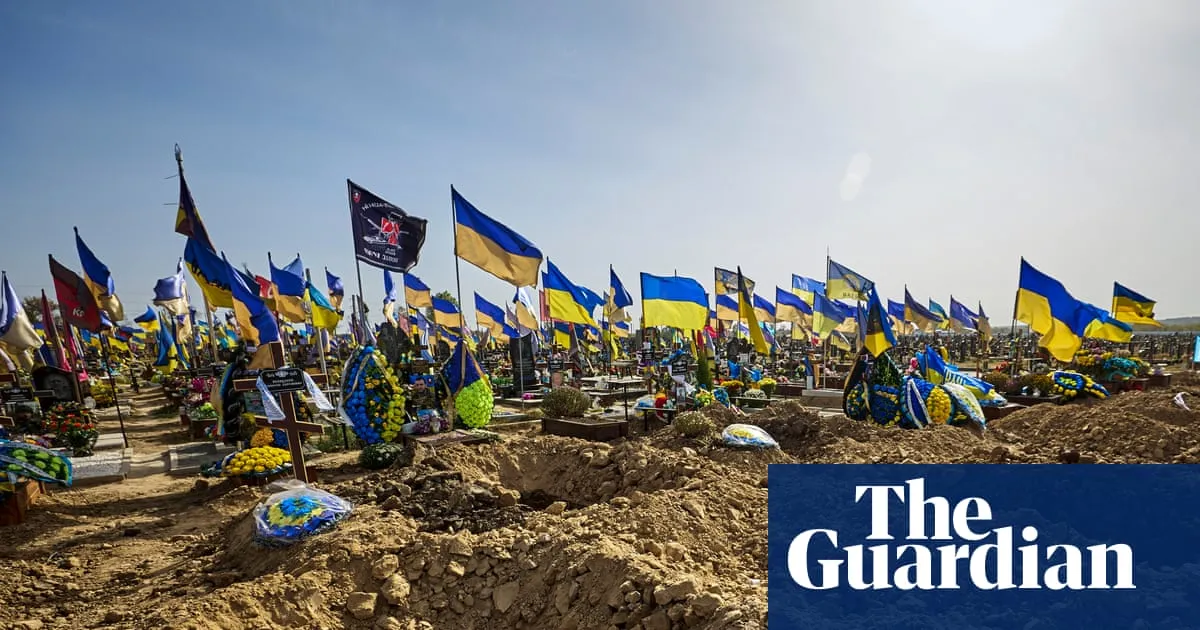
Good morning. Today marks four years since Russian tanks first rolled towards Kyiv as Vladimir Putin launched the full-scale invasion of Ukraine – a war he insisted on calling a “special military operation”. The initial assault was repelled, almost certainly to his surprise, and Volodymyr Zelenskyy’s government remained intact to marshal the nation’s defences.What followed has been widely perceived as a grinding war of attrition. While Russia has made incremental advances across territory it had already destabilised through Moscow-backed separatist republics, Ukraine has been subjected to a relentless aerial assault on its infrastructure – one that western support, from sanctions to air-defence systems and fighter jets, has not been able to halt. Peace initiatives – with varying degrees of sincerity – have come and gone.For today’s newsletter, I spoke to Francis Farrell, a Ukraine-based reporter with the Kyiv-independent" class="entity-link entity-organization" data-entity-id="25548" data-entity-type="organization">Kyiv Independent and co-author of its War Notes newsletter, about how the war looks from inside Ukraine four years on – and what he believes the west’s audience and leaders still misunderstand. First, this morning’s headlines.Five big stories Peter Mandelson| Peter Mandelson has been arrested and released on bail by detectives investigating claims he committed misconduct in public office during his friendship with Jeffrey Epstein. Education | Hundreds of thousands fewer children with special educational needs and disabilities (Send) will be given education, health and care plans (EHCPs) as a result of long-awaited changes announced by the education secretary. UK politics | Reform UK’s plan to create an ICE-style deportation agency has been condemned as “sadistic”, after the party’s home affairs spokesperson vowed to face down “progressive outrage”. Media | The BBC has issued a new apology for its handling of an incident at the Bafta film awards which saw the N-word broadcast during BBC One coverage of the ceremony and remain overnight on BBC iPlayer. Iran | Donald Trump’s decision to order airstrikes against Iran will hinge in part on the judgment of Trump’s special envoys, Steve Witkoff and Jared Kushner. In depth: ‘This war is being fought as a struggle for democratic values’The aftermath of a Russian missile strike on the Ukrainian city of Kharkiv in January. Photograph: Sergey Kozlov/EPAFour years into the war, there is a sense of permanent exhaustion in Ukraine – but also a continued determination to push on, because there is no alternative, Francis Farrell tells me.The experience of war, he says, varies widely across the country, and even within the same city. Recent waves of attacks on energy infrastructure have left residents in Kyiv with only two or three hours of electricity a day. Which floor you live on in an apartment block can determine whether you have water, heating or access to an elevator.“What is frustrating for Ukrainians of all stripes,” he says, speaking by phone from Vienna, where he is attending a screening of his documentary about the war, “is that it seems sometimes like western partners and audiences and leaders are almost more tired of the war than they are”.Francis reports for the Kyiv-independent" class="entity-link entity-organization" data-entity-id="25548" data-entity-type="organization">Kyiv Independent, one of Ukraine’s most prominent English-language outlets. Founded weeks before the full-scale invasion as a staff-owned breakaway from the Kyiv Post, the site has grown rapidly and says it now has more than 25,000 members. Its editor, Olga Rudenko, told the Guardian last year that journalism in wartime Ukraine was a moral duty: “If they are dying, we should be using those rights.”How do Ukrainians feel about Trump and US support?The US president’s return to the White House initially prompted cautious optimism in some quarters, Farrell says. There was a belief Donald Trump might be willing to apply more direct pressure on Moscow, and that he was someone Vladimir Putin might take seriously – or at least more seriously than the ailing Joe Biden.That optimism has largely curdled into distrust. “There is a very clear understanding that this war is being fought as a struggle for democratic values,” Farrell says. “When Ukrainians see the leader in Washington displaying contempt for those values and for Europe, and warmth towards dictators, that quickly turns into distrust.”There is weariness, he says, about Kyiv having to engage in what he calls diplomatic “theatre” in order to avoid a worst-case scenario of being cut off from US support. The realpolitik of the relationship between the US and Ukraine was laid bare in the astonishing public spat this time last year in the Oval Office, as Trump told Zelenskyy “You’re not in a good position. You don’t have the cards right now,” and the Ukrainian replied: “I’m not playing cards. I’m very serious, Mr President. I’m the president in a war.”What is Zelenskyy’s standing now in Ukraine?Andriy Yermak, right, abruptly quit as the president’s chief of staff in November 2025. Photograph: Gleb Garanich/ReutersZelenskyy’s approval ratings have fluctuated over the four years, dipping amid corruption scandals and public anger at officials perceived to be profiting during wartime. But Farrell says most Ukrainians separate such scandals from the president personally. He says that Zelenskyy’s – albeit delayed – decision to let go of chief of staff Andrei Yermak (pictured above right) over corruption allegations showed Zelenskyy put “the importance of the mission and his duty to country higher than loyalty to his friends”.It would, Farrell says, be “stupidly dangerous or dangerously stupid to hold elections right now, with Russia attacking on all sides,” and he says polling earlier this year showed less than one in 10 Ukrainians are in favour of holding them. Ironically, Trump’s dressing down of the president boosted Zelenskyy’s standing with many.Farrell tells me that if they distrust Trump, Ukrainians also don’t place to much stock in the decisiveness or bravery of European leaders. For better or worse, it appears, for many “Zelenskyy is the leader that continues to guide Ukraine through the war, despite his flaws”.What is happening on the frontline?Farrell, 28, who grew up in Sydney and was finishing postgraduate studies in post-Soviet geopolitics when the full-scale invasion began, is keen to correct what he sees as a western misconception about the battlefield. The fog of war and increasingly difficult conditions at the front have reduced the ability and willingness for some outlets to report directly.He says some of this can be attributed to the increased danger from drones. More journalists are being killed near the front and Russia is able to target media workers 20km away from the front using drones if, as Farrell puts it, “they stay out in the open too long”.He says western audiences are left with the impression that the war is “bogged down”. It is not a war of manoeuvre, he says, but an attritional war of position. Russia is throwing resources at degrading Ukraine’s ability to defend a long frontline, often with what are euphemistically termed “single-use infantry”. That is cannon fodder to you and me.He says the idea of a stable, static frontline should not be taken for granted. It leads to the assumption that continued aid alone guarantees stability. “The frontline is not held by a constant pipeline of international aid,” he says. “It is held by humans, who are in limited quantity and have a limited enduring strength.”The human cost mounts. A report by the Washington-based Center for Strategic and International Studies (CSIS) earlier this year estimated Russia has incurred about 1.2 million casualties, including as many as 325,000 deaths, while close to 600,000 Ukrainian troops have been killed, wounded or gone missing. Official sources are more coy: in February, Zelenskyy conceded 55,000 Ukrainian service personnel have been killed in the war – Russia has disputed the CSIS figures and says only the Russian defence ministry has the authority to release them.What does an endgame look like in 2026?Farrell is sceptical of recurring talk of imminent peace deals. “It is important for people to understand that the peace talks are not peace talks,” he says. In his view, they are largely diplomatic theatre designed to influence Washington and other partners. Russia’s core demand, he argues, remains Ukraine’s political and military capitulation.“The full-scale invasion began with an attack on Kyiv,” he tells me. “It wasn’t about limited objectives. And that hasn’t fundamentally changed.”Four years after an invasion many thought would last weeks at most, the war remains grinding and unresolved, with huge numbers of casualties. For Farrell, the defining question is not whether Ukraine can endure – but whether Europe is prepared to act according to the reality of Russia’s ambitions rather than the hope of a negotiated shortcut.“The sooner Europe acts according to that reality,” he says, “rather than hoping for a magical solution, the better.”What else we’ve been readingGirls are facing objectification, hate, rape threats both online and off. Illustration: R Fresson/The Guardian I felt sick to my stomach reading this first-person account of the harrowing sexism teenage girls face in their daily lives, both online and off. Aamna Our film editor Catherine Shoard asks the simple question – if the Baftas film awards organisers had time to cut out political comments about Donald Trump and Palestine, how could they simply not see that a racial slur should be edited, too? Martin Zoe Williams’s interview with royal biographer Andrew Lownie is a fascinating read from start to finish, leaving you wondering how the former prince Andrew was able to operate so openly for so long. Aamna Jonn Elledge rather eloquently puts together how I feel about artificial intelligence: it is a useful tool in some specific settings, but why do I need this information pollutant in every damn app I use? Martin If, like me, you’re sad that the Winter Olympics are over, check out this list of this year’s most wonderful moments from the Games. Aamna SportBenjamin Sesko scores to secure a 1-0 victory over Everton. Photograph: MB Media/Getty ImagesFootball | Manchester United supersub Benjamin Sesko scored 13 minutes after entering the field to seal a 1-0 win over Everton in the Premier League.Boxing | Floyd Mayweather and Manny Pacquiao will face each other on 19 September in Las Vegas in a rematch of one of the biggest fights in boxing history.Cricket | England’s planned Twenty20 series in South Africa next January has been scrapped owing to a clash with the domestic SA20 tournament in the latest indication of the growing primacy of franchise cricket.The front pages Photograph: The Guardian“Mandelson arrested on suspicion of misconduct over Epstein links” is the Guardian splash, and that’s the theme of the day across all the front pages. “Mandelson arrest sparks jeopardy for Number 10” headlines the i paper, the Telegraph says “Mandelson arrested” and “Things can only get sweatier” quips the Sun. The Times runs “Mandelson arrested over ‘secrets passed to Epstein’”, “Disgraced Lord Held” is top story at the Mirror, and the Mail says “Now Mandelson faces the music”. The FT leads on “Mandelson arrested on suspicion of misconduct over Epstein connection”. Just after 2am, the Metropolitan police said Mandelson had been released on bail pending further investigation.Today in FocusA DJ turned soldier explains how life has changed for Ukraine’s men while Tracey McVeigh and Shaun Walker report on the impact of the conflict and what could happen next.And finally, the Guardian’s puzzles are here to keep you entertained throughout the day. Until tomorrow.
SRCThe Guardian - World News
LANGEN
LeanCenter-Left
WORDS1,863
ENT11
TUE · 2026-02-24 · 06:41 GMTBRIEF NSR-2026-0224-18765
NSR-2026-0224-18765News Report·EN·Conflict
Tuesday briefing: The long and winding road of war in Ukraine, as the human cost mounts
Four years after Russia's full-scale invasion of Ukraine began in 2020, the conflict continues as a grinding war of attrition. Russia has made incremental territorial gains, while Ukraine faces relentless aerial assaults on its infrastructure.
Martin BelamThe Guardian - World NewsFiled 2026-02-24 · 06:41 GMTLean · Center-LeftRead · 8 min
The Guardian - World NewsFIG 01
Reading time
8min
Word count
1,863words
Sources cited
1cited
Entities identified
11entities
NEWSAR · AI
Four years after Russia's full-scale invasion of Ukraine began in 2020, the conflict continues as a grinding war of attrition. Russia has made incremental territorial gains, while Ukraine faces relentless aerial assaults on its infrastructure. Western support, including sanctions and military aid, has not halted the attacks. Various peace initiatives have been unsuccessful. A reporter based in Ukraine notes a sense of exhaustion but also continued determination within the country, viewing the war as a struggle for democratic values. Other news headlines include the arrest and release of Peter Mandelson, changes to education plans for children with special needs, Reform UK's controversial deportation agency plan, the BBC's apology for broadcasting a racial slur, and Donald Trump's decision-making process regarding potential airstrikes against Iran.
Confidence 0.90Sources 1Claims 5Entities 11
Framing
Conflict
Human Interest
Tone
Measured
AI-assessed
CalmNeutralAlarmist
Factuality
0.70 / 1.00
Factual
LowHigh
Sources cited
1
Limited
FewMany
01
Russian tanks first rolled towards Kyiv four years ago.
factualnull
Confidence
1.00
02
Recent attacks on energy infrastructure have left Kyiv residents with limited electricity.
factualFrancis Farrell
Confidence
0.90
03
Ukraine has been subjected to a relentless aerial assault on its infrastructure.
factualnull
Confidence
0.90
04
The initial Russian assault on Kyiv was repelled.
factualnull
Confidence
0.90
05
Russia has made incremental advances across territory it had already destabilised.
factualnull
Confidence
0.80
§ 04
Full report
8 min read · 1,863 wordsKey playerOppositionContextPositiveNeutralNegative
People4
ukraine war
1.00
russian invasion
0.90
war of attrition
0.70
western support
0.60
democratic values
0.50
military operation
0.40
peace initiatives
0.40
§ 07
Connections
Who appears together in the newsIn this articleWider coverageLine weight = articles in common
Laying out network…
Strongest ties articles in common
- 3,926
- 1,519
- 1,390
- 1,299
- 1,276
- 1,204
Recurring context not named in this article
- LUnited Stateslinks 11
- OEuropean Unionlinks 11
- PDonald Trumplinks 10
- LIsraellinks 10
- LFrancelinks 10
- LChinalinks 10
- LUnited Kingdomlinks 10
- ONATOlinks 10